
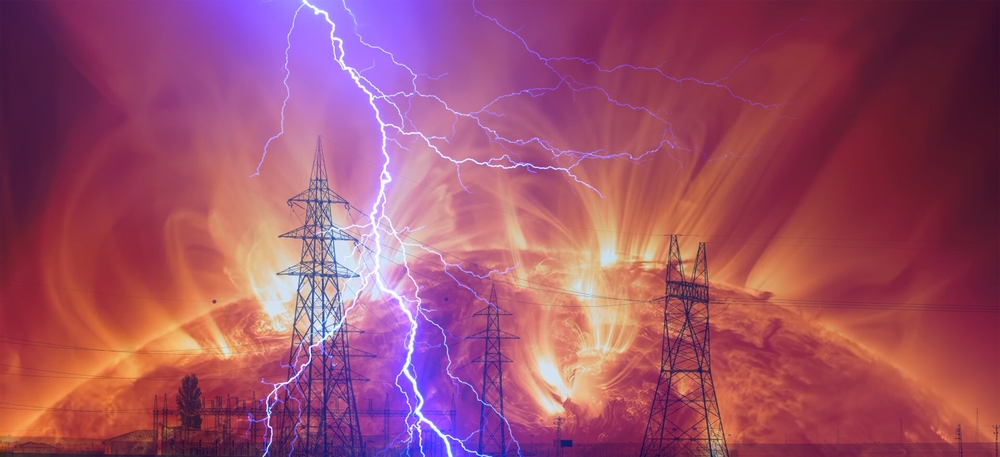
A team of researchers led by Boston University engineer Brian Walsh has unveiled a bold proposal to defend Earth against extreme space weather events.
The concept, known as StormWall, would use a network of spacecraft to strengthen Earth’s magnetic shield during major solar storms, potentially reducing their impact by as much as 50%.
The proposal comes as scientists warn that modern society is becoming increasingly vulnerable to disruptions caused by space weather.
Solar storms can interfere with satellite operations, navigation systems, communications networks and power infrastructure, creating widespread economic and technological consequences.
Computer simulations conducted by researchers from Boston University and the University of Michigan suggest the StormWall system could significantly weaken the intensity of geomagnetic storms before they reach Earth.
The findings were recently published in the journal Space Weather.
Why space weather is an increasing concern
While storms on Earth can cause visible destruction, space weather presents a different type of threat. Solar flares and powerful bursts of charged particles from the Sun can disrupt technologies that underpin everyday life.
Modern economies rely heavily on satellite-based services. GPS systems support transportation, agriculture, logistics and financial networks. Even electronic transactions depend on highly precise timing signals delivered by satellites.
The risks became clear in May 2024 when a severe solar storm disrupted GPS-guided farming equipment across parts of the United States. The outage affected planting and harvesting operations, resulting in losses estimated at hundreds of millions of dollars.
Beyond navigation systems, major geomagnetic storms can damage satellites, interrupt radio communications, and trigger electrical currents that can overload power grids. Experts have long warned that a large-scale solar event could have global consequences.
A new approach to defending Earth
Traditionally, efforts to address space weather have focused on forecasting incoming solar activity and hardening infrastructure against potential damage.
Walsh and his colleagues are proposing a fundamentally different strategy: actively intervening in the space environment to reduce the threat before it reaches Earth.
The StormWall concept is inspired by a naturally occurring process in which particles escaping Earth’s atmosphere help reinforce the outer boundary of the planet’s magnetosphere, the protective magnetic bubble that surrounds Earth.
Researchers believe this process could be amplified artificially.
Under the proposal, six spacecraft would be positioned in geosynchronous orbit. Each vehicle would carry stores of alkaline elements such as barium or lithium.
When released, the material would become electrically charged through exposure to sunlight, creating plasma near the edge of Earth’s magnetic field.
According to simulation results, this plasma cloud would interfere with the transfer of energy from an incoming solar storm, helping redirect harmful effects away from Earth.
Simulations show promising results
The research team’s modelling indicates that the system could substantially reduce the severity of a major geomagnetic storm.
By introducing additional plasma into key regions of the magnetosphere, StormWall would effectively create a temporary protective barrier.
The simulations suggest this intervention could cut storm intensity roughly in half, potentially reducing damage to satellites, communications systems and critical infrastructure on the ground.
Although the concept remains theoretical, researchers argue that the underlying physics is sound and that current launch capabilities are sufficient to support such a mission.
The study challenges the long-held assumption that humanity can do little more than monitor and endure solar activity. Instead, it suggests that active mitigation of space weather may eventually be possible.
Cost remains the biggest challenge
Despite the promising findings, significant hurdles remain before StormWall could become reality.
Launching six spacecraft loaded with large quantities of material would require a substantial financial investment. Once deployed, the system would also have a limited operational lifespan because the released material cannot be recovered or replenished.
Researchers estimate the mission would consume the equivalent of roughly a dozen tanker trucks of material. However, they argue that the cost must be weighed against the potential consequences of a severe geomagnetic storm.
A repeat of an event comparable to the historic Carrington Event of 1859 could cause trillions of dollars in economic damage, particularly through impacts on power grids, satellites and communications networks.
As governments and private companies continue investing heavily in space infrastructure, the economic case for preventative measures may become increasingly attractive.
Next steps for the StormWall project
The research team is already exploring ways to improve efficiency and reduce costs. Future studies will examine whether smaller quantities of material could achieve similar results and whether releasing plasma in pulses could extend the system’s effectiveness.
Scientists are also evaluating alternative orbital configurations and investigating which chemical elements would provide the greatest benefit.
Environmental concerns appear limited. According to the researchers, the charged material would naturally leave the magnetosphere within a matter of hours after deployment, preventing the long-term accumulation of debris in space.
Could space weather geoengineering become reality?
StormWall represents one of the most ambitious ideas yet proposed for managing space weather. While the concept remains in its early stages, it introduces a new way of thinking about Earth’s vulnerability to solar storms.
Rather than relying solely on prediction and preparedness, future generations may have the ability to actively strengthen Earth’s defences against disturbances originating from the Sun.
If further research confirms the initial findings, StormWall could mark the beginning of a new era in space weather protection, offering a potential safeguard for the technologies and infrastructure that modern civilisation depends upon.