
Summary
Golf participation has surged to record levels with more than 160 million people playing worldwide in 2025.
Artificial intelligence is transforming the sport through self-driving caddies, swing analysis apps and smart equipment that offers real-time advice.
High costs and traditional rules present barriers to AI integration with some smart features banned from competitive play.
AI-generated summary was reviewed by a CNN editor.
Golf is experiencing something of a boom. Following a resurgence during the pandemic, participation numbers hit record heights last year.
More than 160 million people around the world played some form of golf in 2025, marking an almost 50% rise from 2023. The US alone is projected to pass 50 million participants across 2026.
Driving ranges like Topgolf and indoor virtual simulators have also helped grow participation in the sport, with a new wave of casual players driving demand for golf gadgets. And in 2026, where there are gadgets, there is artificial intelligence.
The global golf equipment market grew to an estimated $20.9 billion in 2026, according to market research company Mordor Intelligence, and is predicted to reach $26.7 billion by 2031. Among the most influential factors identified for the projected rise is the adoption of AI-driven technology.
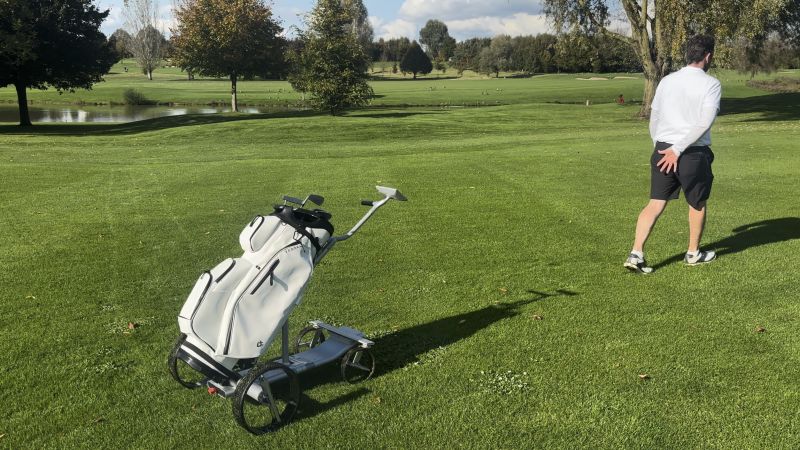
Its impact is being felt from the club-factory floor to the fairway — all the way to a virtual version of the sport’s most important assistant: the caddy. Botronics, a startup based in Nivelles, Belgium, has developed a self-driving golf trolley billed as a digital caddie that can not only carry clubs, but offer advice too.
The iXi trolley uses two cameras and GPS that’s pre-loaded with maps of more than 40,000 courses to autonomously steer itself, with players able to issue commands via hand gestures or voice control. Should the user remove a putter from the mounted bag, an AI-powered camera fitted to the trolley’s front will recognize that the user is on the green and will begin preemptively rolling toward the next tee.
The front camera can film each swing and play it back on a screen that offers frame-by-frame analysis of technique, with footage sharable to coaches via an accompanying app. The screen offers suggestions on club choice and where to aim, with an onboard computer displaying a real-time visualization of the course.
“Think of it as a computer with wheels around it, which not only is programmed to do amazing things but will also keep on evolving,” Botronics chief revenue officer Laetitia Fraikin told CNN.
“What is a caddy?” she added. “It’s someone who is in the right place at the right time, someone who looks at what you do and gives you advice, someone who basically gives you everything that you need so you can get the most out of your game, so you can perform better, so you make better decisions … all those things are now possible to do on a physical golf trolley.”
In development since 2021 and previously scheduled to be delivered to customers this summer, the trolley is currently in the “advanced prototype” phase and is hoped to begin shipping in June 2027 following testing with golfers, Fraikin said. Set to retail for $5,385, discounts were offered to those who preordered the trolley as part of a crowdfunding drive that raised roughly $1 million.
Around 125 units were preordered within the first 10 minutes of being available, said Fraikin, who believes the uptake is reflective of the rising demand for AI-driven innovations among tech-savvy and traditional golfers alike.
“There’s a group of people who are saying, ‘Listen, I don’t really want to understand what happens (with the technology), I just want to be able to 100% focus on my game,’” Fraikin explained.
Club fittings and clones
The sport has been an early adopter of AI. Golf equipment giant Callaway has been using machine learning to develop club design since 2019, and its range of Ai Smoke Irons were engineered using an AI model that scanned thousands of swings.
Rival manufacturer Wilson launched its mobile app Fit AI in 2024 to help club-fitting staff at stores and courses across the US choose the best option for customers. Clients hit a few balls in front of a launch monitor — a device that measures the physical data of a golf shot and club swing, and then feeds the findings in real time through an algorithm to generate club recommendations.
But now a range of companies are putting AI directly into the hands of golfers. In April, two-time US Open winner Bryson DeChambeau led a group of investors in the acquisition, for an undisclosed “8-figure sum,” of Sportsbox AI, a technology company whose 3D Golf app creates a motion-capture avatar of a user swinging to give feedback on where to improve.
Nicknamed “The Scientist” for his eagerness to leverage technology in the pursuit of performance gains, DeChambeau revealed earlier this month that he had consulted Google’s AI assistant Gemini to help him work through some issues in his swing. He also partnered with Google Cloud last year, developing an AI coach that could run on a smartphone.

Similarly, SWEE is a mobile app that is rolling out AI “clones” of real-life golf coaches as part of a subscription-based service that allows users to get personalized feedback and practice plans on their swing.
Out on the course, AI is transforming rangefinders, devices used by golfers to measure distances. Arccos’ Smart Laser claims to take data gathered from more than 1.5 billion shots and 25 million rounds to generate strategy for each shot, suggesting a recommended club and target based on factors including wind speed and altitude.
Challenges and regulations
However, there are barriers to the uptake of these products. The costs and complexities of adopting new AI technologies present “significant challenges” to their integration into sport, according to a 2025 study led by the UK’s Loughborough University.
Golf already grapples with a perceived financial barrier for entry, with Mordor Intelligence highlighting the high initial investment and overall cost of equipment as the most significant obstacle to the growth of the global equipment market. The iXi costs thousands of dollars more than a standard trolley, the Arccos rangefinder retails from $299.99 and requires an annual $199.99 subscription fee after the first year, while a set of Callaway’s Smoke Irons can fetch almost $800.
What’s more, golf is a sport famed for its adherence to tradition, and not all technological advances are permissible in competitions.
The Arccos rangefinder has a “competition mode” setting that toggles off advanced metrics to comply with pro-tournament rules, a feature that Botronics is also incorporating to ensure its trolley can be used solely as a manual carrier, as opposed to an intelligent caddie.
“Lots of things we do are not yet regulated, so that will be interesting as well to see where regulation goes,” Fraikin said.
“Not everything will be a problem, but some things I expect will be.”