
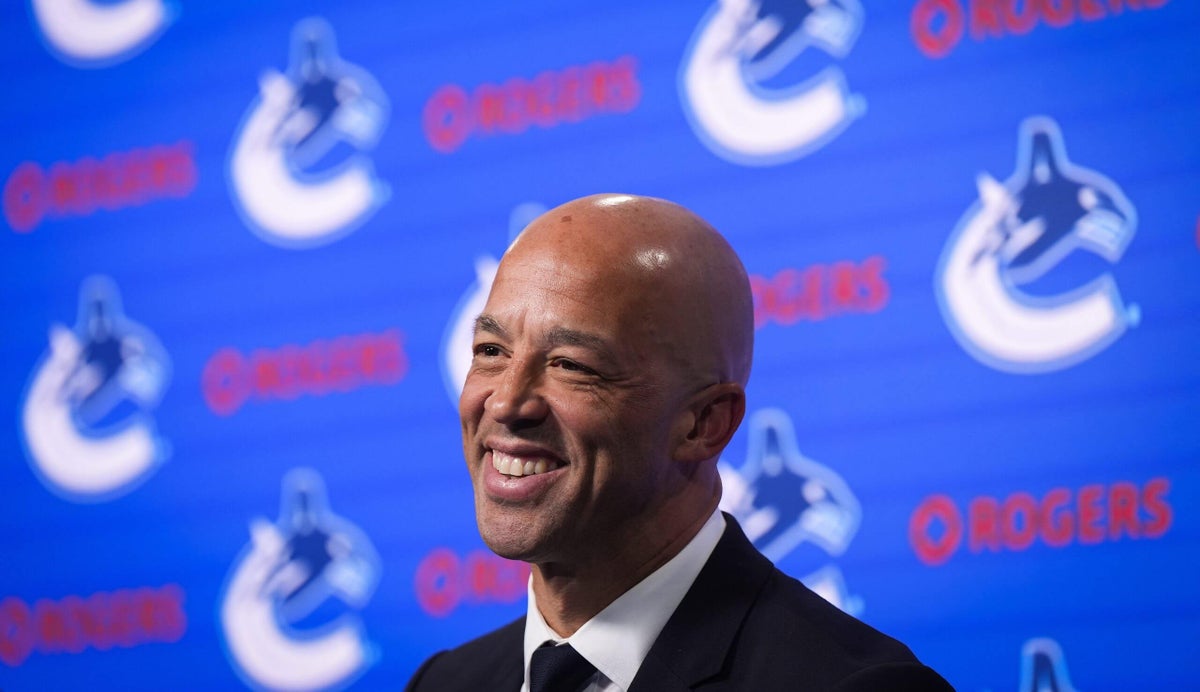
VANCOUVER — On Thursday morning at the dais in the makeshift video/media room in the bowels of Rogers Arena, Canucks general manager Ryan Johnson formally introduced Manny Malhotra as the team’s new head coach.
Malhotra, whose hire was announced Monday night, shortly after Frank Seravalli broke the news that the hiring was imminent, was long viewed as the front-runner to succeed Adam Foote as the 23rd head coach in Canucks history. In fact, as far back as early April, we were specifically discussing the possibility of an “Abbotsford Succession plan” which would pair Johnson and Malhotra at the top of the Canucks hockey operations pyramid.
That Malhotra’s introduction came two and a half days after the club confirmed the hire, and that the outcome here was long expected, did nothing to take away from how compelling Malhotra is as a spokesperson for this organization.
A former Canucks player with longstanding roots in this city, Malhotra has a bone-deep understanding of what this franchise means in this community. He projects calm and competency in his demeanour. He’s selective, thoughtful and intentional in the manner with which he speaks. And Malhotra easily communicated all of that in a concise, authoritative manner in his first meeting with the media as Canucks head coach.
The Athletic was there on Thursday, and here are five primary takeaways that stuck out to us from the formal beginning of Malhotra’s Canucks tenure.
1. How Malhotra will measure success next season
After finishing 32nd in the NHL standings and at the dawn of a rebuild, Johnson and Malhotra have both acknowledged that the team’s success won’t be measured by wins and losses next season. It’s the first time in several years that there won’t be any pressure or expectations on making the playoffs, which means the goalposts will naturally shift.
“I think one thing that we experienced in Abbotsford was that the commitment to the daily improvements was something that helped our group get to where we did over the course of the year,” said Malhotra. “I think that is one of the major reasons why this is such a special opportunity.
“For me and our coaching staff, it’ll be about those daily incremental improvements. Today’s practice needs to look better than yesterday’s practice. The level of execution needs to be better than what it was yesterday. I think by developing that mindset with the guys, you start to see individual growth, collective growth in the group, and that’s where we’ll start to take strides.”
Prioritizing development and improvement is a fairly obvious goal for a team in Vancouver’s position, but the specific ways Malhotra wants to pursue that target sound thoughtful, intentional and rooted in practical, implementable concepts. He spoke, for example, about how teams across the league mostly focus on the same principles for what they want their team’s identity and culture to be, and how critical it would be to relay that messaging to players in a crystal-clear, easy-to-apply roadmap.
“If you listen to 31 other teams, they’re gonna be using the same lingo, ‘We’re going to compete. We’re going to hold each other accountable,’” said Malhotra. “We’re going to use those same words in our process, but our guys are going to have a very clear definition as to what those things mean to the daily.
“What is our standard about? What does compete mean to us? What does accountability look like on a daily basis? What does it look like on the bench? I think implementing that understanding of what those words are going to mean for our group will give us a much clearer path for how we’re going to navigate this and get out of it.”
Malhotra’s understanding of the importance of going deeper with his players and being as transparent and specific as possible, rather than sticking solely to vague platitudes and hockey buzzwords, is part of what makes him such a skilled communicator as a head coach.
2. Manny on the possibility of coaching his son, Caleb
It’s no secret that Manny’s son, Caleb, has shot up draft boards to the point where he’s a strong contender to be a top-five pick, and a legit consideration for the Canucks with the No. 3 selection. Johnson’s commentary earlier this week signalled that the Canucks won’t shy away from drafting Caleb if they believe he’s the best player available. On Thursday, Manny didn’t want to go too far down the hypothetical road, but he sounded comfortable with the possibility of coaching his son, if the organization chose to select him, even if he stopped short of giving his full-blown blessing to a potentially awkward situation.
“We’ve had a very clear understanding in my household that first and foremost, I am dad, who also happens to be a professional hockey coach,” said Malhotra. “When we are talking about hockey, there’s a decision by my kids whether they want to talk to dad or coach. We will continue to have that rule in my house, and it’s served us well as a family.”
Part of that comfort surely comes down to the precocious maturity and high character that Caleb has shown.
“If it happens, I would treat him just as any other player,” said Malhotra. “And I know people would say, ‘You can’t because it’s your son,’ and I do understand the challenges there. The one thing going back to that rule of do you want to talk to dad or do you want to talk to coach, when Caleb talks hockey to me, he always wants to talk to coach.
“I’ve seen his growth the last couple of years and what they’ve done in Brantford and the evolution of his game. I think he would have the wherewithal and ability to separate the two at the next level.”
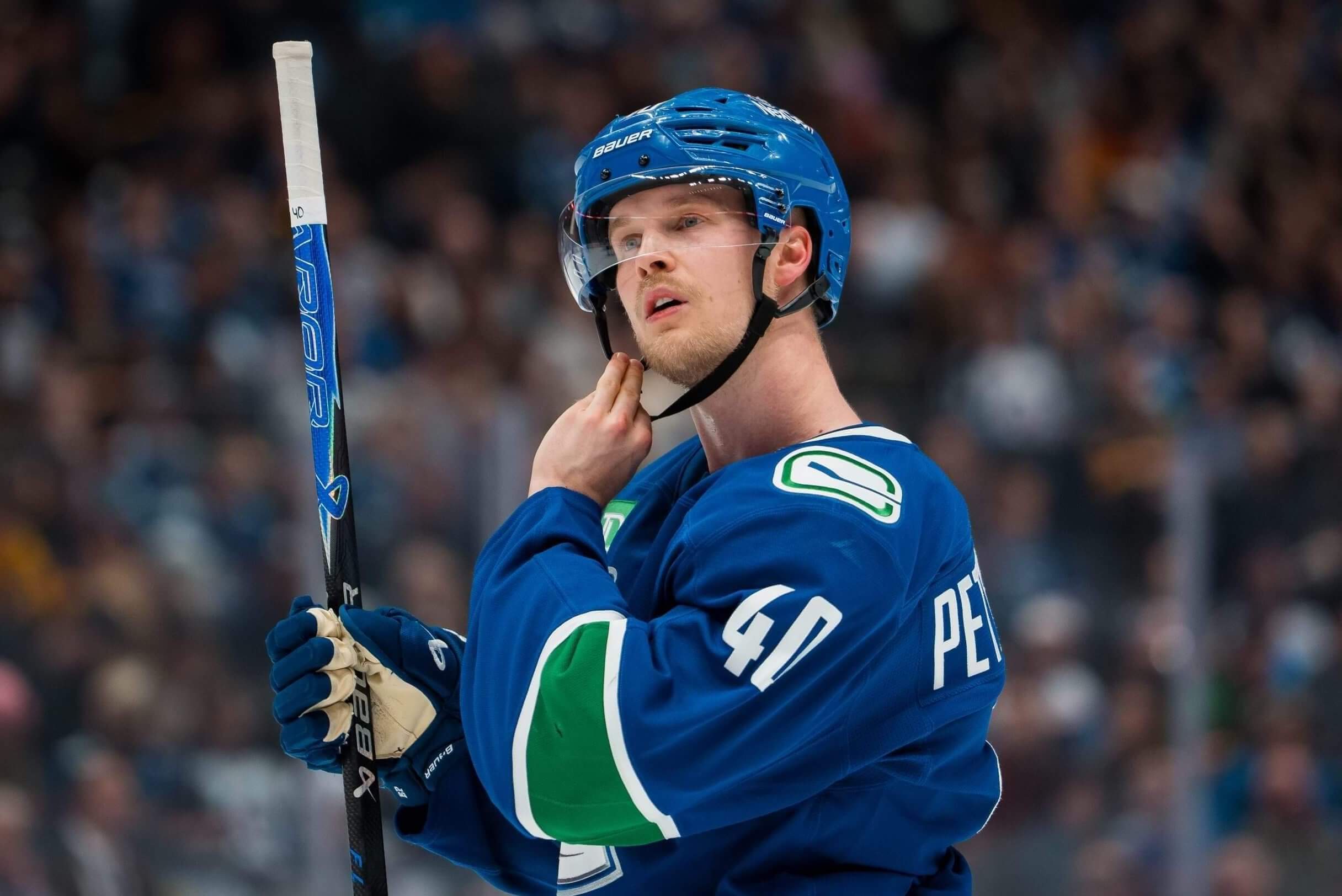
Elias Pettersson scored 51 points in 74 games for the Canucks in the 2025-26 season. (Bob Frid / Imagn Images)
3. A new day in handling Elias Pettersson
After Henrik and Daniel Sedin echoed previous management by focusing on preparation in discussing the deterioration of Elias Pettersson’s game when they were introduced as co-presidents, incoming Canucks leadership has appeared to find a very different tack in discussing Pettersson this week.
“I haven’t spoken with him yet,” Malhotra said, when the inevitable Pettersson question was posed on Thursday morning, “and as I was saying before with every player, my goal is to help him find his game. We all know what he’s capable of doing, the talent that he possesses and the ability that he has on the ice. One of the things I like most about coaching is finding that connection with players, finding what makes them tick and how to get the best out of them. So it’s on myself and the staff to help him find his best game and to be the player that we know he’s capable of being.”
This is a very different tone than previous Canucks coaches have taken with Pettersson, especially since his struggles really set in during the spring of 2024. Malhotra, effectively, has put his hand up and taken on the responsibility for getting Pettersson back on track.
In so doing, he’s also attempted to cast something of a protective shield around Pettersson. It’s on the coaches, Malhotra is saying, to figure out what makes Pettersson tick and help him find his best game.
That won’t necessarily work if Pettersson’s struggles persist, of course, there’s just much water on the bridge in this market. It’s a worthwhile attempt, however, especially for an incoming bench boss who hasn’t even spoken directly to the player yet.
Right off the hop, at the very least, Malhotra made sure to defend Vancouver’s often criticized $11.6 million man. At least in public, Malhotra is going to have his player’s back.
In concert with Johnson’s commentary on Pettersson from earlier this week, we can see a pretty significant tonal shift in how the Canucks are talking about Pettersson publicly.
“I think the biggest thing, whatever happens here moving forward, is I just wanted him to know that I am very comfortable with him just being himself,” was what Johnson told the media on a video call on Tuesday. “I told him, whatever communication, I’m not going to ask him or put an expectation on him to be something other than what he is, and that’s OK. And that he and I can work together in any capacity. We may ask things of him, but we’re not going to ask him to do anything outside of (who he really feels he is at the core).”
Taken together, these quotes represent the most supportive the club has sounded about Pettersson in years. At the very least, it clearly represents a new attempt by the organization to reach him.
4. How Canucks’ new leadership understands relating to the modern player
Alignment is a concept Johnson has discussed extensively in his relationship with the Sedins and Malhotra. Johnson was asked whether it mattered that the team’s new co-presidents, GM, and head coach were all former Canucks, and his answer was very illuminating. It was self-aware and showed why this new leadership group understands how to relate to modern NHLers.
“As soon as you talk about ‘Well, when I did this (as a player)’ the wall goes up,” said Johnson. “They don’t wanna hear that. I think it (our experience playing for the Canucks) gives us a sense of relatability and understanding, but I know between Daniel and Henrik, Manny, myself, I think you could ask any player we’ve been around, they’ve never heard ‘Well, when I did this, and I did that.’
“I think it’s also a respectful way of saying this isn’t about me, this is about your journey. I’m using the knowledge I have as a player to relate to you in a way, and I can use language and approach you differently with you maybe understanding that I do have a little experience, but I find as soon as you talk about yourself, you lose today’s player.”
Malhotra undoubtedly shares the same approach, which is part of why he’s so well regarded by the players who came through Abbotsford.
5. “Finding the joy”
There’s been a dreariness, or a sneering joylessness, that’s surrounded the Canucks for much of the past decade.
This sense of joylessness has become, seemingly, infectious. From the fans in-arena going quiet and seemingly panicking when things don’t go the Canucks’ way to a skeptical media pool dissatisfied with the club’s direction and handling of availabilities to the defensiveness of decision-makers and the players themselves feuding in the locker room and at practice, and being far too concerned with the chatter on social media.
This force, or dark cloud, hovering over Rogers Arena is a challenge that the Sedins, Johnson and Malhotra appear prepared to address. And that starts by acknowledging it and coming up with a plan to address it.
“Part of our task is helping guys find the joy of hockey,” was how Malhotra summarized the task at hand on Thursday. “The NHL is a pretty good league by all accounts, it’s a pretty special place to play, there’s only 700 or so guys that get to do it.
“So giving guys that understanding that this is a fun league to be in, and you have to enjoy the moments. There will be some good times, and there will be some bad times, but the privilege of being an NHL player is all the motivation and joy you need to come to the rink every day …
“Finding the joy in the game and helping the guys have fun out there and enjoy practices and enjoy the grind and enjoy the race. I don’t think the guys need me to come in and give a rah rah speech, it’s just in helping (them) find the joy that’s already here.”
This was a compelling formulation from the Canucks head coach, one that appears to put the idea of relating to the modern player — not by centring yourself, but by practically applying your experience in the game to the environment you’re seeking to create — into practice.
It’s also a statement that reflects Malhotra’s own diverse set of experiences. From a top prospect to trade bait to NHL journeyman to PTO striver to big money unrestricted free agent to highly respected defensive ace, Malhotra has seen the NHL experience from just about every angle. He also knows better than most how quickly it can all be taken away.
Professional sports is the toy department of life. For most Canucks players, this is the best time in their lives, a moment in which they’re highly paid to play for a signature NHL team in a market that deeply cares.
Some challenges come with it, of course, but those challenges have to be embraced if they’re going to be overcome. And you have to have fun doing whatever it is you’re doing to excel at it.
At the start of this rebuilding era, Canucks leadership appear to have a deep understanding of this. It’s perhaps the club’s most welcome early change under this new regime.