
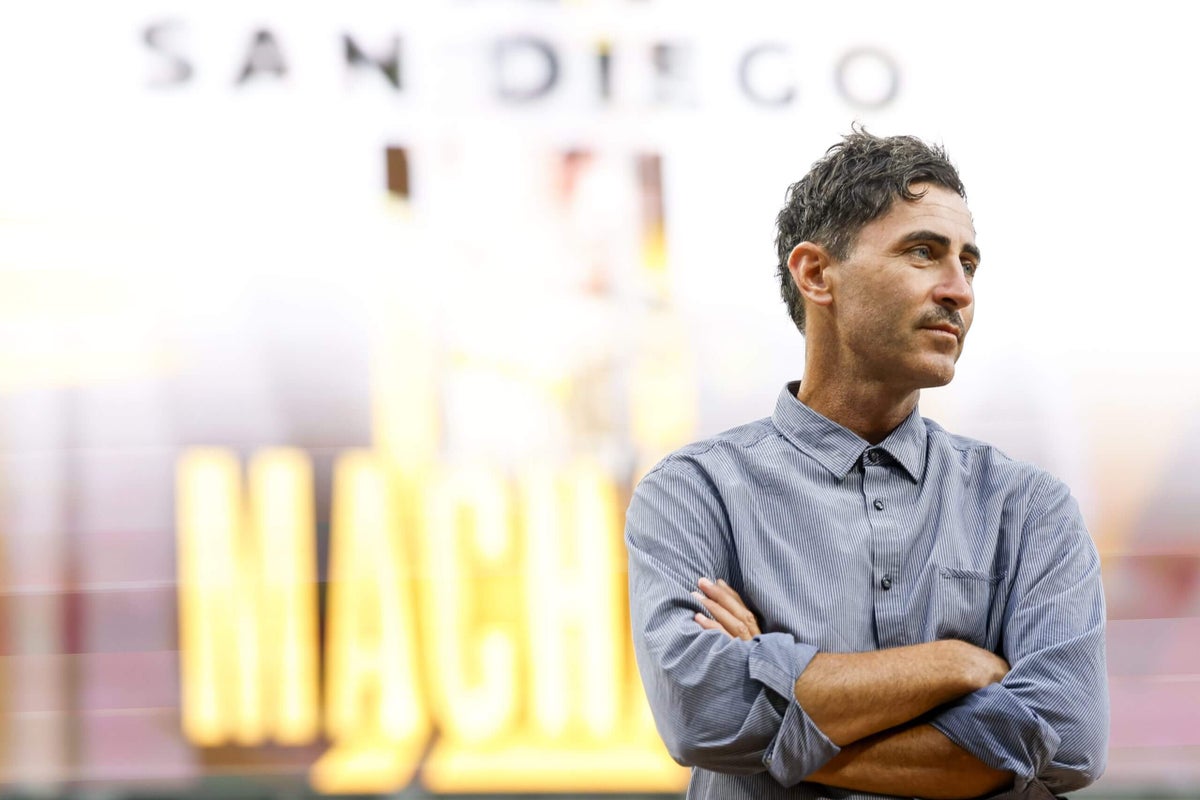
If Fernando Tatis Jr., Manny Machado and Jackson Merrill fail to hit to their accustomed levels, San Diego Padres president of baseball operations A.J. Preller might consider it futile to adopt his usual frenzied approach at the trade deadline.
But seriously, does anyone expect that out of the executive who gives the entire sport whiplash virtually every year?
If anything, Preller could become even more dangerous once the Padres’ $3.9 billion sale to José E. Feliciano and his wife, Kwanza Jones, is finalized. At the past three deadlines, Preller operated with limited payroll flexibility. Some teams hear that Feliciano and Jones, while not yet approved, plan to grant him greater financial leeway.
The Padres’ farm system, depleted from all of Preller’s wheeling and dealing, is the worst in baseball, according to The Athletic’s Keith Law. But people seem to say that every year, and every year Preller comes up with prospects to trade.
The bigger questions, perhaps, are whether the Padres will merit reinforcement at the deadline, and what their biggest needs might be.
Somehow, the Padres are tied with the St. Louis Cardinals for the first wild-card spot in the National League. With Tatis, Machado and Merrill all sporting OPSes below .700. With the offense through Tuesday ranked ahead only of the Kansas City Royals in runs per game. With right-hander Yu Darvish spending all season on the restricted list while recovering from major elbow surgery, and with Nick Pivetta and Joe Musgrove still not close to returning from injuries.
Tatis has been hot of late, but complementary players such as Gavin Sheets, Miguel Andujar and Ty France have been among the Padres’ biggest offensive contributors. If Machado and Merrill return to form, the team’s lineup should be in relatively decent shape.
Then again, another outfielder could help. Ramón Laureano struggled before going on the injured list with a hip issue. Nick Castellanos was designated for assignment on Wednesday after batting .191 with a .560 OPS in 122 plate appearances.
The bigger void, though, almost certainly will be in the rotation, which the Padres have been piecing together behind righties Michael King and Randy Vasquez all season.
Which prospects are left for Preller to move?
Catcher Ethan Salas, who just turned 20 on Monday, has regained his status as one of the game’s top young talents, batting .309 with an .857 OPS at Double A. But Preller, as he did with Merrill, might consider him too valuable to trade.
Freddy Fermin, one of Preller’s acquisitions at last year’s deadline, entered Wednesday batting .130 with a .403 OPS. And Salas by the end of this season might be ready to pair with Luis Campusano, who got off to a good start and should return before long from a fractured left big toe.
If not Salas, Preller can dangle left-hander Kash Mayfield, the Padres’ first-round pick in 2024, who is pitching well at High A. Righty Tucker Musgrove, a seventh-rounder in 2023, is a reliever at High A averaging more than two strikeouts per inning. Another possibility would be outfielder Ryan Wideman, a third-rounder in 2025. Wideman is hitting well and stealing bases at Low A, but his batted-ball luck indicates regression is possible, if not likely.
Preller will do something. He always does. Never afraid to double down on a strength, he has explored the market for high-end relievers, as The Athletic’s Dennis Lin wrote last month. And if the Detroit Tigers make back-to-back Cy Young winner Tarik Skubal available, president of baseball operations Scott Harris should expect to hear from his counterpart in San Diego, over and over again.
Maybe the Padres will stumble, forcing Preller to refrain from heavy action. Maybe Feliciano and Jones will be unable or unwilling to provide fresh financial resources, depending upon when they are approved.
For the Padres, a lot rides on the next two months, even more than it does for most teams.
Brewers’ Turang a tower of strength
During the World Baseball Classic, Los Angeles Dodgers third base coach Dino Ebel served in the same capacity for Team USA and threw batting practice to the top American hitters.
One day, Ebel posed a question to Team USA manager Mark DeRosa.
“If you had to pick the guy who hit the ball the farthest consistently, who would you think it was?” Ebel asked.
As Ebel recalls, DeRosa guessed Aaron Judge or Bryce Harper.
“Brice Turang,” Ebel replied.
Ebel said that during batting practice in Houston and Miami the Milwaukee Brewers second baseman hit balls to places he had never seen, displaying “Shohei-type power.”
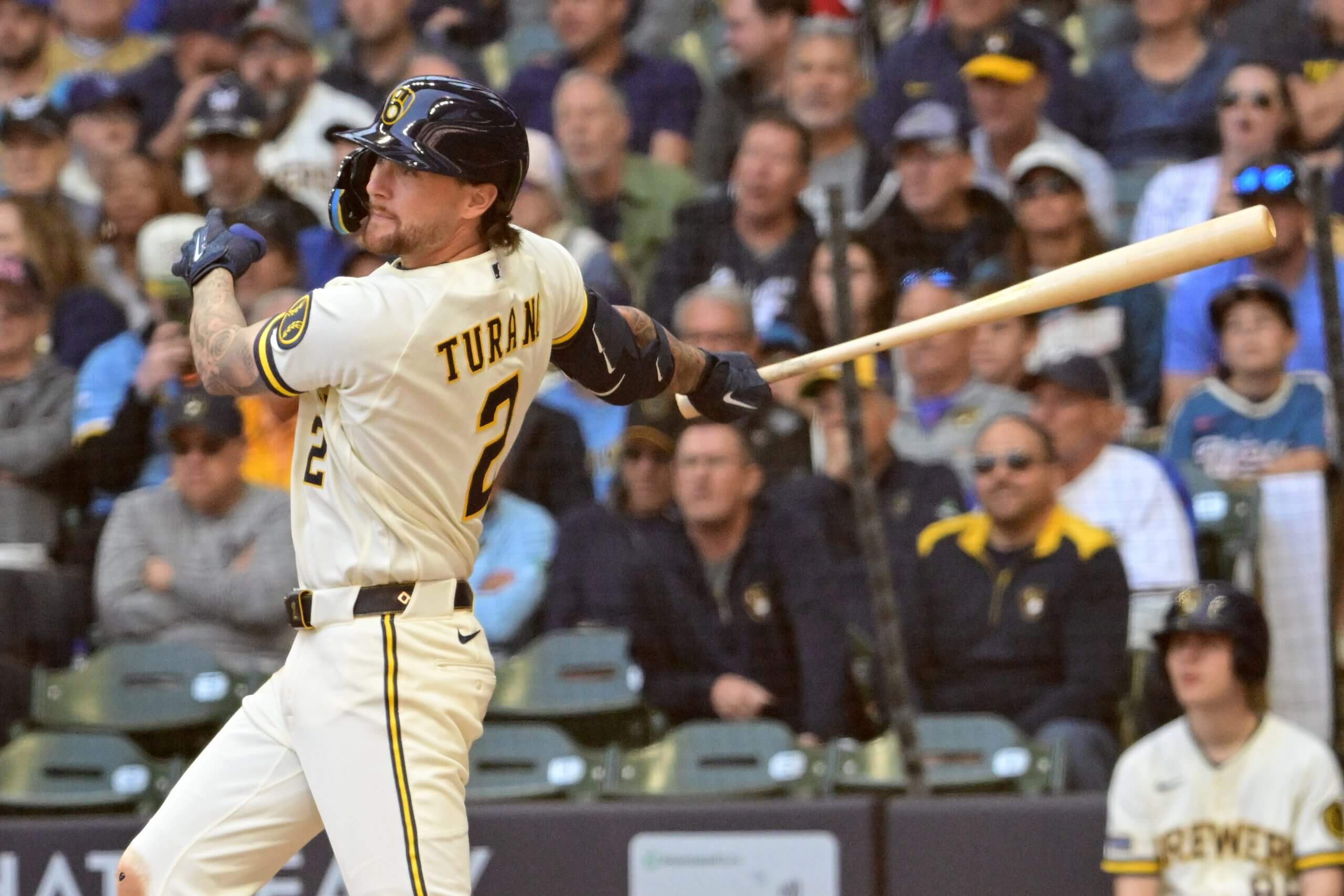
Brice Turang swings in a game against the Padres earlier this month. (Benny Sieu-Imagn Images)
Turang, 26, hit a career-high 18 home runs last season. This season he has seven, and his .456 slugging percentage and .858 OPS would represent career-highs. Ebel believes he is capable of one day hitting 35 to 40 homers.
Baseball America, in its report on Turang entering the 2018 draft, wrote, “at just 6-foot-1, 165 pounds, the biggest knock on him is his size.” The 165 might have been a generous estimate. You would never know it looking at him, but Turang estimates he has gained 35 pounds since the Brewers took him 21st overall out of Santiago H.S. in Corona, Calif.
His biggest weight jump came after his rookie season in 2023, when Turang said he gained about 25 pounds, “eating everything you can possibly eat, drinking tons of protein shakes.” Training with Keith Coury, with whom he first worked when he was 16, he has increased his weight to the 185-190 pound range.
Coury, who once ran the sports performance side at a baseball training center operated by Turang’s father, Brian, said Turang was concerned he might lose speed if he put on weight.
To Coury, who now works at MW Athletix, a facility founded by former NFL safety Marcus Williams, one didn’t need to come at the expense of the other. Coury said his goal is always to create the best athlete possible, regardless of his or her sport.
Turang believes in him.
“He’s made a big difference, for sure,” Turang said. “I look skinny, but with the strength side of things, the explosiveness, running and all that stuff, he’s helped me tremendously. A good bit of why I’m here today is just from the training I’ve had with him, his knowledge of training.”
Turang even recommended Coury to Ebel, a longtime acquaintance whose sons, Brady and Trey, were star shortstops in Turang’s hometown at Corona High. The Brewers last year drafted Brady with the 32nd pick overall. Trey, part of this year’s draft class, is expected to go in the first three rounds.
Either would be fortunate to ascend to anywhere near Turang’s level.
“He wants to be one of the greatest at what he does,” Coury said. “And he’s starting to see that he has the opportunity to be really, really, really good at an elite level. That motivates him even more.”
How Dodgers’ Roberts helped Conforto
A frank conversation with Los Angeles Dodgers manager Dave Roberts couldn’t save outfielder Michael Conforto’s 2025 season. But it might have helped salvage his career.
Conforto, 33, flopped with the Dodgers, but is enjoying a resurgence with the Chicago Cubs. The impetus, he said, stemmed from his talk with Roberts near the trade deadline last July.
“I had a tough realization last year, had to rethink the way I view the game, understand how I help a team win,” Conforto said. “In L.A., I wanted to slug with the superstars. When I wasn’t doing that, I didn’t have a place to go.”
The essence of Roberts’ message, Conforto said, was, “You have to find a way to be valuable. You’ve got to give me a reason to keep you around.”
The Dodgers ended up keeping Conforto the entire season, even though he batted just .199 with 12 homers and a .637 OPS. However, they excluded him from all four of their playoff rosters.
“I could see that once he was with us, from spring training all throughout the beginning part of the season, he was pressing. He just wasn’t himself,” Roberts said. “I could tell by nature he’s a pleaser. He wanted to please his teammates, his coaches, the fans. I tried to give him as much runway as possible. I wanted him to be the guy.”
Roberts told Conforto to become more like the player he was at Oregon State and in the minors – athletic, free and easy, imposing his will on pitchers. But after signing his one-year, $17 million free-agent contract with the Dodgers, Conforto became passive, an overthinker, Roberts said.
By the time Conforto turned into the hitter Roberts envisioned – during live batting practice sessions in October, while off the active roster – it was too late.
“That really bummed me out,” said Roberts, who describes himself as an admirer of Conforto’s.
But after a period of reflection — with Conforto asking himself, “Do I want it or not?” — the 11-year veteran got on the right path.
“I took a lot of motivation with me into the offseason, found myself again, got back to the things I used to do,” Conforto said. “Get in my legs. Use the whole field. Hit the fastball. Be a tougher out.
“You can’t be a guy who just gets fastballs blown by him, not in the profile of hitter I am. I really worked hard to get back to doing things the way I do ‘em.”
He described the free-agent contract he signed with the Cubs — one year, $2 million — as a “prove it” deal. So far, Conforto is doing just that. He’s currently batting .266 with four homers and a .904 OPS. The latter figure would be his highest in a full season since 2017.
Roberts is thrilled for him.
“I couldn’t be happier for his success,” Roberts said.
Short kings in Arizona
Around the Arizona Diamondbacks, it’s almost like a running gag.
“There’s definitely a joke about how we love to draft little left-handed hitting outfielders,” said right-hander Merrill Kelly. “It’s definitely been a common theme since I’ve been here.”
Actually, the Diamondbacks fancy all kinds of hitters on the smaller side. Their most recently promoted prospect, the 5-foot-10 Tommy Troy, is playing left field while the DBacks await the return of Lourdes Gurriel Jr. from a left hamstring strain.
But he joined the organization as a right-handed hitting infielder, drafted 12th overall out of Stanford in 2023.
The Athletic’s Andy McCullough wrote last October about how the 6-foot-3 Christian Yelich was the only Brewers regular taller than the major-league average, which was just north of 6 feet. The DBacks are not quite that extreme. But they’re not exactly giants, either.
Their best player, right fielder Corbin Carroll, is 5-foot-10. Another of their outfielders, Jorge Barrosa, is 5-foot-9. Two of their catchers, Gabriel Moreno and Adrian Del Castillo, are 5-foot-11 and 5-foot-10, respectively. Outfielder Alek Thomas, whom they traded to the Dodgers last month, is 5-foot-11.
The DBacks’ past two first-round picks, 5-foot-9 outfielder Slade Caldwell, and 5-foot-10 shortstop Kayson Cunningham, also fit the pattern.
“It’s hard not to notice the trend, just from like the past five drafts,” Troy said, smiling.
The DBacks do not focus exclusively on shorter players. Outfielder Druw Jones, their first-rounder in 2022, is 6-foot-2, as is third-base prospect LuJames Groover, a second-rounder in 2023. The difference is that while some in the industry steer clear of undersized hitters, the DBacks do not.
“If we feel there’s enough power there, forget about the stature, we still have a lot of interest in those guys as hitters,” general manager Mike Hazen said.
Both Hazen and assistant GM Amiel Sawdaye came from the Boston Red Sox, who had great success drafting two 5-9 players — Dustin Pedroia (second round, 2004) and Mookie Betts (fifth round, 2011).
Sawdaye was a scouting assistant with the Sox when they drafted Pedroia, and their amateur scouting director when they chose Betts.
For his part, Betts had no idea he was an ongoing inspiration to one of the Dodgers’ division rivals. He said over the years he noticed the speed of certain DBacks’ outfielders, but not their size.
“It’s weird because that’s kind of not where the game is,” Betts said. “Now every time you look up, every top prospect, everybody coming in to debut, is some type of 6-3, 220. Every position is becoming that. It’s almost like natural selection is finally starting to take its way in baseball.”
Well, teams might need to rethink that.
As pointed out by MLB.com’s Mike Petriello, shorter players are deriving the biggest benefit from the introduction this season of the Automated Ball-Strike System (ABS)
Petriello wrote that 2025 Triple-A data showed that at least in the minors, “it wasn’t the biggest players who benefited the most from ABS, it was the shortest.” And that pattern has continued in the majors.
Here were the overturn rates through Tuesday:
Short (5-foot-9 and under): 48.3 percent
Medium (5-foot-10 through 6-foot-2): 46.2 percent
Tall (6-foot-3 and above): 45.3 percent
“They’ve been drafting short guys for years, not even knowing ABS would be a thing,” 6-foot-5 DBacks reliever Ryan Thompson said, referring to the team’s front office. “I think now it probably plays into our hands even more.”
Around the horn
• Wondering when the Brewers might promote shortstop Cooper Pratt and/or third baseman Jett Williams? June 16, the first date teams can trade free agents in the first year of contracts without their consent, is a day to keep in mind.
Luis Rengifo, whom the Brewers signed to a one-year, $3.5 million free-agent deal, likely has minimal trade value – he’s batting .204 with a .531 OPS. But rather than release him, the Brewers surely would prefer to find a taker that might give them either a measure of financial relief or a low-level prospect in return.
Williams could replace Rengifo at third. Pratt, who is hitting respectably at Triple A, could become the starter at short, with Joey Ortiz either remaining with the club in a utility role or getting demoted to the minors.
As well as the Brewers are playing, there is no urgency to any of this, no need to disrupt a good thing.
• The Diamondbacks expect to pursue a left-handed first baseman/DH type at the deadline, people briefed on their plans say.
The DBacks’ top three hitters – Ketel Marte, Carroll and Geraldo Perdomo – are either left-handed or switch-hitters. But the team’s only other left-handed options are first baseman Pavin Smith, who returned Monday after missing two months with left elbow inflammation, Del Castillo and the switch-hitting Barrosa.
Among the left-handed hitters who might be available and potentially could fit the DBacks’ desired profile: The San Francisco Giants’ Luis Arraez; Cardinals’ Lars Nootbaar, Tigers’ Zack McKinstry; and Colorado Rockies’ TJ Rumfield and Troy Johnston.
• The shifting of right-hander Carmen Mlodzinski from the rotation to the bullpen is not the only way the Pittsburgh Pirates are trying to upgrade their bullpen.
The team, which on Monday traded righty Justin Lawrence to the Minnesota Twins for cash considerations, is actively pursuing bullpen help, according to people briefed on their discussions.
One rival executive joked, “That’s not news. Everyone is looking for ‘pen.” But the same exec said the Pirates are being more aggressive than most clubs in that search.
The Pirates entered Wednesday ranked fifth in runs per game and fourth in rotation fWAR, but only 19th in bullpen fWAR.
• The Texas Rangers are two games below.500 but somehow just a half-game out of the final AL wild-card spot. But the true test of whether they are an actual contender likely will come after shortstop Corey Seager and left fielder Wyatt Langford return from the injured list.
Seager (back) is expected to return this weekend, Langford (forearm) either by then or shortly thereafter. The Rangers, who entered Wednesday ranked 23rd in runs per game, desperately need to lengthen out their offense. Third baseman Josh Jung, second baseman Ezequiel Duran and designated hitter Joc Pederson have been their only productive hitters of late.
• Last Friday, St. Louis Cardinals shortstop Masyn Winn expressed disappointment with his home-run total, saying, “One homer at this point is pretty embarrassing.” Winn hit No. 2 on Monday, but his overall numbers are not where he or the Cardinals envisioned.
Winn has power – he hit 15 home runs in 2024, his rookie season – and players know how much slugging is valued in today’s game. The catch is, when a hitter chases power, it often leads to poor results.
Cardinals people believe Winn is at his best when he’s a tough out. He hasn’t been that this season. But it’s easy to forget, he’s still only 24.