
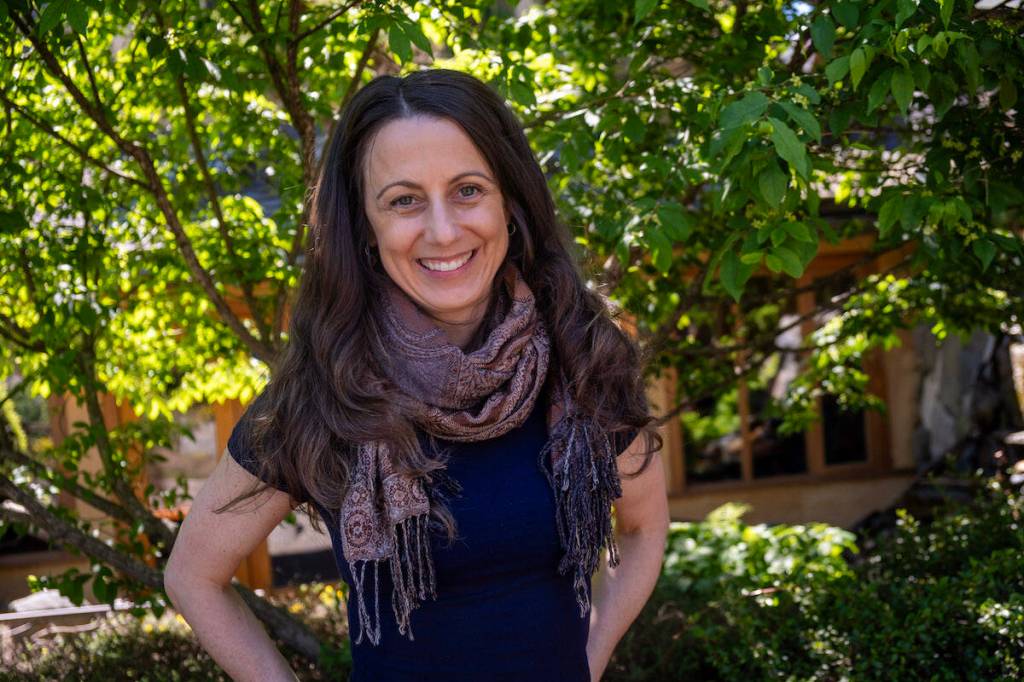
When the Nelson writer Jayme Moye traveled to Tanzania in 2012 to write a story for National Geographic about the first “climb-and-fly” paragliding attempt from Mount Kilimanjaro, she trained for it.
“I needed to hike up Kilimanjaro,” she says. “It’s a pretty non-technical hike, but it gets into the mountaineering realm a little, so I was focused on high-altitude hiking.”
When she traveled to China in 2021 to write for Canadian Geographic about the first-ever ski touring expedition in the Altai Mountains, she had to first upgrade her ski touring skills.
“I was relatively new to ski touring at the time. And the thing about ski touring is it’s not just an endurance sport with the uphill, but also you have to have very strong downhill, deep powder skiing abilities. I felt like I was a little bit out of my league there if I didn’t train first.”
Many of Moye’s stories for high-end travel and adventure publications involve the writer embedding herself in the adventure, and being skilled enough and fit enough to pull that off.
What better way to document Afghanistan’s (short-lived) women’s road bike racing team than to spend time in that country as a road bike racer herself, as she did in 2013?
Road bike racing was Moye’s original sport (from well before the Afghanistan trip) to which she has since added trail running, climbing, stand-up paddleboarding, sailing, hiking, diving, camping, birding and skiing (Nordic, backcountry and downhill).
But she says she is first a writer. That’s how she has distinguished herself in articles not just for National Geographic and Canadian Geographic but for Outside, Adventure Journal, Alpinist, Conde Nast Traveler, Travel+Leisure, and more.
She has done this from her previous home in Colorado and then from Nelson, to which she moved in 2017.
Moye has won many awards for this work. Her latest distinction is the inclusion of one of her articles in the book Best Women’s Travel Writing, an anthology published every few years in the U.S.
“It’s one of the greatest honours of my career,” she says. “It’s thrilling to be in it. The book is beautifully done and the stories are world class. They always do a really good job of having a really large world view. You’re getting stories from literally all over the globe.”
Moye will present and discuss her winning article – entitled The Magnificent Mother of the Sea – and the anthology that contains it, for Notably Books at the Nelson United Church at 7 p.m. on Thursday, June 18.
The Great Barrier Reef
To write the article, Moye dove and snorkeled off a floating lab near the coast of Australia, observing the spawning of corals in the Great Barrier Reef.
She was documenting a groundbreaking scientific effort to restore sections of the reef that have been damaged by climate change. The project is a collaboration between the Australian government, an Indigenous organization and the tourism industry.
Moye’s story of this adventure is an artful mix of biological science, her interactions with the scientists, the perspective of an Indigenous member of the team, and the author’s sense of wonder.
… as soon as my face is underwater, I’m distracted from the task at hand … by a riotous cornucopia of life, and everything, including the water itself, is in constant motion. I watch an emerald-blue parrotfish grazing on algae — I can actually hear its buck teeth scraping the reef. Just beyond, a purple starfish lounges in a colony of yellow corals, like the color wheel come to life.
Corals, Moye reminds us, are not plants but animals that live in colonies and reproduce by spawning. The Great Coral Reef is the largest living structure on earth, visible from space and housing thousands of other species of fish, insects and animals.
The scientists were applying a reef restoration technique known as larval reseeding. Spawn from a healthy section of the reef is moved to a damaged section of the reef and released, to repopulate the coral community there.
For most corals, the spawn happens after dark for a few nights following the full moon, when tide fluctuation is most negligible. At that time, coral colonies across the reef are simultaneously ejecting trillions of tiny bundles of egg and sperm, collectively called gametes, into the ocean.
Very few humans have been under the sea with a flashlight at precisely the right moment to bear witness to the spawn, let alone snorkel through a tropical snow globe of gametes. As a journalist from Canada, it is certainly my first time.
Given that humanity is not reducing its carbon emissions and the destruction of the reefs is well underway, Moye had to wonder why the scientists are doing this perhaps futile work.
“The scientists I spoke with, they didn’t flinch at that,” she says. “They just kind of looked right back at me and were like, ‘Yeah, that’s definitely possible. But we can’t just stand by and do nothing.’”
‘What the heck am I doing here?’
Sometimes the challenges she takes on make her wonder why she does this.
In China, in addition to the ski touring challenges she faced, Moye’s role was difficult because of the geopolitical situation at the time (China had just imprisoned two high-profile Canadians). In Afghanistan, her task, while navigating an extremely foreign culture, was to write a delicate social justice story about women’s empowerment in a country where that was a sensitive subject, even though the Taliban were not in power at the time (but soon would be again).
Camping on a ledge in Yosemite for three days on El Capitan, “when you’re dangling 3,000 feet above the earth and the wind kicks up, there were some days where I’m like, ‘What the heck am I doing here?’.
“But that’s how I get the story. I get so immersed in the story. That intensity, that passion, the way it grips me, yeah, I’d almost go anywhere or do anything for it.”