
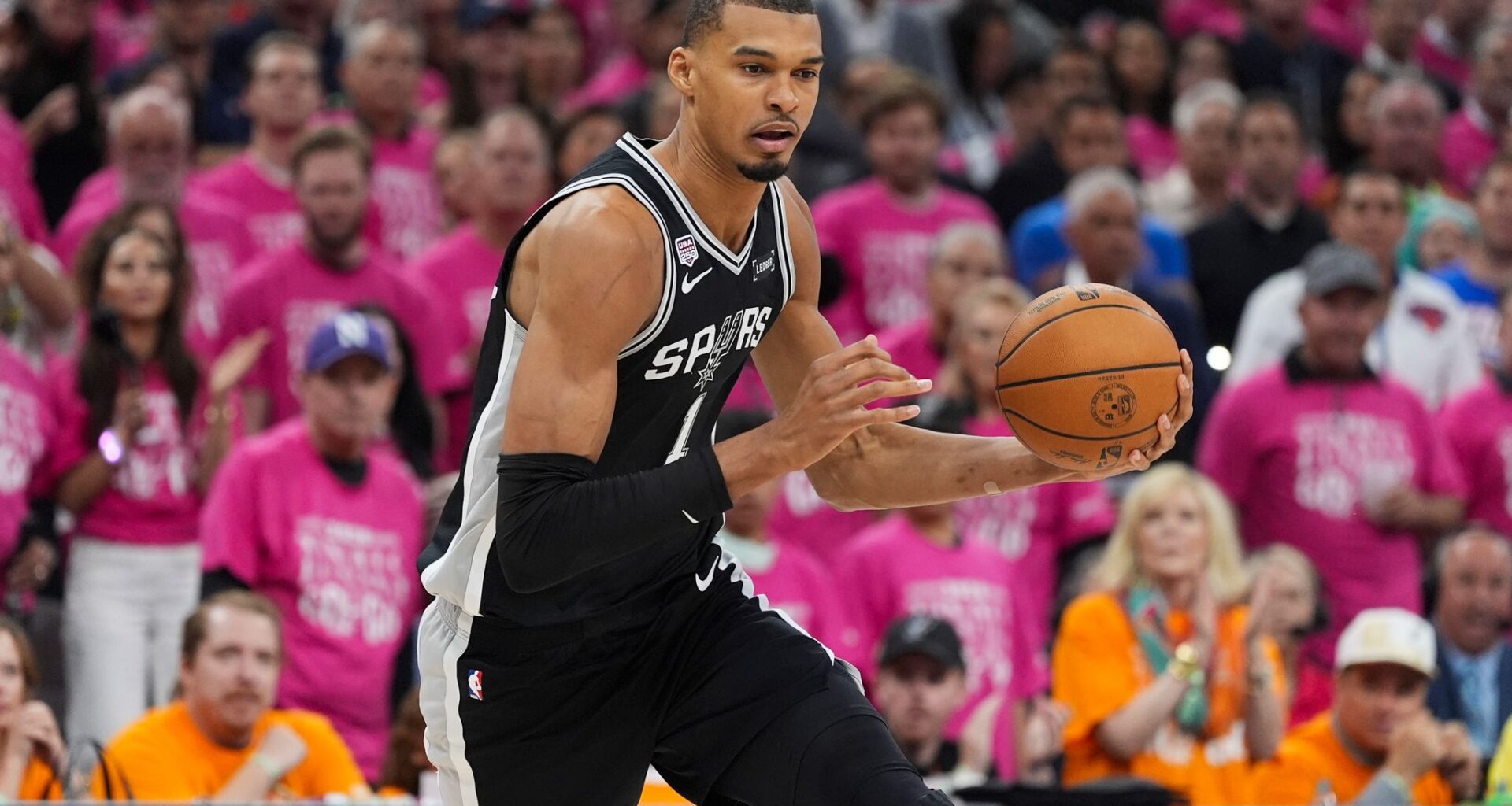
The Spurs’ Victor Wembanyama drives against the New York Knicks during the first half of Game 1 of the NBA Finals on Wednesday in San Antonio.
Eric Gay/Associated Press
The San Antonio Spurs’ Victor Wembanyam, called “the first perfect center” by Shaquille O’Neal, has embraced alternative training methods as he seeks to maximize his potential.
Sam Owens/San Antonio Express-News
Scanning the landscape as people of normal height, we have no idea how it feels to be 6-foot-10, 7-1 or 7-4. Aloof, they are often called, detached physically and perhaps emotionally from the fray.
“There goes a basketball player,” we’ve always said at first glance, wondering how it must feel to grab a rebound or throw down a dunk with such an obvious advantage. And it’s all of that for those with true athletic ability.
Most of those towering folks take a separate path. Some are just good enough to play the game professionally. The highest level is what we’re witnessing now, in the NBA Finals, with the San Antonio Spurs’ Victor Wembanyama.
Article continues below this ad
Shaquille O’Neal has taken to calling Wembanyama “the first perfect center,” elevating him above the entirety of NBA history for his ability to do everything spectacularly well: handle the ball, shoot from any plausible distance, deliver crisp passes within the team concept, raise barriers of impenetrable defense, run the court like a sprightly guard.
In a sense, every great NBA center was perfect for his time, among them George Mikan, Wilt Chamberlain, Hakeem Olajuwon and Shaq himself. But not like Wembanyama, and here we discover a different kind of comparison, calling to mind what he shares with Bill Russell, Kareem Abdul-Jabbar and Bill Walton: a spiritual awakening.
San Francisco Chronicle Logo
Make us a Preferred Source to get more of our news when you search.
Add Preferred Source
Wembanyama had reason to believe his career was over, at 21, when a blood clot known as deep vein thrombosis was diagnosed in his right shoulder. He missed the end of the 2024-25 season, and the breadth of his recovery reached far deeper than the medical profession.
Article continues below this ad
Wembanyama is a thinker, a philosopher at heart, and he set upon a remarkable journey upon his clearance to resume physical activities. Devoted since his early teens to exploring alternative methods of training, from meditation to the martial arts, he traveled to China and immersed himself in the teachings of the Shaolin Temple in the province of Henan.
In a pursuit expertly detailed by ESPN’s Ramona Shelburne, Wembanyama sought out his untapped potential in a monastery founded in the late fifth century. He returned with fresh, invaluable perspectives on courage, endurance and awareness, all of it sharpened by an extreme focus on the disciplined mind.
We find him now as an NBA work in progress, all of those tenets immediately confronted as the Spurs lost Game 1 of the Finals to the New York Knicks. That’s exactly what he wants, to be challenged, and he relishes the notion of handing his skeptics a fresh new masterpiece.
Bill Russell’s journey to greatness wasn’t nearly so complex. It took place in Oakland, completely within himself, no outside help. Strictly a defensive asset, struggling to even make the team at McClymonds High in the mid-1950s, he found comfort in the school library, devouring every subject that caught his interest. But one school took notice: USF, just across the bay, and Russell found himself on a midwinter tour for seniors who had graduated in January.
Traveling on bus rides through the Northwest, Russell began to realize the potential of his limited game, built entirely around defense. Charting out scenarios in his mind, “There were moments when new skills seemed to drop out of the sky,” he later recalled. “I wanted to use my gifts in ways no one had ever used them.”
Article continues below this ad
This was all about footwork, blocking shots, the maximizing of angles, peripheral vision, how certain feats could stick in an opponent’s distracted mind for weeks. And it was all entirely new: First at USF, and especially later with the Boston Celtics, no one had seen anything like Russell playing defense — or exerting the influential powers of the mind. He left the game in 1969 with 11 titles in 13 years, the greatest winner the sport has known.
Abdul-Jabbar was born Lew Alcindor, and he was known that way as he dominated the gyms and playgrounds of New York City in his youth, all the while troubled by discontent. Pushing aside his parents’ Baptist religion and a rules-bound Catholic school — feeling “imprisoned by an image of what I was supposed to be,” he wrote in 2015 — he was introduced to Islam during his freshman year at UCLA.
Changing one’s name, at that time, for that reason, “made me nervous and uncomfortable,” he wrote. But he felt that his true self was emerging, eventually as a very public figure in the fight for Black people’s rights. The story runs far deeper than these pages, but as often as he encountered blatant racism, Abdul-Jabbar spent his life in proud defiance, keeping as private as humanly possible — and laying waste to mere mortals on the basketball court (three championships at UCLA, five more with the Lakers), later detailing his beliefs in articulately written dispatches.
Bill Walton knew all about Alcindor during his high-school days in San Diego, and when it came to pure, textbook basketball, he was very much in that league. He knew UCLA was the place to go, but as a scraggly-haired, dope-smoking kid who loved to display his political activism in public, he was everything coach John Wooden did not want in a player.
To Walton’s everlasting credit, Wooden changed him. He didn’t give up the so-called “hippie” lifestyle — not ever — but he played by Wooden’s rules, and when the Bruins trotted onto the court before games (somehow, they did that more impressively than any team I’ve ever seen), Walton was just another well-groomed, disciplined kid about to take your team apart.
Article continues below this ad
It was the preparation that really struck home, the precise adherence to rules. Naturally and often blatantly rebellious, Walton acknowledged Wooden’s genius and fell wholly in line. Describing his first day as a freshman in “Nothing But Net,” Walton’s autobiography, “Coach Wooden walked into the locker room, pulled up a stool, sat down and told us exactly how he wanted us to put on our socks, how to lace our shoes, how to tuck our jerseys in, how to tie the drawstrings in our pants, how to dry our hair after practice. My entire game-day routine — in fact, my entire life routine — was taught to me by John Wooden.”
It goes without saying that Wooden’s teachings translated directly to the court. UCLA won back-to-back NCAA titles in 1972 and ’73, going undefeated each year, and although Walton saw his NBA game routinely dismantled by injuries, he won titles with the 1977 Trail Blazers and the 1986 Celtics.
“I’ve never coached a better player,” Walton’s Portland coach, Jack Ramsay, said years later. “I’ve never coached a better competitor, and I’ve never coached a better person.”
These are the stories that illuminate the NBA right up to the present, soaring above the 3-point obsession, overly sensitive referees and a collective bargaining agreement that reads like numbers randomly scribbled on a chalkboard. It’s people such as Russell, Abdul-Jabbar, Walton and Victor Wembanyama who make it so, tales of triumph and introspection that never grow old.
Article continues below this ad
Bruce Jenkins writes the 3-Dot Lounge for the San Francisco Chronicle. Email: jenksurf@gmail.com; Twitter: @Bruce_Jenkins1