
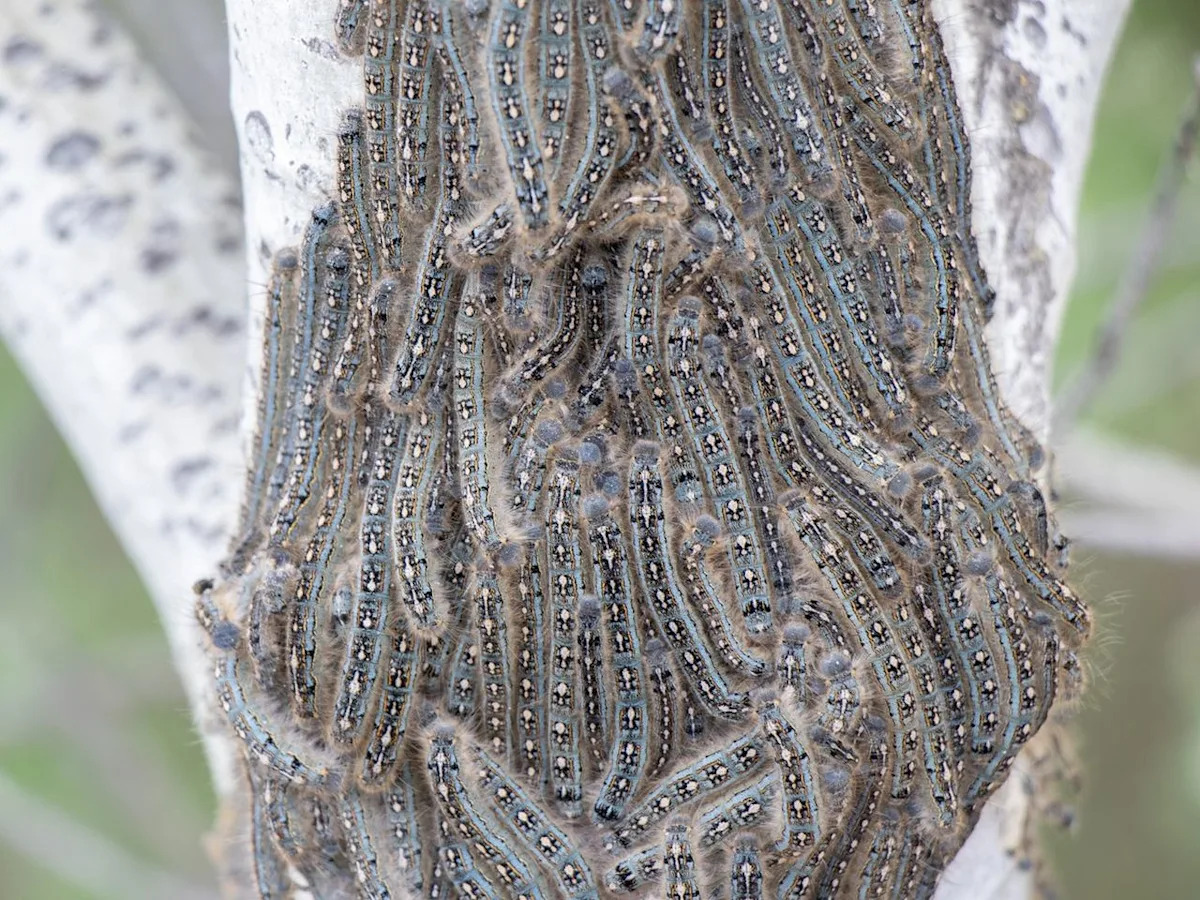
Hundreds of thousands of caterpillars — maybe millions — all of them hungry for poplar leaves. Numerous forest tent caterpillars are worming their way around Edmonton branches.
Creepy, but essentially harmless and native to the Alberta ecosystem, they are helpful for the forest, over all, although trees already suffering poor health may not fare as well.
The writhing critters can, however, turn a bike path into a hazard, cautions Mike Jenkins, senior scientist for the City of Edmonton.
Rising numbers year after year suggest the Malacosoma disstria is on a 10- to 15-year roll in Edmonton.
“They’ve emerged from their egg cases and they’re moving out on to the leaves of the poplar trees and growing from there and they kind of start off in little clusters. You’ll see a big patch of them sitting on the trunk of the tree all together,” Jenkins told Postmedia.
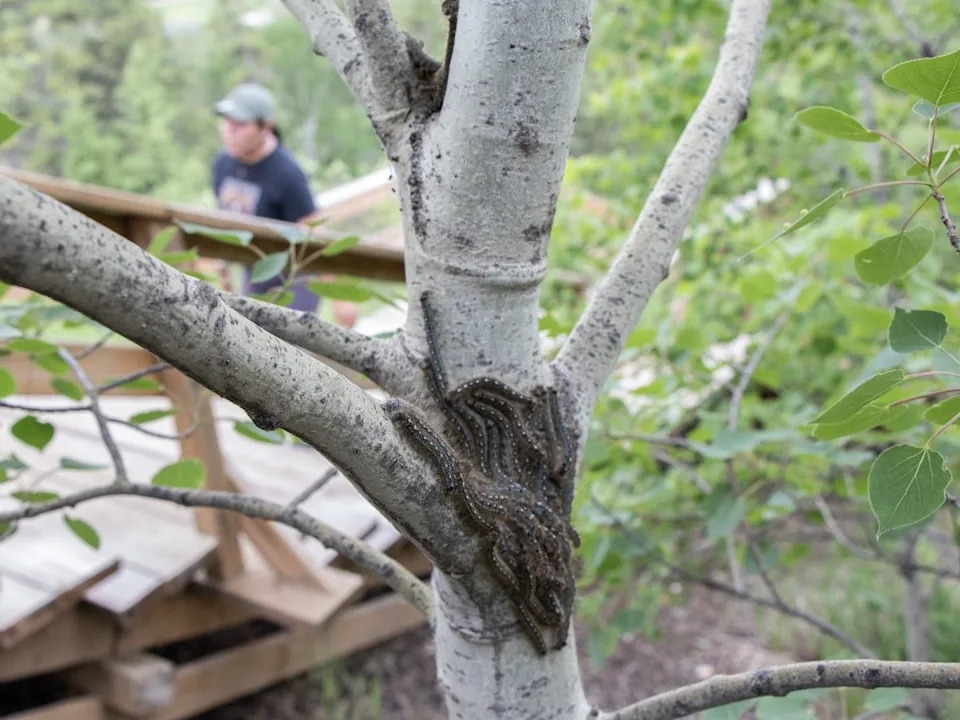
Forest tent caterpillars in the Edmonton river valley on Friday, June 5, 2026. Forest tent caterpillars are native to the Edmonton area and have a distinct row of whitish spots running down their backs and wide blue bands along their sides. Shaughn Butts/Postmedia
When the fuzzies get big enough, unlike their cousins, the Eastern tent caterpillars, they don’t actually make tents in trees.
Instead, they look for a spot to cocoon — other trees, your fence, your garage. Your house.
“They spin themselves sort of a little silken pierogi and pupate inside there for about a week or so,” Jenkins said.
A week later, a little chunky brown moth comes out around the end of June — and where there are bright lights in the big city, big clouds of them fly around. And mate. Many become crispy protein snacks for birds, bats, reptiles and amphibians and small mammals.
Many will lay a band of eggs on the tips of poplar branches, little rings of tiny black “beads” that winter on the branch tips, hatching out into a new batch of caterpillars in the spring.
When the numbers boom too high, natural enemies take advantage and help control the population. Ground beetles, normally ground foragers, forego slugs, grubs and cutworms, going Tarzan to climb trees with a yen for caterpillars.
Ants, parasitic flies and wasps, oh my — caterpillars are their jam.
“There are birds that actually expand their range to take advantage of some of those outbreaks — red-eyed vireos we don’t usually see in very large numbers around here, but when there’s an outbreak of forest tent caterpillar, they end up moving in to take advantage of that food source,” Jenkins said.
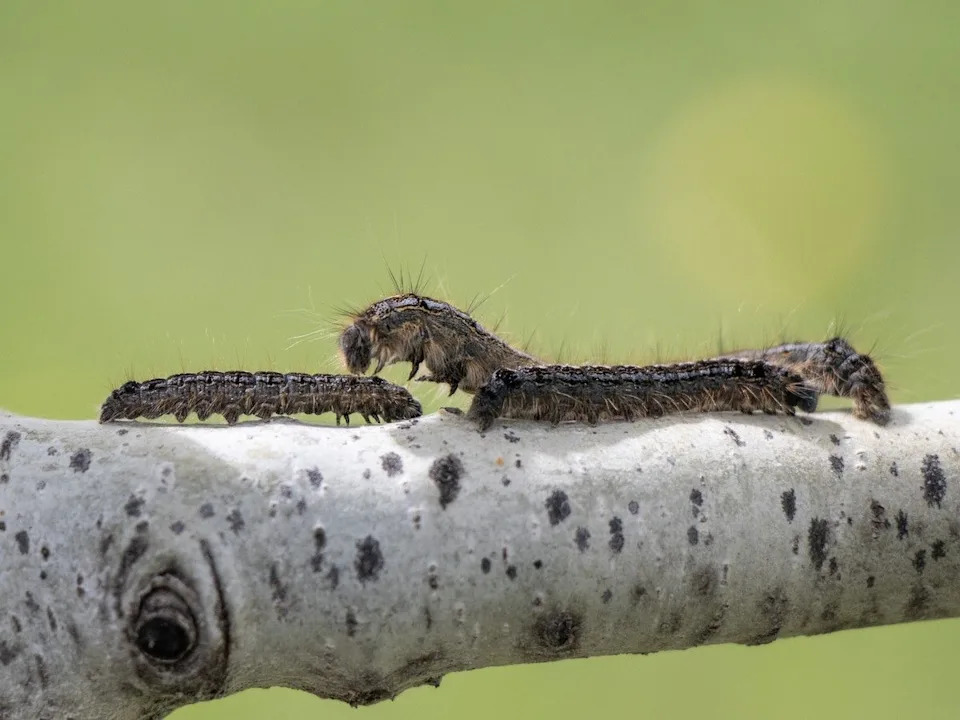
Forest tent caterpillars in the Edmonton river valley on Friday, June 5, 2026. Shaughn Butts/Postmedia
Then there’s viruses. Nuclear polyhedrosis is something of a body-snatcher, turning their insides into liquid, leaving them dangling dead from the tree by their forelegs.
“Then if anything touches them, they kind of burst open and spray virus-laden goo all over all the rest of the caterpillars and spread the virus that way,” Jenkins said.
If it all sounds too Aliens vs. Predator, don’t worry — it’s nature balancing things out.
“It helps to get a bunch of the nutrients that are in the trees basically into the soil as the caterpillars turn it into caterpillar frass.”
(That’s science for caterpillar poop.)
“Frass is a good nutrition for lots of the other things that are in the forest,” he said.
Edmontonians have nothing to fear but the fear of bugs itself. The poplar trees have evolved to bear getting stripped several years in a row, although trees that are already in poor health may be worse for wear.
“(Poplars) can actually photosynthesize a little bit, even with no leaves at all. They’ve got chlorophyll underneath their bark, and it’s probably part of their adaptations for being regularly stripped by caterpillars like this. The trees will survive,” Jenkins said.
And if the sight of hundreds of caterpillars writhing on your home’s exterior is disturbing, just think, they can actually become a road hazard when they’re crossing a street or a roadway. Ontario’s tent caterpillar outbreaks have been severe enough to cause accidents.
Jenkins hasn’t seen caterpillar slicks for a long time, but in the ’80s, bike paths got treacherous with them, he said.
So what does it sound like?
“There’s a pretty distinctive popping sound, and yeah, definitely you can lose traction fairly quickly,” he said.
As a science-minded kid, Jenkins learned about caterpillars the hard way — there was the jacket that went through the wash with a couple dozen caterpillars in the pocket, and then the beer case of caterpillars left in the living room, forgotten, when the kids were called for dinner.
“By the time dinner was done, there were caterpillars all over the living room. We tried to argue for a stay of execution, but they did not grant one,” he recalled.
Related
Bookmark our website and support our journalism: Don’t miss the news you need to know — add EdmontonJournal.com and EdmontonSun.com to your bookmarks and sign up for our newsletters.
You can also support our journalism by becoming a digital subscriber. Subscribers gain unlimited access to The Edmonton Journal, Edmonton Sun, National Post and 13 other Canadian news sites. The Edmonton Journal | The Edmonton Sun