

Listen to this article
Estimated 4 minutes
The audio version of this article is generated by AI-based technology. Mispronunciations can occur. We are working with our partners to continually review and improve the results.
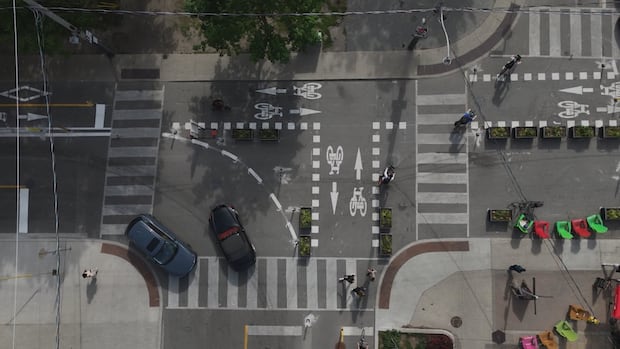
The downtown intersection of Wellington Street W. and Portland Street is now among the most pedestrian and cyclist-friendly in Toronto with the introduction of new barriers.
Anyone driving on Wellington towards the disjointed intersection is now forced to turn onto Portland, while those driving up or down that road now have no choice but to be diverted onto Wellington.
Now, as part of a multi-year project to improve cycling infrastructure on Portland Street and Dan Leckie Way, the middle of the intersection invites people outside of cars to walk, sit or roll, without navigating auto traffic coming from stop signs in multiple directions.
“It was a very complicated intersection, many, many interactions between drivers and near misses with especially pedestrians, but also people cycling,” Adam Popper, manager of project design and delivery at the city’s transportation services department.
“So simplifying the intersection, improving public space was part of the goal. And that’s safety first,” he said.
WATCH | Take a ride on Toronto Bike Share’s new prototype: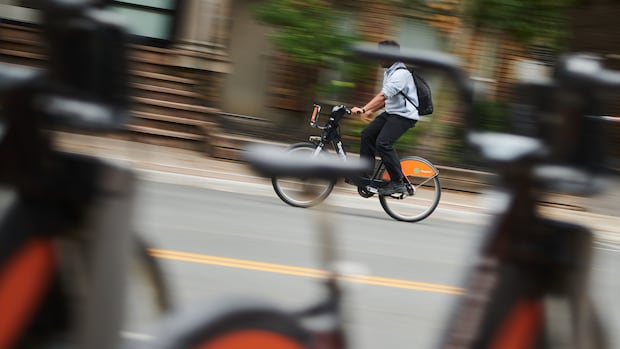
Better baskets, automatic gears: We tested out Toronto’s new e-bikes
Toronto Bike Share is testing out a new e-bike prototype. Our unofficial cyclist-in-chief Lane Harrison tested them out to see how they compare to the old ones.
Between 2013 and 2023 there were about 1,500 collisions on Portland and Dan Leckie, according to a city report about the project, including six which seriously injured or killed a cyclist or pedestrian.
City adds planters, seating to intersection
The Portland and Wellington intersection has been reconfigured with flex posts, planters and Muskoka chairs placed in the extra area that used to be road space.
“There’s ten times as many pedestrians and people cycling at the intersection of Portland and King Street on a typical Saturday night than there are people in their cars,” Popper said. “And so we really want to emphasize the public spaces.”
Commuter Digvijay Mehra was glad to see the changes after recently riding a Toronto Bike Share through the intersection during morning rush hour.
“It was a very confusing intersection before,” he said. “Pedestrians, cyclists, cars would show up and nobody knows who’s turn it is and where to go. So it helps.”
In addition to the updated intersection, there’s also a new two-way protected bike lane on Portland Street running from Queen Street W. to Front Street.
The new bike lane allows cyclists to connect with other popular bike lanes on Richmond and Adelaide streets, without needing to mix in with car traffic on a large road like Bathurst Street.
WATCH | Ontario’s internal documents say removing bike lanes may not improve congestion:
Ontario’s bike lane removal plan may not reduce congestion: internal documents
New internal documents reveal that Ford’s government is aware of many of the risks associated with removing bike lanes in Toronto. As CBC’s Lane Harrison explains, the report shows the move may not have an impact on congestion and could increase collisions for everyone who uses roads.
Rickey Wang lives nearby and said he welcomes the improvements both as a pedestrian and as a driver, because it means there are less potential conflicts to look out for when behind the wheel.
“You don’t have to look seven different ways before you cross,” he said after walking through the reconfiguration. “I feel safer.”
But like any major change in Toronto, especially those that impact people’s drives, not everyone is a fan.
“I think gridlock’s been made worse,” said nearby resident Jeremy Thomas. He disputes the city’s argument that there were issues accommodating cyclists before.
Nearby resident Melissa Wessel thinks the changes will add significant time to her drive in and out of the neighbourhood.
“If they think that there’s not gonna be traffic still and bumper to bumper traffic with this craziness, think again,” she said.
City hopes changes encourage cycling
From the city’s point of view, Popper said after safety, reducing congestion in the area is the next goal.
“When we provide opportunities for people to ride bikes, connect to transit, we overall bring down the number of people who are in their vehicles,” he said.
“That actually helps reduce congestion in a growing city like this.”
People tend to wildly misunderstand what a transportation network will be like with change, said Shoshanna Saxe, an associate professor of engineering at the University of Toronto, who specializes in sustainable infrastructure.
“For some people, this is going to feel really inconvenient,” she said.
“But for the vast majority of people, it’s going to feel like nothing or it will feel like this is much, much safer, much more convenient and much faster.”