


Listen to this article
Estimated 4 minutes
The audio version of this article is generated by AI-based technology. Mispronunciations can occur. We are working with our partners to continually review and improve the results.
Quirks and Quarks54:00Humans and animals love the same sounds, and more…
On this week’s episode of Quirks & Quarks with Bob McDonald:
How the brain can learn to truly multitask
Quirks and Quarks7:55How the brain can learn to truly multitask
How many tasks can you do at once? Like walking and chewing gum. Or watching TV and playing on your phone. The idea of multitasking, doing more than one thing at a time, has been controversial in science. Many scientists didn’t think it was possible, believing that what many consider “multitasking” is actually the brain switching back and forth between tasks. Max Reisenhuber, a neuroscientist at Georgetown University School of Medicine, says his team has mapped how our brains can pull it off, but only if we become so good at one of the tasks that it becomes automatic. Their study is in the Journal of Cognitive Neuroscience.
 A new study mapped out how the brain can multitask and handle working on two things at once. (Jaime Reina/AFP/Getty Images)Humans and animals share a ‘taste for the beautiful’
Quirks and Quarks10:39Humans and animals share a ‘taste for the beautiful’
One hundred and fifty years ago, Charles Darwin noticed that birds and humans were both drawn to bright plumage and elaborate displays, and called this interspecies esthetic appreciation a “shared taste for the beautiful.” Now, an interdisciplinary team of scientists has put this idea to the test to determine whether humans and animals do in fact share esthetic preferences — at least, when it comes to sounds. The researchers made an online game where people could pick the animal sounds they preferred, and they were surprised to find out that we generally agree with animals on which sounds were more attractive. The research was published in the journal Science.
Producer Amanda Buckiewicz spoke with:
Logan James, a postdoctoral researcher in the department of biology at McGill University, and University of Texas at Austin. Samuel Mehr, a cognitive scientist at the Yale Child Study Center in New Haven, Conn., and at the University of Auckland in New Zealand. When the túngara frog adds extra clicks and chucks to its mating call, it’s more likely to attract a mate — and, according to a recent study, it’s also more likely to be attractive to humans as well. (Kim Hunter)From the archives: The Russian space mirror that flashed across Canadian skies
Quirks and Quarks6:16From the archives: The Russian space mirror that flashed across Canadian skies
The sun is always shining somewhere, but it’s not always where you want it or need it. What if you could use a large space mirror to turn night into day? Thirty-three years ago, Russian cosmonauts tried to do just that. On Feb. 6, 1993, host Bob McDonald spoke to Vladimir Syromyatnikov, one of the Russian scientists working on the experimental mirror, shortly after it passed over Canada.
 Znamya-2 after its deployment in February 1993. The photo was taken from the Russian space station Mir. (RSC Energia/Wikipedia)The Matrix is real: birds, dragonflies and dogs see the world in slow motion
Quirks and Quarks8:25The Matrix is real: birds, dragonflies and dogs see the world in slow motion
Animals experience time in a vastly different way than humans — an ability that’s linked to the speed with which they live their lives. Animals that live in the fast lane, like dragonflies or eagles, see at a faster pace than those that dawdle, like starfish and worms. In a recent study of 237 species, spanning the entire animal kingdom, scientists looked at how quickly each processed visual information and correlated that rate with their way of life. The research was led by Clinton Haarlem, a neuroscientist at Trinity College Dublin, and published in the journal Nature Ecology & Evolution.
 Dogs’ perceive the world around them in slow motion. (DTeibe Photography/Shutterstock)Could the next giant particle collider unlock the mysteries of the universe?
Quirks and Quarks18:14Could the next giant particle collider unlock the mysteries of the universe?
Deep underground, on the outskirts of Geneva, lies the largest scientific instrument ever built. The Large Hadron Collider speeds up protons to nearly light speed along a 27-kilometre-long ring and sends them crashing into each other to create new particles, all so that scientists can make sense of the universe. Now, after nearly 20 years of operation, the discovery of the Higgs boson and several Nobel Prizes, physicists are thinking about building the next big experiment to shed light on the unknown universe. Science journalist Dan Falk helps make sense of the proposals being put forward.
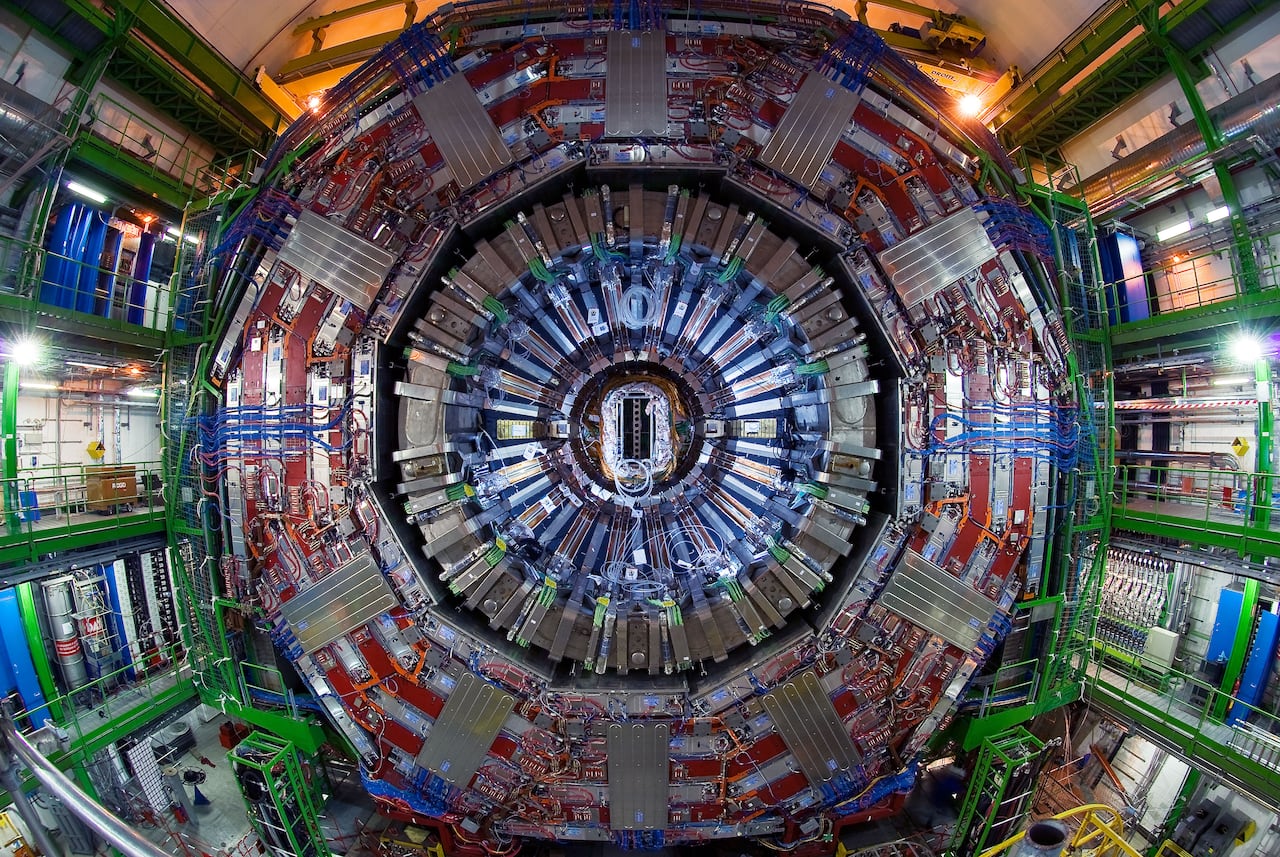 The Compact Muon Solenoid experiment is a large particle physics detector at the Large Hadron Collider at CERN. It discovered the Higgs boson in 2012. (CERN)