
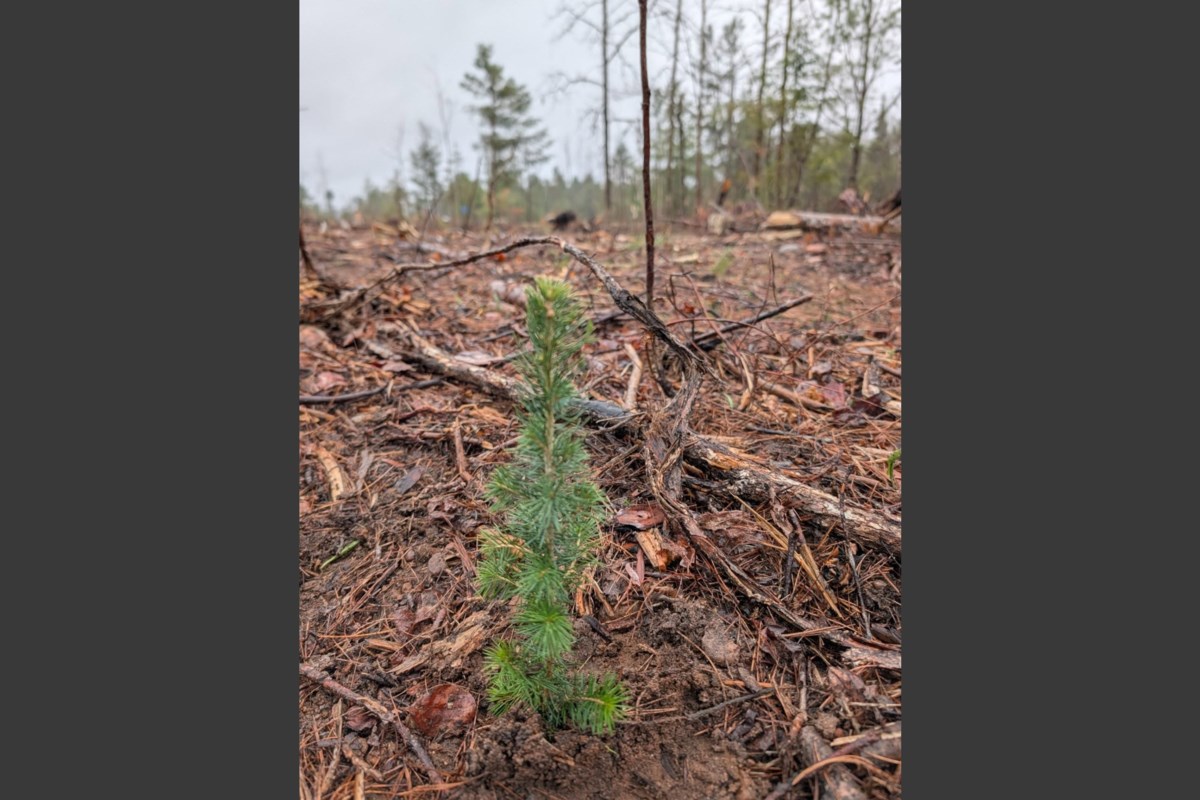
Funding for replanting harvested Crown forests in Ontario depends heavily on how much wood is cut, foresters say, creating challenges for renewal efforts during market downturns and reduced harvest levels. Back Roads Bill explores regreening efforts and issues surrounding it
A couple of things to note beyond the fact that trees are our largest plants.
On the back roads, one of the joys of spring is watching the landscape shift from white to brown to vibrant, evolving greens. It is not like a scripted play, with acts; it is natural theatre.
There are no doubt healthy forests can provide a relatively low-tech way to help offset greenhouse gas emissions and combat a changing climate.
There’s a discolouration though, underway.
When economists talk about “discolouration” or shifting colours in the economy, they are generally referring to the visible warning signs of an economic downturn, such as an economy turning away from a “healthy green.”
The forest sector has been a lifeline for communities across the country and an important pillar of Canada’s economy. In the face of unjust U.S. trade measures and climate goals, Canada’s forest industry is pivoting from traditional lumber toward a bioeconomy.
It was on February 26 of this year that the federal government took decisive action with a massive $500-million transformation fund. This will support the forest sector, protect workers and their jobs, and give companies the stability they need to weather short-term shocks and retool for a stronger, more diversified future. We have seen it in northern Ontario with a continued string of mill closures.
We quickly forget.
There’s been a cumulative effect. Recently in Nairn Centre and Gogama (Interfor) – the sawmills were indefinitely closed. In March, in Ignace, Domtar indefinitely shut down its sawmill. Also, this winter in Thunder Bay, Thunder Bay Pulp and Paper discontinued its newsprint mill operations. In the fall of 2025 Ear Falls and Kapuskasing – Interfor indefinitely idled its sawmill in Ear Falls. Meanwhile, Kap Paper narrowly averted a permanent shutdown in October 2025 following a $29-million joint bailout from provincial and federal governments. Then in January 2024, Terrace Bay – the AV Terrace Bay pulp mill remains closed.
The trend started in November 2023 in Espanola, when the historic Domtar paper mill was permanently shut down, laying off hundreds of workers. The Wawa wood pellet mill is not currently operating as a traditional manufacturing plant, having undergone several closures and ownership changes.
Just for a geography mention, there are operating mills in Hearst, Chapleau, Cochrane, Timmins, Elk Lake, Englehart, Rutherglen, Kenora, Hornepayne, Atikokan and Dryden. Depending on the size and type, there are now about one hundred remaining licensed facilities in northern Ontario.
A couple of other things though. Our forests are well managed. And we need trees and therefore tree planting.
Restoration project
I was moved to find out a little more about tree planting because of the devastating storm of June 21, 2025.
Tree planting has started within Samuel de Champlain Provincial Park (SAM) and around the Canadian Ecology Centre as part of the post-storm regreening.
And here there is a big difference in the definition of reforestation and deforestation. You will see it here on the park’s changing landscape.
Jessica Kaknevicius is from Forests Canada (FC), a national charity dedicated to “our vision of diverse, resilient, thriving forests today, and for future generations.”
She said since their rebrand in November 2024, FC have been expanding their scope to look for ways to support forests across Canada despite having delivered projects in other provinces since 2014. This includes delivering on-the-ground restoration projects. SAM is one of these because of the colossal derecho.
Forests Canada began working with Ontario Parks in 2025 by leading the restoration efforts. “We were able to mobilize quickly to source appropriate stock and find qualified planting partners to support the regreening.
She explained the impetus.
“This project came about through Professor John Pineau, who was looking for hands-on experience for Algonquin College (Pembroke) students. Because of our existing relationships in the park and the demand for support for restoration efforts, we were able to mobilize to pull something together quickly. We had stock available through our nursery partner, and because John was supervising the project, we knew that the delivery of the project would be of sound quality.”
FC supports capacity building across the planting sector – “so it was great to be able to give students a direct experience in restoration, especially as this sector continues to grow. We hope this inspired some students to continue to explore opportunities in restoration.”
I was able to interview some of the students on May 16 in SAM. In driving rain and cool temperatures, Angie St. Mars from Winnipeg said, “Yeah, it’s great to be able to come here. to come out after the storm and start planting trees so that the next generation will be able to enjoy them.”
Another student, Josh Von Dehn from Simcoe, said
“We’re planting the forest of tomorrow in a park that needs our help.” He is off to Iceland for a student placement,” said Josh Von Dehn from Simcoe, and also a student.
They are not employed tree planters; more on that occupation later in the story.
Protected areas, like parks, are critical for conservation; maintaining and stewarding these natural spaces are just as critical. Ms. Kaknevicius says, “They face a lot of pressures like climate-related events, invasive species, and daily park use. Responding to incidents and being able to restore quickly can help with faster forest recovery. Just as important is how these restored areas are fitting into the operations at parks and how they will continue to get maintained and supported.”
These projects are important, small-scale, but tree planting in the province is at a different scale.
Tree planting
‘Tis the season.
I wanted to check AI’s numbers. “Ontario’s forestry sector plants approximately 65 to 73 million tree seedlings annually to regenerate harvested Crown forests. An additional 126 to 365 million seeds are dispersed aerially. Separately, afforestation programs plant another 2.5 to 3 million seedlings yearly on private lands.” That’s a good number of trees.
The Forest Products Association of Canada says about 600 million seedlings are planted each year across the country. They also say: “The $73.6-billion-a-year forest products industry represents 12 per cent of Canada’s manufacturing GDP and is one of Canada’s largest employers operating in over 600 communities, providing 230,000 direct jobs, and over 600,000 indirect jobs across the country.” The direct and indirect jobs (logging, transport) remain important.
More fact checking. Long-time forester Scott McPherson an analyst with the First Resource Management Group, a geospatial technology company providing solutions for forest management, carbon, and wildfire risk. He explained the province’s Forest Renewal Trust (FRT).
“The FRT is a fund that is dedicated to regenerating harvested areas of Crown forests. For every cubic metre of wood harvested from Ontario’s Crown forests, a renewal fee is charged based on the species and grade of wood that is cut. When forest managers undertake renewal activities, they submit invoices to the FRT to be reimbursed for the completed renewal work.”
There are differences with the species planted.
“Higher rates are charged for species that are more costly to regenerate through tree planting, like white and red pine, and lower fees are charged for hardwood species that are regenerated naturally, such as maples, poplars, and birches. As such, the more wood that is cut, the more funds there are to regenerate areas harvested. This ensures funding is consistently available for renewal activities, which wasn’t always the case prior to the creation of the FRT under the Crown Forests Sustainability Act (CFSA) that was passed in 1994. Prior to the CFSA, funding for forest renewal came from the provincial budget, which at times was constrained by political pressures of the day, and therefore funding could be redirected to other priorities.”
Now there is a difference.
“With the FRT, funding is dedicated specifically for regeneration, and forest managers must maintain a minimum balance in the accounts for assurance that renewal obligations are met. Unfortunately, when harvest levels drop due to challenging markets and economies, such as we are in now, it is more difficult for managers to maintain that balance in their accounts. We have also seen a reduction in renewal activities and expenditures in recent years, following the lower harvest levels.”
The average expenditure over the last five years is just over $60 million, with $56 million being spent in 2024.
A large portion of this spending is directed to growing and planting tree seedlings. Over the last five years, over 64.6 million seedlings were planted on Ontario’s Crown forests, which is significantly lower than 20 years ago; and that follows the harvest trend, which has been reduced to half of what it was in 2004 (currently just over a third of the available, sustainable harvest level is actually utilized).
Scott provided a link to interesting information on planting and harvesting in the province.
Who grows the trees?
Jenny Millson does. She is deeply rooted in northern Ontario.
She is a second generation with Millson Forestry Service in Timmins, started by her parents, Sue and Dave, in 1980.
Bingo! Occasionally, you discover a source of information that makes good sense.
I was drawn to their website because of ‘How to Plant a Tree.’ (And ‘How to Build a Fire’ – but that’s another story, along with their growing of lettuce!)
But I was really attracted to ‘Forestry, another “F” word,’ one of those easy-to-understand explanations and this statement: “Being Green” – we’re not saying it’s hard, but it does take continuous effort.”
Millson Forestry has three acres of gutter-connected greenhouses. These facilities are heated and equipped with lighting, which allows for growing year-round.
Jenny said, “In general, all of our services are provided under contract – so the seedlings we’re growing have an owner. Most of these owners also provide the seed that we’re using to grow the seedlings since they need to ensure that the seedlings are suited for the areas they will be planting.”
As an example, one of the owners is the Sustainable Forest Licence (SFL) holder – Nipissing Forest. We must know that the private sector manages the forests; the Ministry of Natural Resources oversees the Forest Management Plans.
The relationship between SFL holders and the government is a heavily regulated public-private partnership. The Crown owns roughly 90 per cent of the province’s forests and uses SFLs to grant private companies long-term (up to 20 years) tenure to harvest timber in designated Forest Management Units.
“Nipissing (along with most Ontario SFLs) are clients of our seed division (extraction, cleaning, testing, storage). The landowner/manager (whether it be SFLs, crown corporations, conservation authorities, etc.) are generally making arrangements to have the cones collected (we deal primarily with conifer, so it is cones coming in.’
Their growing operations have historically focused on the propagation of containerized conifer tree seedlings. Seedling growing operations started in 1982 with 250 000 containerized tree seedlings. Annual production has expanded to 15 million trees.
Millson Forestry Service has a seed extraction plant that has been in operation since April 1996. The plant offers seed extraction (from cones), cleaning, testing (to ISTA standards), and storage. The International Seed Testing Association provides globally recognized, science-based rules and procedures for sampling and testing seeds. There are standards for just about everything.
And then something new.
She explained, “It has been identified that there is now a shortage of cone pickers. Most of the pickers we see are people who have been doing it for quite a while and are aging – we don’t see too many new pickers coming online.
“It is kind of like tree planting in that the pickers are generally paid a rate per hectoliter (a metric unit of volume and capacity equal to 100 litres) of cones collected (by the land owner/manager). It is a job that has become more difficult over the last while, with more processing at the stump harvesting taking place. With the tree-length harvest system, the cones end up at the roadside, which makes it much easier to harvest (also some species need to be picked within a specific period when the seeds are mature and before the cones open to disperse the seed). With the process at the stump, the cones are dispersed over the entire harvest block.”
Hmmm? Those seeds are important.
Seeds and certification
And so, there’s more than just planting the trees. There is also this seed certification that I tripped over.
Back to Scott McPherson.
“Tree seeds can’t be planted anywhere, from any source. There are specific seed zones in the province, and forest managers have to track where seed comes from and plant seedlings or sow seeds according to seed transfer guidelines. There is also guidance for use of seed from climate zones that could help mitigate effects of climate change, e.g., the Forest Gene Conservation Association provides recommendations of where to best source seeds based on climate change projection
“The training and certification course for seed collectors helps forest managers ensure quality standards are met for cones and seeds, and collectors are sourcing and tracking seeds properly. This is good information for Forest Stewardship Council (FSC) certification too, but not required.”
See the Forest Gene Conservation Association, a leader in forest genetic resource management. Across Ontario and Canada, there is growing recognition that successful recovery efforts must integrate genetics into conservation decision-making.
How do you know if a forest is carefully cared for?
FSC is one of the labels you look for when you go to the hardware store for your 2’ X 4’s. After the 1992 Earth Summit in Rio failed to produce an agreement to stop deforestation, a committed group of environmentalists, businesses, and community leaders joined to create a revolutionary market-based approach to improve forestry practices worldwide. It is a global network of individuals and member organizations representing environmental, social, and economic perspectives.
And on it goes from the stump to the dimensional lumber or pulp.
Who plants the trees?
George Graham knows about trees, especially little ones.
He was the co-owner of Thunderhouse Forest Services in Hearst, recently retired. For about 25 years, the company planted between 100 and 120 million trees from 1994 to 2019. That’s a lot of seedlings. And he said it is not like planting a tree in your front lawn.
I asked George a few questions.
“Bill, to your question: How is the number of trees to be planted each spring decided?”
He said the starting point is: What is the purpose for planting trees? There are many reasons to plant trees, ranging from simple to extremely complex. Is it to replace what was cut?
He first offered a basic example we can understand. “If you are replacing that dead tree on your front lawn? Then the decision might be to plant one tree. The objective is met! For a Christmas tree grower who sells 2,000 trees each December, the objective can be to replace every tree cut, so planting 2,000 trees next spring makes sense.”
Then the complexity begins; we are talking about thousands of hectares of forests with different growing conditions and species. “But for a forester who plans a reforestation program on sustainably managed public forest, the reasons are many and calculating how many to plant is complex. All of these factors are considered.”
He carried on explaining the complexity of factors with many questions.
“Maintaining biodiversity, in numbers and species of trees. Which species grew there before they were cut, or burned or blew down in a windstorm? This raises the question of how “natural’ we want the landscape to be, and what is ‘natural’ anyway?”
He said environmentalists preach the evils of monocultures, “yet monocultures exist naturally in common forest circumstances, often, but not everywhere. Do we want the same species back there, or should changes be made? “
And he said we have to think about the changing climate regarding the forest of tomorrow.
“There are the soils to think about, wildlife habitat, the inventory before harvest and then the future harvest when the forest eventually grows up. With the forestry sector in another transition, how much timber is expected to be cut when the forest grows up?
“Do we want the forest yielding timber as quickly as possible, in which case more trees should be planted instead of relying on natural regeneration? What quality of timber is desired? Tight or wide-grained, knotty (limby) or clear wood? Will there be subsequent thinning in 20 or 30 years to influence spacing? How widely spaced those trees are planted affects wood characteristics and obviously how many to plant? Spacing distances and wood characteristics often change with species.”
He said thinning may also be needed for some species on certain sites to reduce moisture stress in a warm climate.
The usual trajectory of forests is to start with a high density of young trees closely spaced together, and experience decreasing density through to maturity. He gave a boreal forest example: Jack pine can start with upwards of 20,000 trees per hectare after a fire, only to mature over decades to less than 1,000 per hectare.
There are many questions to be answered before a tree gets put in the ground.
And we haven’t even considered the cost of the logging roads transporting the seedlings into the ground. This story of July 21, 2021, tells all you need to know about these valuable back roads.
Tree Planting Underway
And finally, a quick tree planting spring update email received from forester Andy Straughan from the Nipissing Forest SFL.
“Nipissing Forest tree plant wrapped up this morning in McConnell Lake area (Thorne). There were 314,000 seedlings planted in 4.5 days with 27 planters.
He said the plantations of red, white and jack pine will be monitored with 15 sample plots at year two, three and five to record insect/mammal damage as well as tree/shrub competition to assess need for tending.”
Andy said, “Yes, 314,000 trees (white/red pine, jack pine). Site dependent. We seldom plant one species in a ‘block’. Planters are instructed to ‘salt and pepper’ the species based on microsite. Cost to plant average is $0.33/tree.
“The 314k included white pine grown from seed from southern seed zone (zone #35 Lanark area. Under the current forest management plan, the objective is to improve the resilience of the Nipissing Forest to possible effects of climate change. Supplement seed sources with up to 10 per cent seed from additional recommended climate‐appropriate zones.”
The tree planters were the Haveman Brothers; see their two-minute tree planting video.
The blocks planted were harvested in 2022 and 2023. “Most received mechanical site preparation one year post-harvest, then herbicide site preparation two years post-harvest. Some blocks include naturally regenerating red/white pine that we supplemented with planting.”
Nipissing Forest plans to plant 208,000 trees in 2027. Trees have been purchased from PRT (approx. $0.22/tree).
And there’s another cost to get the seedling into a new habitat. That breed of tree planters.
Mostly twenty-something years of age, it is an occupational culture. They view the job as a rite of passage, a way to build mental toughness, or an avenue to save money.
It is a physically and mentally demanding seasonal job. You temporarily live in tent camps with communal mess tents, outhouses, and limited running water.
You wake up in the dark, in your own tent, get ready, get on the bus, move on bumpy logging roads to a previously harvested site, plant 1,500 to 4,000+ trees in an 8 to 10-hour shift, and endure the weather, the bugs and the repeated physical strain of carrying hundreds of seedlings on undulating ground. You look forward to going to the closest small town or hamlet, at the end of the week, for some respite and the general store.
Back to George Graham, I asked him to profile tree planters.
“Profile of a tree planter, holy cow! How on earth do you characterize the hundreds, even thousands, of planters who worked for us? We started in 1994 with First Nations (FN) planters; individual and entire families. Father, mother, eldest kids (adolescents) planting. Dad and the kids would head out in the morning. After having fed her family breakfast and cleaned up the prospector tent “home,” mom would head out for a part day, leaving early to return home and make supper. We camped within walking distance of the planting sites. Buses were not needed then. Babies and babysitters in camp were common! For these planters, tree planting was as much seasonal lifestyle as it was for income.”
He said FN camps ended after the 1997 season as the number of planters was declining each year due to growing employment opportunities closer to home. “I continued to hire individual FN planters until our last season in 2019.
“In 2015 we organized our first camp of largely university students. Very different dynamic. Young, energetic, usually planted more trees in a day but very unaware/inexperienced in living and working in the bush.”
George explained about the work ethic, which is often a comment on current generations. “The best planters from a standpoint of their physical output and emotional commitment to the job were those with a healthy outlook on life, who grasped responsibility to earn a living to support themselves or their families and recognized the work for what it is; one tree at a time, physically demanding, comfort-challenging and not necessarily mentally stimulating; confident, and more so with the student planters, up for a challenge yet patient to learn despite the new hardships encountered. They have to have the ability to take in and appreciate the environment and meet new comrades and reacquaint with planter friends from previous years.”
Did we miss something?
There’s so much to know. You don’t just put a shovel in the ground.
Trees provide more. In this episode of the Backroads Bill podcast, I sit down with world-renowned botanist, medical biochemist and author Diana Beresford-Kroeger. She has spent decades studying the chemistry of trees and their direct connection to human health. We need the trees.
There are the fall colours to marvel at. There are the hues and tones of spring.
You can see this entertaining play on the back roads; just know there’s more behind these natural stage curtains. There are many actors, with lines to rehearse, who care for the new trees as they are put back into the ground – the performance continues.