
This week I caught two High-A games between the Bowling Green Hot Rods and the Wilmington Blue Rocks. Below are my scouting notes from those games.
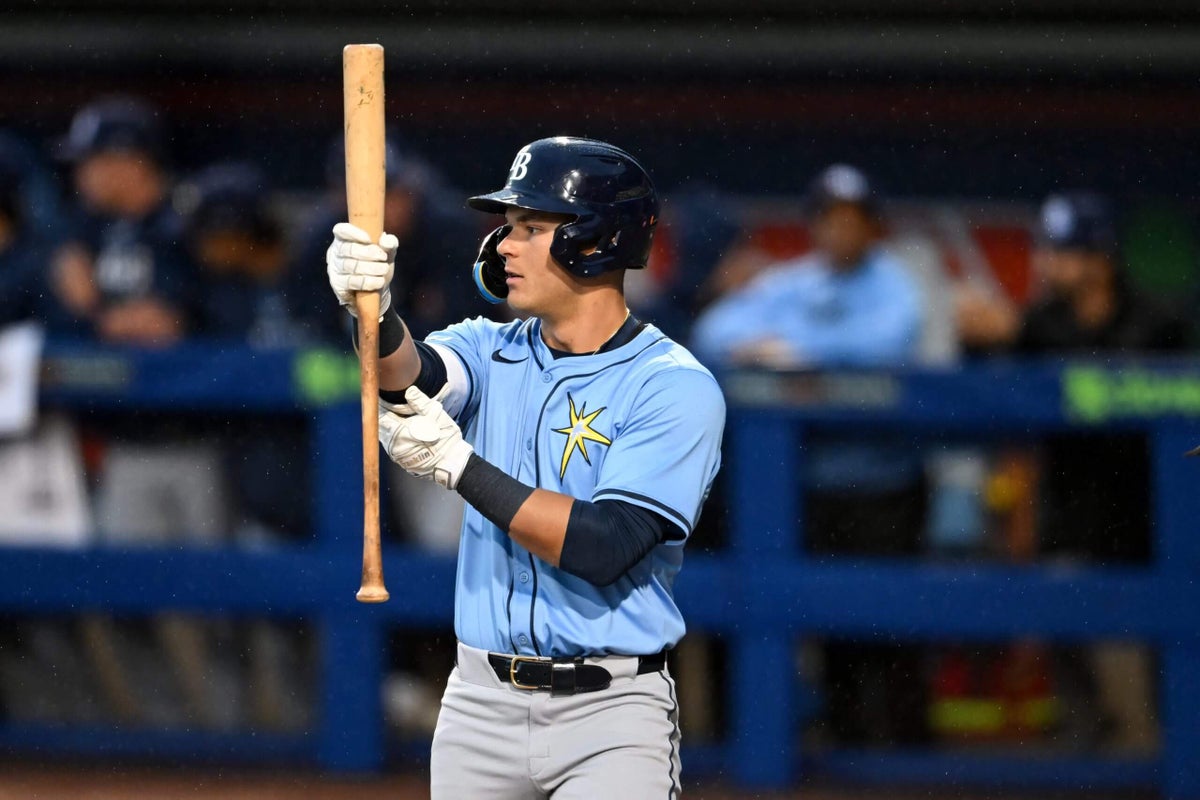
Theo Gillen was the Tampa Bay Rays’ 2024 first-round pick, back when he was a high school infielder who couldn’t throw well while recovering from shoulder surgery. He’s now an outfielder who landed at No. 27 on my most recent top prospects ranking. As of Friday, he was hitting .327/.432/.582 in High A while riding a nine-game hitting streak.
In the two games I saw, Gillen, 20, showing outstanding plate discipline and ability to foul off pitches when behind in the count. In Friday’s game, he saw 30 pitches in five plate appearances, including the last one, when he lined a first-pitch 94 mph fastball to center for a single.
His approach is really advanced, and he made visible adjustments to different pitches. He even collected a pair of hits off a lefty in the first game, which has been his big weakness this season. The swing hits that sweet spot between being short enough to get him on time to the ball and long enough to let him build up some momentum (and bat speed) before he makes contact.
Gillen played left field in one game and center field in the other, playing better than average at both spots. I didn’t get a great read on his running speed out of the box, but watching him on the bases, he’s at least a 60 (on the 20-80 scouting scale). He looks like a future All-Star, especially given how much smarter a hitter he is than any other A-ball hitter I’ve seen this season.
Sime makes his High-A debut with plenty to work on
Washington Nationals right-handed pitching prospect Miguel Sime Jr. earned some press in March when he struck out J.J. Wetherholt on a 100.8 mph fastball in the Cardinals-Nationals Spring Breakout game. He made his High-A debut for Wilmington on Friday night and continued to show that arm strength, hitting 101 once and 100 twice in three-plus innings. The rest of the package is a long way off, however.
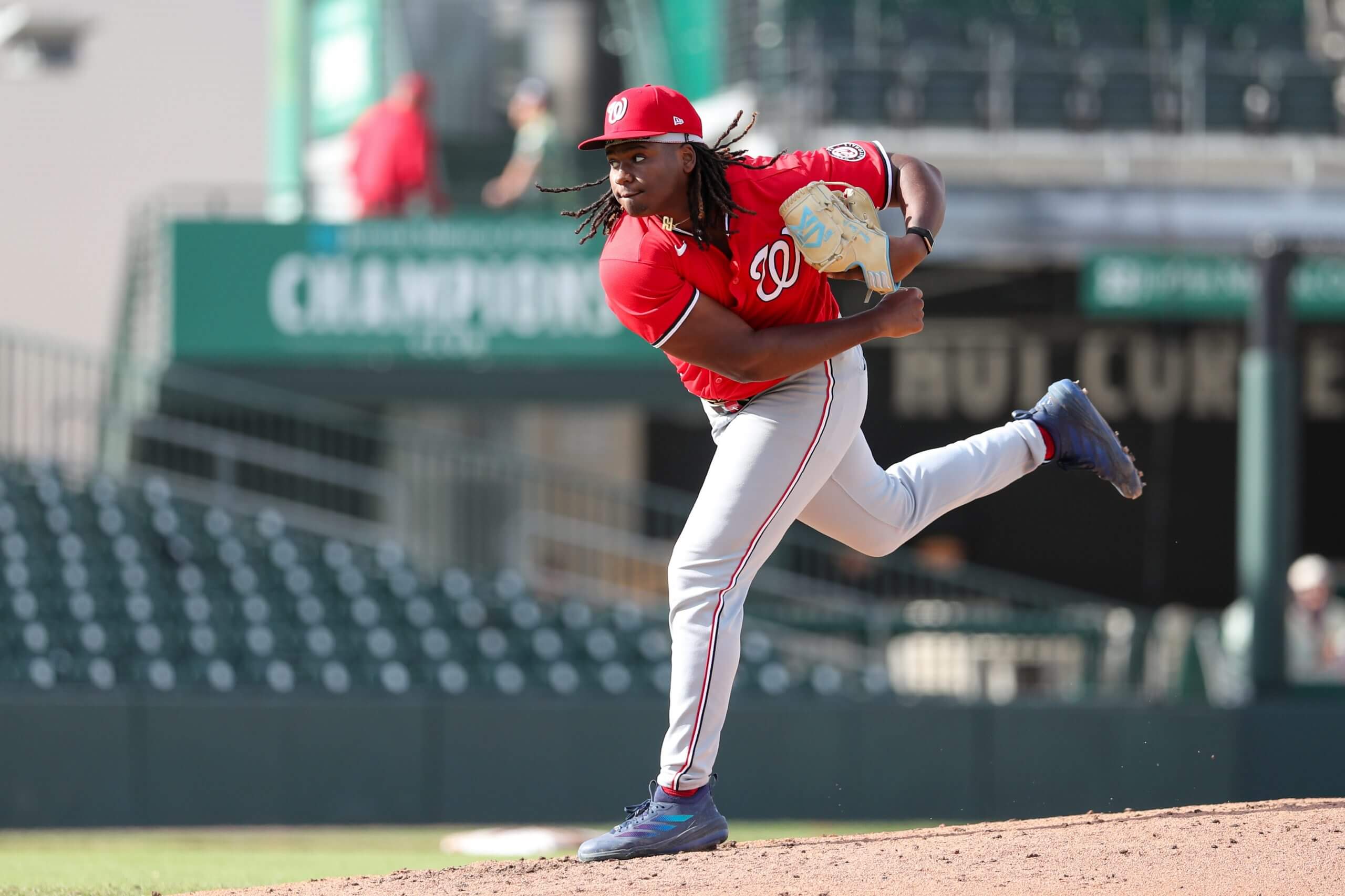
Miguel Sime Jr. has a power arsenal but needs to learn to harness his stuff and throw more strikes. (Jared Blais / MLB Photos via Getty Images)
Sime, 19, started the year in Low A, where almost two-thirds of the batters he faced either walked (21 percent) or struck out (45.4 percent), so the Nationals promoted him presumably so he’d be more challenged by better hitters. Bowling Green’s lineup is loaded and did test him, as Sime allowed five hits, matching his season high, and walked two in 3 2/3 innings.
His four-seamer ranged from 95 to 101, mostly sitting 96 to 98. He showed three off-speed pitches, with none of them better than average. Sime has a changeup that he throws hard, so the arm speed is good, although its movement is just fair. His vaunted slider was below average, and he had no feel for it, faring better with his low-80s curveball, which has the power of a slider or slurve but curveball shape and appears to break downward very late.
Overall, however, his biggest issue is throwing strikes, and I think a lot of that is the delivery and the whole style of pitching. This is all power, all the time, like you typically see in a reliever. He comes from a high three-quarters slot, and his arm is always fighting to catch up to his front side, with his front shoulder still tilted skyward when his front foot is planted, so he’s coming back uphill and then trying to get the ball back down into the zone.
Before the Nationals took him in the fourth round last year, paying him an over-slot bonus of $2 million, I believed he was going to end up in the bullpen because of the delivery, the lack of athleticism and the reliance on velocity. What I saw Friday doesn’t change that evaluation. (As an aside, I can remember only one minor-league pitcher walking batters at this rate and ending up a good big leaguer. Craig Kimbrel walked 22.8 percent of batters he faced in High A, in 26 innings, and that same year walked 16 in 10 1/3 Arizona Fall League innings. He was in the majors the following June.)
Scouting Rays prospects Nathan Flewelling, Trevor Harrison and more
On Friday, Bowling Green started right-hander Trevor Harrison, who is still building back up after missing two starts with some minor arm soreness. He topped out at 98 and sat 93-96, going three innings and 45 pitches while working entirely sinker/slider. The slider ranged from 86-90, and I believe he threw a few cutters up to 92, although that may not have been intentional. The 20-year-old flashed a changeup in warmups but I didn’t see one in the game (I was up the line for a few batters to watch the delivery, so I may have missed one).
There are starter ingredients here, but first and foremost he has to get out of the heart of the zone — he gave up way too much hard contact for this stuff, especially the fastball, and struck out only one of the 12 batters he faced because neither pitch was really getting chases or good enough to get whiffs when he was middle-middle. I’m also mindful that he threw only one inning in a game the previous 26 days, so this probably wasn’t his best.
Bowling Green shortstop Adrian Santana, 20, is noticeably stronger, which makes a huge difference in his outlook; he’s always had the plus-plus defense and a high-contact approach, but the question was whether he’d hit the ball hard enough consistently enough for it to matter. Before this year he looked as if he might be Nick Madrigal-type with 70 defense at short, which is a big leaguer, but probably not an everyday shortstop on a contender.
Santana still probably tops out at 45 power — he did homer Tuesday, which is funny given how much of a pitcher’s park Frawley Stadium is — but I’m more inclined to see him as an average or better hitter with this extra strength. He came out of Friday’s game after he slid into second base on a successful steal attempt and collided with the second baseman and was placed on the injured list on Saturday.
Nathan Flewelling landed at No. 47 on my latest prospect rankings. The Rays catching prospect was hitting .262/.373/.494 through Friday with plus defense so far even though he’s 0-for-June right now (15 plate appearances and five strikeouts). The 19-year-old looks like the archetypical big, power-hitting catcher, 6 feet 2 and broad, with above-average bat speed and a good eye at the plate.
Defensively, he has arm strength and is a very quiet receiver and blocker, faring better than Caden Bodine did, although Bodine caught a better arm. Flewelling had the night off the second game I attended.
Bodine, who started the year in Low A, was DH in the first game I saw and caught the second, which gave me plenty of at-bats from both sides. He was rougher behind the plate catching Harrison, bouncing two throws to second and having a harder time blocking some breaking stuff in the dirt. He has a very short, quick swing, even homering once batting left-handed off a 91 mph fastball. He showed his usual propensity for contact; he’s struck out 10 times all season in 216 plate appearances, and struck out once in these two games — looking, of course.
The Rays acquired Bodine, 22, from the Baltimore Orioles in the Shane Baz deal this winter. When the Orioles took him with the No. 30 pick last year, the report on him was that he was an excellent defender, so if I just got an off night behind the plate, he would easily be an everyday player with this bat.
The Rays took Émilien Pitre in the 2024 second round after he’d posted very strong results, including hard-contact data, as a second baseman at Kentucky. His full-season debut (début?) in 2025 was disappointing, as he had just a .393 slugging percentage as a 22-year-old SEC product in High A. He’s repeating Bowling Green, so there’s a big caveat to some of the improvements, but through Friday, the now-23-year-old is hitting .296/.422/.420 with 35 walks and 21 strikeouts. All I saw from him in two games was hard contact with good adjustments to different pitch types. He really ought to be in Double A — and there’s no one blocking him there.
Scouting Nats prospects Devin Fitz-Gerald and Yeremy Cabrera
Nationals infield prospect Devin Fitz-Gerald, 20, went off in early May, hitting eight homers in 10 games despite not being very big or making particularly hard contact. Since the end of that stretch, he’s hit .172/.250/.259 with just a single homer — playing home games at Wilmington doesn’t help, as the park is on the riverfront and the ball doesn’t carry here — and as I write this is in the midst of an 0-for-15 stretch.
I think he’s pressing a little bit to try to hit for power he doesn’t really have, as he’s swinging very hard but is frequently off-balance after he plants that front foot. I still believe he’s going to hit, and having seen him at three positions now I’d put him at second base (eventually), where a 55 to 60 hit tool with average power would make him at worst a strong regular.
I also got a first look at outfielder Yeremy Cabrera, who came to the Nationals with Fitz-Gerald in the MacKenzie Gore trade. The 20-year-old was promoted to High A in late May after he tore up Low A to a .333/.465/.649 line. He misread a fly ball in center in the first inning and then had a bad read on the bases, thinking a ball was gone and having it end up staying in the park for a double, which resulted in him getting thrown out at the plate.
He has a very wide setup at the plate that gets wider when he strides, and he leaks over his front side when he swings. He does have bat speed, but that’s about all I saw on the plus side of the ledger.