
‘These days, the laws themselves are being dismantled by the Ford government, not to make better laws, but simply to make them go away,’ says columnist
Well, there you have it: nothing to see at the Inch Farm folks.
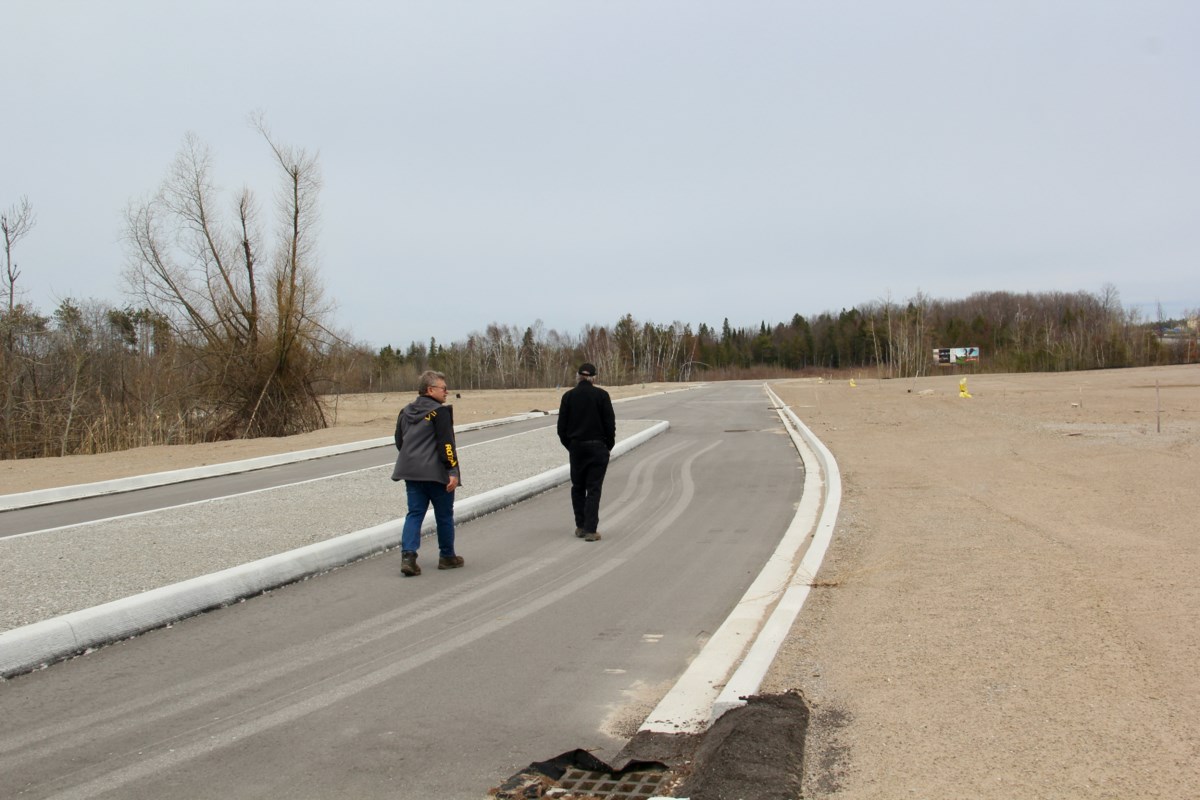
The federal department of Fisheries and Oceans (DFO) spent a little time at the LIV Developments site, where a retention pond failed twice a few months ago, spewing so much sediment that it completely filled in a cold water trout stream for about half a kilometre.
The feds had a look and could find no fish habitat under the mud where the stream used to be, so no problem. Perhaps their tour was accompanied by a quick look at an environmental assessment paid for by LIV.
There does not seem to have been any consultation with Bob Bowles, who knows the site intimately, and who has served as an expert witness on uncounted environmental hearings because of his widely-recognized expertise.
He would have been able to tell them unequivocally that yes, there was fish habitat lost. It’s almost inconceivable that fish habitat adjacent to the disaster site won’t be impacted as well. Unlike bureaucracy, ecosystems don’t operate in neat little boxes on a computer form.
So valued was Bowles’ local scientific ecological knowledge that he had to watch “remediations” from an adjacent property. In the first days of the work, Bowles reports that there has been no restoration. The stream flow is blocked. Mud and sediment were not removed, but rather smoothed over, he says. He doesn’t expect the stream will be restored based on LIV’s past record.
What about the provincial regulations that apply to the LIV disaster? The Ministry of Environment, Conservation and Parks (MECP) has called for better erosion and sediment controls and will monitor “restoration” of the stream.
Apparently there will be no charges and no fines, though the orders clearly show there were violations.
In an earlier column, I predicted that outcome despite the numerous environmental laws designed to address just this sort of situation. I am sad to be proven correct. But I wasn’t consulting a crystal ball when I wrote that there would be no consequences; I was relying on past experience.
During my 14 years working in the environmental sector, I lost count of the number of times a developer or a private landowner violated the standing laws intended to protect our wild places with few or no consequences.
Those charged with applying the laws seem to bend over backwards to find a way not to charge someone who damages a wetland or a river or a forest or a grassland or the habitat of an endangered species. There seems to be a general embarrassment about enforcement. Certainly there is a culture of gentle compromise.
These days, the laws themselves are being dismantled by the Ford government, not to make better laws, but simply to make them go away.
The LIV Development fiasco puts the process on display for the general public.
The net result is habitat loss.
The Ontario auditor general reports that southern Ontario lost 4,500 acres of wetland every year between 2011 and 2015, an annual rate of loss that is three times higher than it was between 2000 and 2011. Things have no doubt progressed merrily since 2015.
Considering there is almost nothing left of the original volume of wetlands in the province, that number is astounding.
Like the missing cold water stream in Orillia that will not be coming back, the evidence that our laws are either gone, or not working, or not being enforced is there for anyone to see.
Mark Bisset spent the past 14 years of his working life as the executive director of the Couchiching Conservancy before retiring in 2024. In a previous iteration of himself, he worked in every news department at the Orillia Packet & Times, a daily newspaper from a bygone era. Mark was the managing editor when he stepped down in 2009. And before all of that, he was a pretty happy kid. He’s a lifelong sailor and gardener who has chosen Orillia as his beloved home for the past 38 years.