
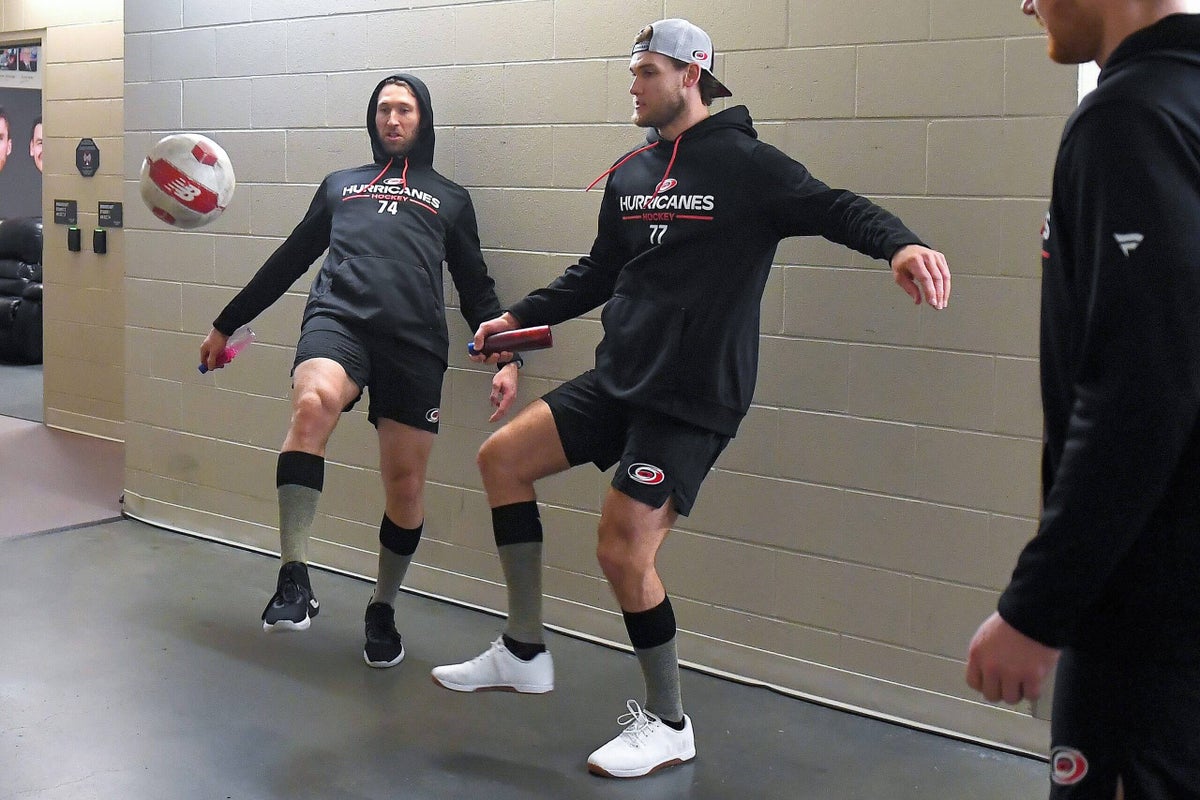
LAS VEGAS — In the leadup to one of the most exciting games of the 2025-26 NHL season, a pressure-packed showdown in Game 3 of the Stanley Cup Final on Saturday night that included a four-goal comeback and ended in double overtime, both hockey teams found space in the bowels of T-Mobile Arena for a different sport.
Near a door leading to a loading dock, a group of players on the host Vegas Golden Knights — including forward Mitch Marner, who went on to score a regulation hat trick in a 5-4 win — stood in a circle and kicked around a soccer ball. The bouncing sound of their passes carried around the curtained-off area, followed by shouts whenever the ball hit the ground. Elsewhere at event level, about an hour and a half before puck drop, members of the Carolina Hurricanes were doing the same thing, some for the second time that day; they’d also broken out a soccer ball at their hotel before a team stretch that morning.
As kickoff to the 2026 World Cup approaches this week in North America, soccer fever is spreading across the globe. For many NHL players, the sport is on their minds throughout the entire season. Whether it’s before an exhibition game or one of the biggest of their lives, their version of soccer, often referred to as sewer ball or two-touch, is a staple of warmup routines around the league.
“As high-pressure as the NHL is, as highly different of a game (as) soccer to hockey is, you kind of get your mind a little off (that day’s) game,” New Jersey Devils defenseman Brenden Dillon said. “You get the juices flowing, get a good sweat going.”
Different teams run slightly different variations of the mini-game, but it usually looks like this: Before on-ice warmups, players in workout clothes gather in a circle and volley the ball with their sneakered feet, trying to keep it in play as long as possible. When the ball hits the ground, the player at fault is eliminated. As one of its names suggests, a maximum of two consecutive touches are allowed by any one player; a third touch also means elimination.
For Nick Bonino, now a Pittsburgh Penguins assistant coach after a 15-year NHL career, pregame sewer ball is one of the things that he misses most about his playing days. The competition level can be high despite the low stakes, leading to crazy bounces off arena walls and balls sometimes getting stuck in ceiling nooks.
“It’s the best part of the day,” the two-time Stanley Cup champion said. “You end up playing it 80 times a year, hopefully more in the playoffs. You get your blood boiling, you have rivalries with guys. Sometimes I wouldn’t even talk to guys during the game, I was so mad at (them).”
Hence Carolina and Vegas players breaking out the soccer ball before their postseason games. But that’s nothing new: Martin St. Louis, Vincent Lecavalier and the 2004 Tampa Bay Lightning, for instance, played frequently during their Stanley Cup run.
“It’s a time killer, a mental reset,” former NHLer Ryan Carter said. “Some guys throw a football around, some teams have basketball hoops up. But it’s mostly soccer. It’s a way to get loose before the game instead of being up tight and focused.”
“I think it unites the team,” current Lightning forward Yanni Gourde added.
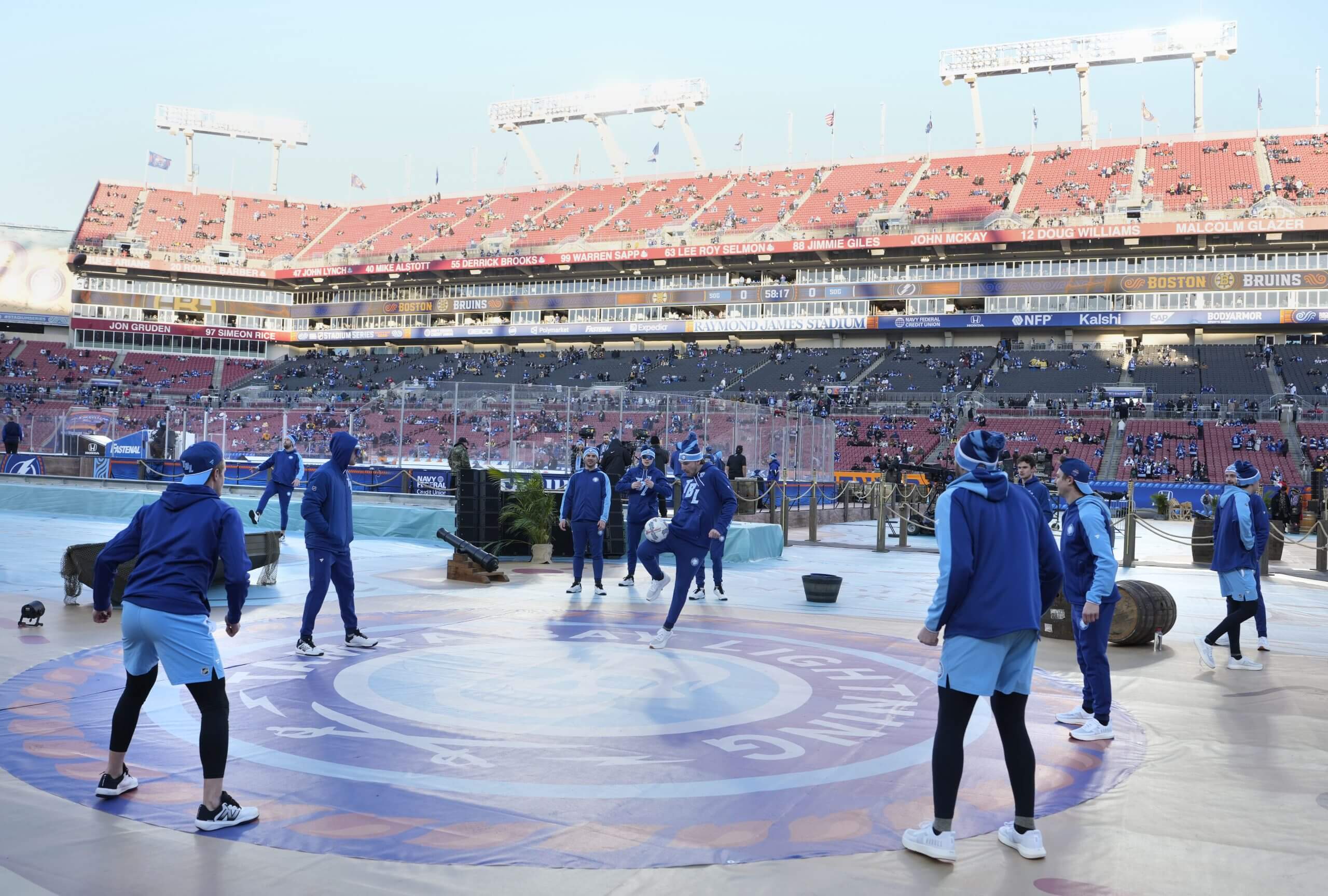
Whether in the bowels of stadiums or under open skies at outdoor games, soccer is an NHL staple. (Christopher Mast / NHLI via Getty Images)
Dillon estimates that upwards of 10 Devils players regularly participate, as did most of his Sharks teammates from his time in San Jose. But warmup soccer isn’t for everyone. Calgary Flames forward Ryan Strome, a veteran of 916 games, doesn’t kick around with his teammates. “I have two left feet,” he said.
It also comes with significant risk. Dillon always exercises beforehand— high-knees, band work, foam rolling — to activate his body and “make sure I’m not one of the sad stories of a guy getting injured in soccer before the game.” There are plenty: Michael Grabner broke his ankle with the Canucks in 2009, and Bonino told the Athletic that he ripped his hamstring 90 percent off the bone with the Anaheim Ducks in 2012-13 when his heel slipped while he was lunging for the ball.
“Guys were nervous to play for the next month, but guys got back to it,” said Bonino, who wound up missing six weeks but still dressed the night of his injury and sat on the bench for the first period, as the Ducks didn’t have an extra forward and didn’t want their opponent to know they were shorthanded. “Guys have broken toes and gotten concussions from hitting their head on the wall trying to head a ball. It always has its danger. But it’s always so much fun, nobody is going to stop.”
The next generation of NHL players can testify to that. Defenseman Chase Reid, a projected top-10 pick in this summer’s draft, said soccer helps him get his hips loose and warms up his hand-eye coordination. When with the Bismarck Bobcats in the junior-level North American Hockey League in 2024-25, he and his teammates developed a routine: Whoever was eliminated first had to dance in the middle of the circle.
“I think it’s just fun to be with the guys and chirp guys when they get out, mess with everyone,” Reid said. “It’s what I do before every game. It’s like a ritual for me now.”
The Devils’ Dillon, now a 35-year-old veteran, remembers feeling excited when he turned pro in 2011 and saw that soccer wasn’t only played at the junior level. Since then, he’s missed an occasional sewer game while working through a lower-body injury, but estimates he’s been in 90-95 percent of the ones available to him.
“There’s something to it,” Dillon said. “Whether you come for one game or you come to play 35 minutes, at least you’re around the guys and having some fun.”
— Sean Gentille contributed to this report.