
Scientists have finally spotted a powerful wind blowing out of the giant black hole at the centre of our Milky Way, and it’s big enough to carve a tunnel through the gas around it.
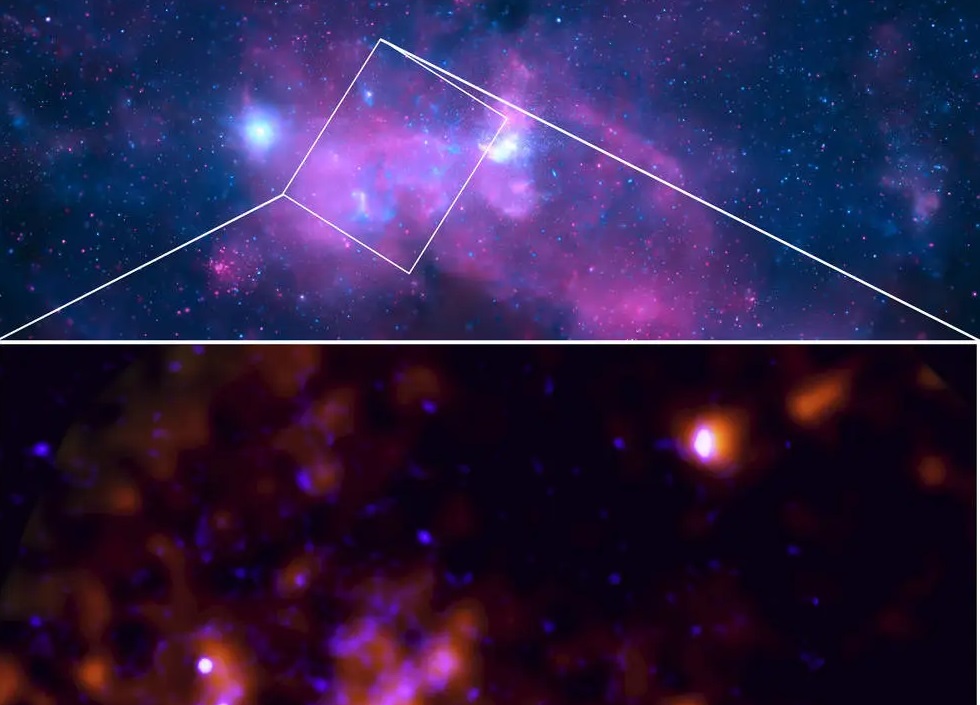
A Quiet Giant That Isn’t So Quiet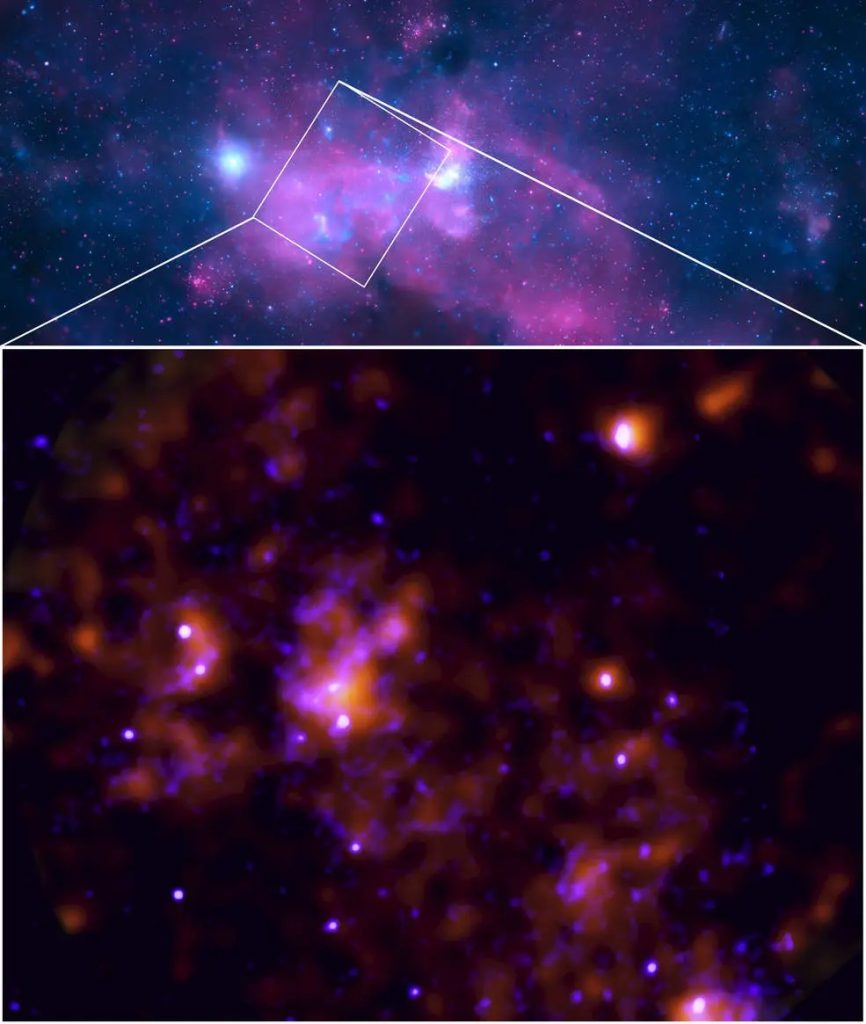 X-ray data of the area around Sagittarius A*, the supermassive black hole at the core of the Milky Way galaxy. Credit: IXPE: NASA/MSFC/F. Marin et al; Chandra: NASA/CXC/SAO; Image Processing: L.Frattare, J.Major & K.Arcand
At the heart of our galaxy sits a supermassive black hole called Sagittarius A*, or Sgr A* for short. For years, astronomers thought it was mostly “sleepy” compared with the monster black holes in other galaxies that shoot out bright jets.
But a new study in The Astrophysical Journal shows Sgr A* is blowing a large, hot wind after all; we just hadn’t seen clear proof of it until now. Think of it like discovering your very quiet neighbour has been running a huge fan in their backyard the whole time.
How Do You “See” an Invisible Wind?
Black hole winds themselves are made of very hot, thin gas, so they’re hard to see directly. Instead, the team used the ALMA telescope in Chile to look at colder gas around the black hole – gas that’s about 100 degrees above absolute zero, still cold by space standards.
They combined several years of highly detailed observations to map this cold gas in 3D, including its velocity. Then they asked a simple question: if a strong wind is blasting out of the black hole, what would it do to this cold gas?
A Cone‑Shaped Hole in Space
The answer: it should punch a hole through it. And that’s exactly what they found. In their maps, the scientists saw a huge cone‑shaped clearing in the cold gas near the black hole, with almost no cold gas inside it. This cone is about 1 light‑year long and shaped like an ice‑cream cone with a 45° opening angle. It is also aligned in a direction that matches other hints of outflows from Sgr A*.
Outside the cone, the gas looks normal and rotates around the black hole like a mini ring or disk, called the circumnuclear disk. Inside the cone, the cold gas is simply missing – as if a powerful space hairdryer has been blasting it away. The team also compared their map with X‑ray images of hotter gas and found that hot and cold gas avoid each other in just the way you’d expect if a hot outflow is carving a path through cold clouds.
Why This Matters for Our Galaxy’s Future
Every large galaxy has a giant black hole in its centre, and these black holes can strongly influence how their galaxies grow by heating up or pushing away gas that could form new stars. Until now, we didn’t have a clear picture of what our own black hole is doing right now.
This new result shows that even in its quiet phase, Sgr A* is actively blowing away gas around it. That makes our galaxy a nearby laboratory for understanding how black holes and galaxies grow up together.