
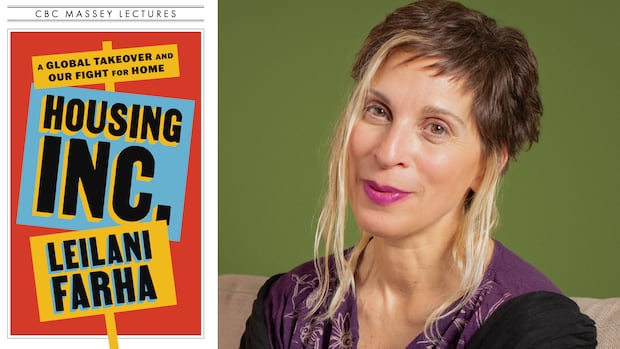
LISTEN | Fighting for housing as a human right and a place to call home:
Ideas8:39Confronting ‘Housing Inc.’ | Meet the 2026 CBC Massey Lecturer
In the midst of a worsening global housing crisis, our homes have been stripped of their essential humanity and treated like “toys” for the world’s biggest industry, says 2026 CBC Massey Lecturer Leilani Farha.
“Home is required for human existence and for life itself…. It’s essential to human dignity, to security,” says Farha, who served as the UN Special Rapporteur on the Right to Housing from 2014 to 2020.
“Home is really everything.”
But over the last half-century, our homes have become something else: a commodity.
“There are a whole bunch of actors — financial firms, pension funds, private equity firms, even governments — who view housing almost like a toy. Something to be played with, but with big monetary gains at the end,” says Farha, global director of The Shift, an international human rights organization focused on housing, finance and climate.
Her Massey Lectures are called Housing Inc.: A Global Takeover and Our Fight for Home.
“Together, this alliance has turned our homes into an asset class, and quite frankly, the biggest business in the world,” she told IDEAS host Nahlah Ayed.
“The global value of residential real estate has reached about $287 trillion US — the largest store of wealth on earth,” she writes in her lectures.
“More than 10 times the value of all the gold ever mined, and more than twice the total of the world’s gross domestic product.”
WATCH | Leilani Farha describes how the housing industry became big business:
Your home is part of the world’s most lucrative industry
This fall, Leilani Farha will deliver her CBC Massey Lectures in five cities across Canada. She served as the UN Special Rapporteur on the Right to Housing and is the global director of The Shift.A new empire
Housing Inc. describes this as a new empire — one driven by the same imperial logic of displacing people deemed inferior and turning their former homes into sites of wealth extraction.
“Financial firms approach housing the way mining companies approach ore deposits, identifying valuable sites and moving in to extract maximum value. The existing residents are seen as obstacles to profit,” she argues.
Today, she points out, algorithms are increasingly used to identify what the industry terms “undervalued assets.” Often these are buildings where long-term tenants pay affordable rents, because they represent the biggest gaps between current and potential profits.
Once those buildings are purchased by a financial firm, the existing tenants are displaced and the building is “repositioned.”
“The language that they use is quite chilling, actually. They say they want to remove ‘legacy tenants’ and replace them with ‘higher-quality tenants,’” she told Ayed.
“The wealth extracted by financial firms flows to international shareholders whose earnings sit in offshore accounts, much like the empires of old that extracted goods and resources from their colonies to ship back to the ‘mother country,’” she writes.
Changing the national conversation about housing
This fall, Farha will deliver her CBC Massey Lectures in five cities across Canada, following in the tradition of past lecturers such as Tanya Talaga, Margaret Atwood and Stephen Lewis.
The book version of Leilani Farha’s lectures will be published by House of Anansi Press in September.
Tickets for the five lectures go on sale in July
Sept. 8, Koerner Hall, Toronto, ON
Sept. 12, Neptune Theatre, Halifax, NS
Oct. 1, Northern Arts and Cultural Centre, Yellowknife, NWT
Oct. 22 and Oct. 23, York Theatre, Vancouver, BC
Oct. 29, National Arts Centre, Ottawa, ON
Farha told Ayed she hopes to spark conversations about more than just housing policy.
“Home has been turned into a power struggle, and it is very revealing of who counts in this world and who doesn’t,” she says.
She argues we need to focus on what human beings need from housing — not what investors want.
“If we can hear more from the people actually affected, I think that will naturally change the conversation,” she told Ayed.
“It’ll be less about metrics and return on investment and profitability, and it’ll be more about human existence, the desire for dignity, and for just a place to call home.”
Since 1965, CBC IDEAS has broadcast the Massey Lectures, exploring the ideas that make us who we are. The lectures are a partnership between CBC, House of Anansi Press and Massey College in the University of Toronto. For more, visit the archives.