
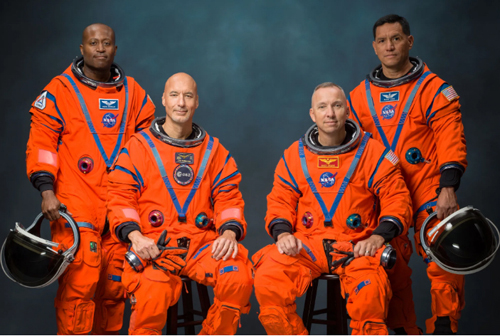
 Artemis III crew official portrait (from left): Andre Douglas, Luca Parmitano, Randy Bresnik, Frank Rubio. [Bill Stafford / NASA]

Wednesday June 10, 2026 | HOUSTON, TX [Posted in VICTORIA, BC]
by Mary P Brooke | Island Social Trends
NASA has announced the four Artemis III crew members for their mission to the Moon.
Crew assignments are:
A backup crew member was also announced: NASA astronaut Bob Hines.
One of the crew members is from Italy and the others are American.
Artemis III crew official portrait (from left): Andre Douglas, Luca Parmitano, Randy Bresnik, Frank Rubio. [Bill Stafford / NASA]
On the heels of Artemis II:
The previous Artemis II mission from April 1 to 10 had three US astronauts and one Canadian astronaut (Jeremy Hansen).
That mission was primarily to test the performance of the Orion space capsule and various other technologies for surviving and performing in outer space, including communications with Earth.
The goal for Artemis III is to help the agency prepare to send the first astronauts to Mars.

Steps forward:
Artemis III is about taking another step toward one of the most complex human spaceflight missions in recent history, said NASA on June 9,
The mission will undertake a series of challenging tests in Earth orbit in 2027, essential for Artemis IV, the first planned crewed mission to the lunar South Pole in 2028.
During Artemis III, the agency’s SLS (Space Launch System) rocket will launch the Orion spacecraft and its crew from NASA’s Kennedy Space Center in Florida to low Earth orbit.
After Orion systems checkouts, the spacecraft will, for the first time, demonstrate rendezvous and docking capabilities with test versions from one, or both, American commercial human landing systems in development by Blue Origin and SpaceX.
“This highly choreographed mission includes a dramatic multi-launch campaign of the world’s most powerful rockets, testing integrated hardware between Orion and the landers, including system interfaces, software, propulsion, and communications,” says NASA.

Artemis III will do this:
Artemis III includes launching the world’s most powerful rockets in short order. Blue Origin’s lander pathfinder, which is able to stay in orbit for multiple weeks, will launch first and await the crew. NASA will send the astronauts aboard Orion by SLS to orbit Earth, before rendezvousing in space with the company’s lander test article and spending about two days docked together for tests and technology demonstrations, including entering the lander.
After completing docked operations with Blue Origin, Orion will detach and await Starship. SpaceX’s Starship pathfinder will launch and meet up with Orion to spend about a day connected for checkouts and testing. After that, Orion and its crew will undock and return home, splashing safely down in the Pacific Ocean where a team from the U.S. Navy and NASA will recover the astronauts.
In total, the crew is expected to remain in space for about two weeks, with exact mission length to be determined in real-time based on launch, rendezvous, and docked operations.

Moon base setup:
Moon base setup will be done in three phases, as announced May 26.
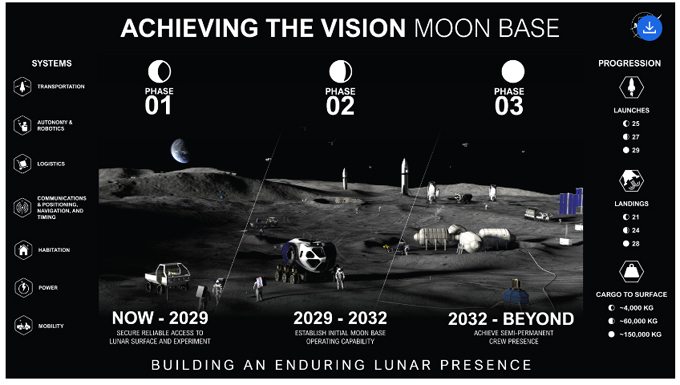 Vision for achieving the NASA Moon Base. [NASA / May 2026]
Golden Age:
As part of the Golden Age of innovation and exploration, NASA says it will send Artemis astronauts on “increasingly difficult missions”.
Those missions will be to explore more of the Moon for scientific discovery, economic benefits, establish an enduring human presence on the lunar surface, and to build on our foundation for the first crewed missions to Mars.
 Reliable informative news through professional journalism. Local, provincial and federal news and analysis posted daily at IslandSocialTrends.ca
===== RELATED: