
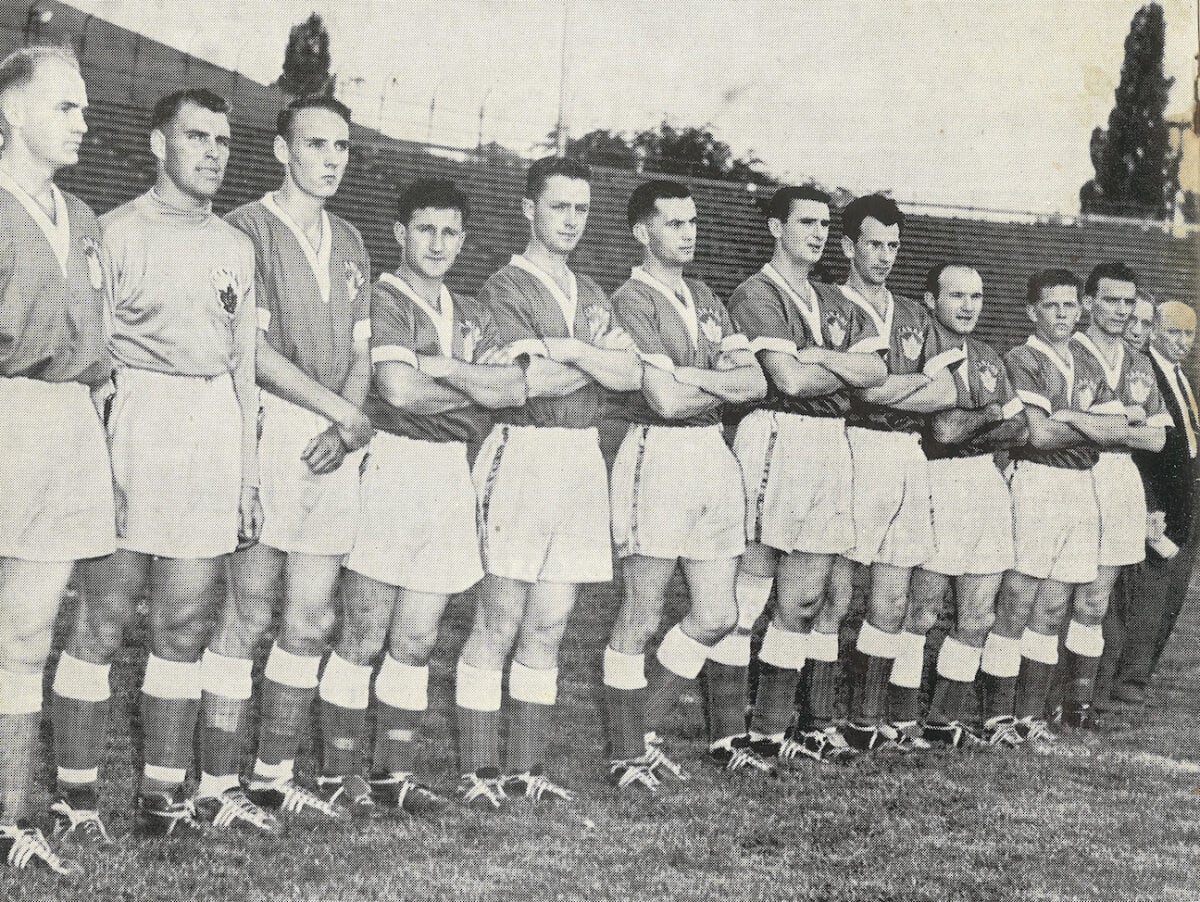
Canada won 5-1 against the United States in its first-ever World Cup qualifying match, on June 22, 1957, at Varsity Stadium in Toronto. Unfortunately, Canada would lose to Mexico twice in its next two matches and fail to make the tournament. The team wouldn’t qualify for a World Cup until 1986. This year marks only the third time Canada’s men will play at a World Cup, following the team’s participation in 2022.
Since its earliest days, one challenge to the success of soccer in Toronto, and most of Canada, is that it’s a challenge to play outside year-round — though a report in The Globe (the predecessor to The Globe and Mail) from 1877 describes one especially motivated team who practised “all winter on the snow.” Soccer also had competition from already-popular summer team sports, like cricket and lacrosse, just as it does now from basketball and baseball.
Another Globe article, a year later, predicted that “though [soccer] is not at all likely to become a national game in any sense of the word, there is a strong probability of its obtaining a firm foothold here.”
But Scott thinks things are shifting. “The game [in Canada] has changed by leaps and bounds,” he says. He adds that “the momentum has really been there the last 20 years,” citing the 2007 men’s under-20 World Cup, which Canada hosted, as a major milestone. That tournament featured players who would go on to be global superstars, like Sergio Aguero, Angel Di Maria and Luis Suarez. But most important for Canadian soccer was the construction of BMO Field in Toronto, which was built for the tournament and held the final. The stadium has also been the home of Major League Soccer team Toronto FC since its inception in 2007.