
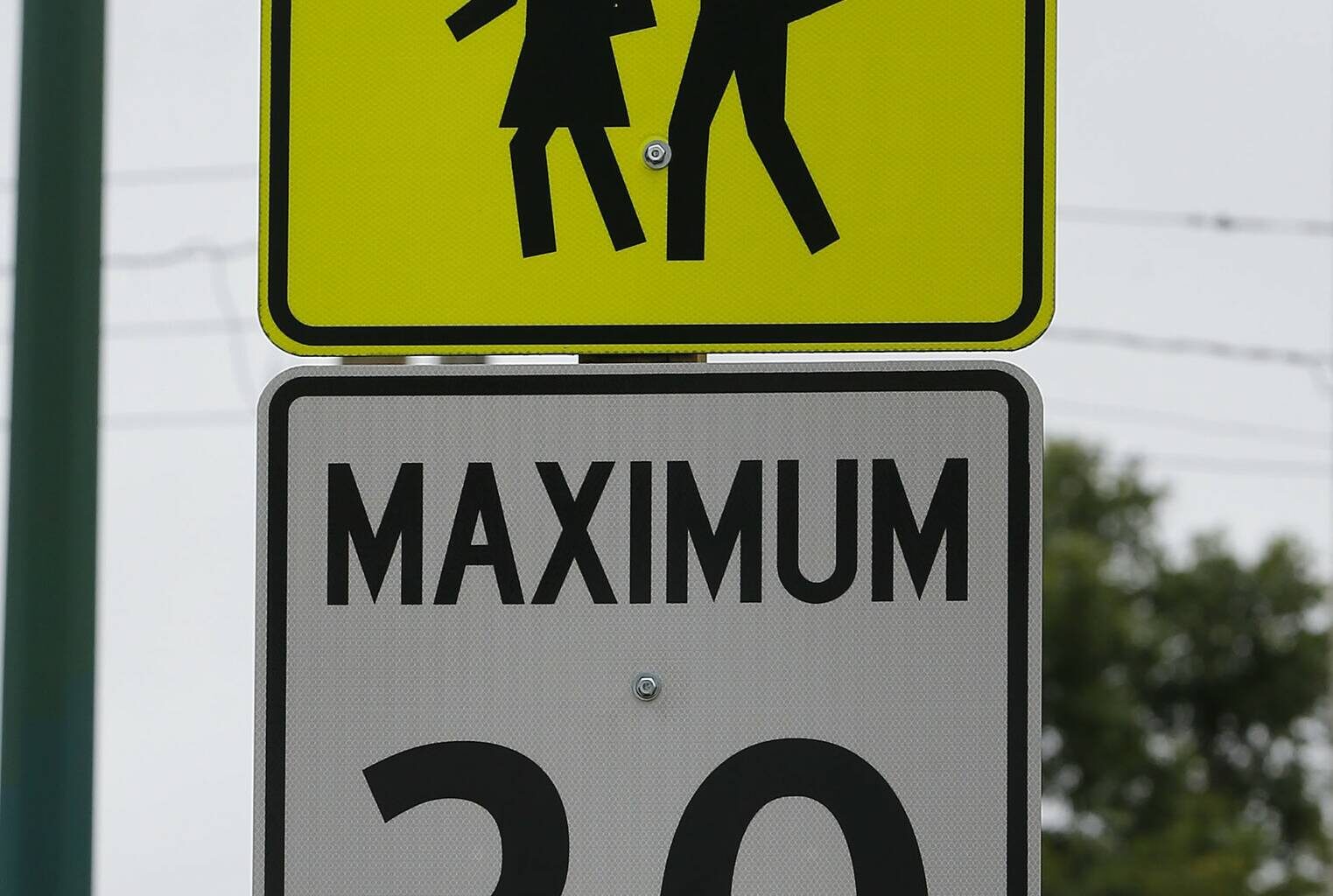
The City of Winnipeg will study whether to expand its 30 km/h school zone speed limit to additional residential streets, or even busy regional roads.
City council’s public works committee has directed staff to review those options with the goal of calming traffic and allowing safer travel for kids.
Mayor Scott Gillingham said he’s open to studying the idea but, at first glance, doesn’t believe a 30 km/h speed limit would be a reasonable fit for regional roads.
MIKE SUDOMA / FREE PRESS FILES
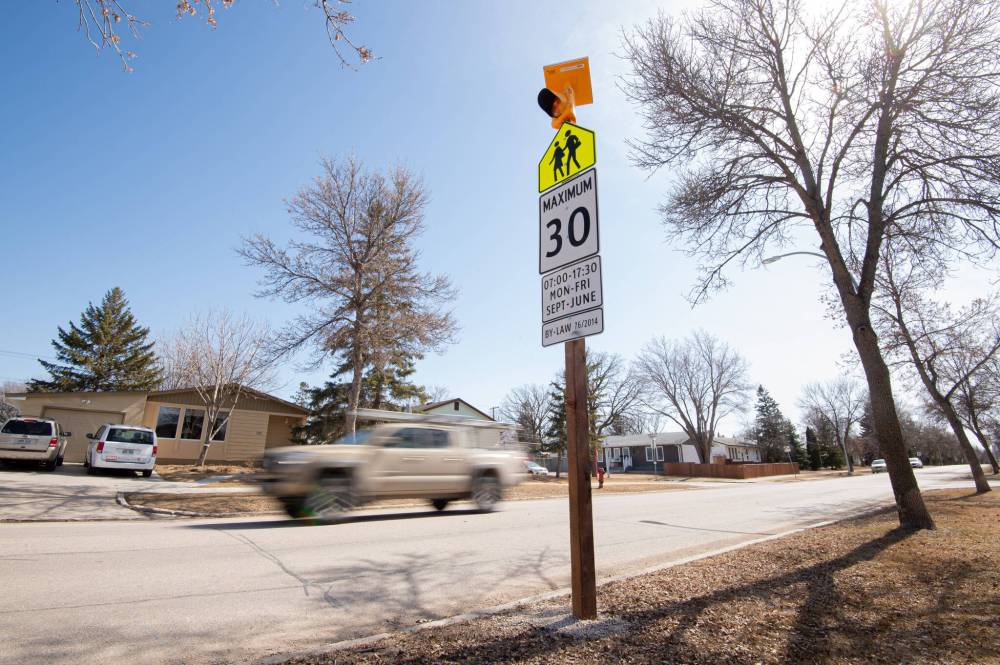
Winnipeg city council’s public works committee has directed staff to study whether to expand its 30 km/h school zone speed limit to additional residential streets, or even busy regional roads.
“Our regional roads are our major corridors … and we need to make sure those are flowing. At the same time, we need to make sure our streets are safe,” said Gillingham.
A reduced speed limit of 30 km/h, typically down from 50 km/h for residential roads, currently applies around many schools from 7 a.m. to 5:30 p.m., Monday to Friday, from September through June. That typically applies to any city street that borders a private or public school with students in Grade 6 or lower, except for regional/ arterial streets.

MIKE DEAL / FREE PRESS
Winnipeg Mayor Scott Gillingham.
Staff will also study options to post the 30 km/h speed limit at more residential roads surrounding schools, such as streets that connect with key paths entering school property, not just those directly adjacent to the building.
Coun. Janice Lukes, chairwoman of public works, fears both changes could have unintended consequences.
“I don’t support having a school zone in the middle of a regional road. Regional roads are major arteries that we’ve designated to move vehicles … Our regional roads are (also) dedicated for emergency vehicles,” said Lukes (Waverley West).
The councillor said schools on regional streets are required to have crossing guards, which helps reduce safety risks.
She said the motion’s call to reduce more 50 km/h roads around schools to 30 km/h speeds could confuse drivers.
“Regional roads are major arteries that we’ve designated to move vehicles.”
“It would get challenging when you’ve got all these multiple speeds throughout the city. That’s why I’m really supportive of just dropping (the speed limit on all residential) roads to 40 km/h,” said Lukes.
Coun. Emma Durand-Wood said she would support both expansions to school zone speed limits.

SUPPLIED
Coun. Emma Durand-Wood.
“If we’re thinking about the school zones as a tool for safety, then we need to think about all the streets surrounding the schools. We’ve got pretty good research to show reducing speed limits doesn’t have a really tangible effect on travel times…. I think most people are OK with slowing down a little bit for the safety of kids,” said Durand-Wood (Elmwood-East Kildonan).
“As for emergency vehicles, I think when people are driving a little bit more slowly and more carefully, they’re more attentive to their surroundings and it lets them be able to react more quickly, if they see (an emergency vehicle) coming up behind them.”
A group lobbying to reduce the speed limit on all residential streets to 30 km/h said slowing traffic on regional routes could be difficult to enforce.
“I think we should investigate it. At the very least, speeds should drop to 50 km/h on regional streets in front of elementary schools. I think that’s totally reasonable. Ideally, it would be 40 (km/h) but I kind of feel like we need to take baby steps on regional streets,” said Ian Walker, the chairman of Safe Speeds Winnipeg.
“I think most people are OK with slowing down a little bit for the safety of kids.”
Walker, who is also a Louis Riel School Division trustee, said he has heard multiple complaints about the speed drivers travel past Archwood School, which is located on Archibald Street, a 60 km/h arterial road.
He said reduced-speed school zones should be expanded to more residential streets as soon as possible.
“We should absolutely be slowing cars down on adjacent streets (to schools) that we know kids are walking on, that kids are crossing…. We have lots of disconnections in our network of safe routes to school,” said Walker.
MIKAELA MACKENZIE / FREE PRESS FILES
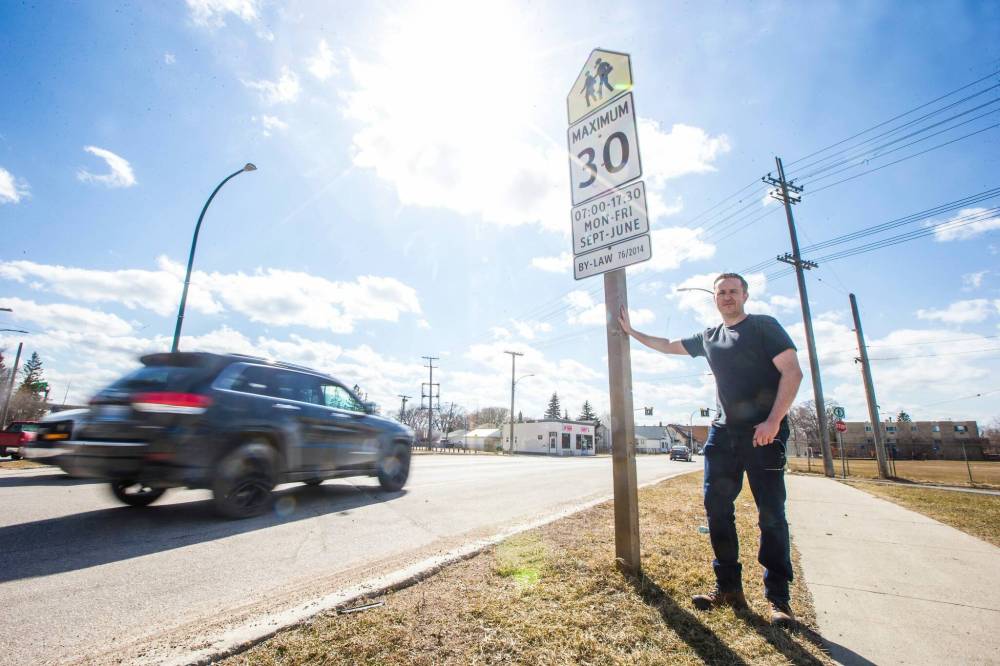
Ian Walker, chairman of Safe Speeds Winnipeg.
Coun. Devi Sharma, who raised the motion, said her key focus is to address residential roads directly around schools, following safety concerns from parents around R.F. Morrison, an elementary school in Garden City that has a 30 km/h speed limit in place on Morrison Street.
Residents have asked the city to expand the speed zone, she said.
“There’s an adjacent street, Buttercup (Avenue), where there’s a pathway and it leads into the school green space, and a lot of students are using that route, and there is no 30 km/h there,” said Sharma (Old Kildonan).
She emphasized that reducing speed limits on arterial roads was not her original intention, noting that option was added after conversations with city traffic experts.
Winnipeg Free Press | Newsletter

Sharma said she’s not sure if a reduced speed would make sense for arterial roads.
“I’d have to give that more thought… I think it’s important to keep traffic moving,” she said.
Dale Fuga, whose grandchildren attend R.F. Morrison, supports the call to reduce speeds around the facility.
“I think (the speed limit) should be just consistent anywhere around the school,” said Fuga. “If everybody took a little bit more care and caution, it would be a little bit safer.”
David Patman, the city’s manager of transportation planning, was not available for an interview Thursday.
joyanne.pursaga@freepress.mb.ca
X: @joyanne_pursaga

Joyanne is city hall reporter for the Winnipeg Free Press. A reporter since 2004, she began covering politics exclusively in 2012, writing on city hall and the Manitoba Legislature for the Winnipeg Sun before joining the Free Press in early 2020. Read more about Joyanne.
Every piece of reporting Joyanne produces is reviewed by an editing team before it is posted online or published in print — part of the Free Press‘s tradition, since 1872, of producing reliable independent journalism. Read more about Free Press’s history and mandate, and learn how our newsroom operates.
Our newsroom depends on a growing audience of readers to power our journalism. If you are not a paid reader, please consider becoming a subscriber.
Our newsroom depends on its audience of readers to power our journalism. Thank you for your support.