
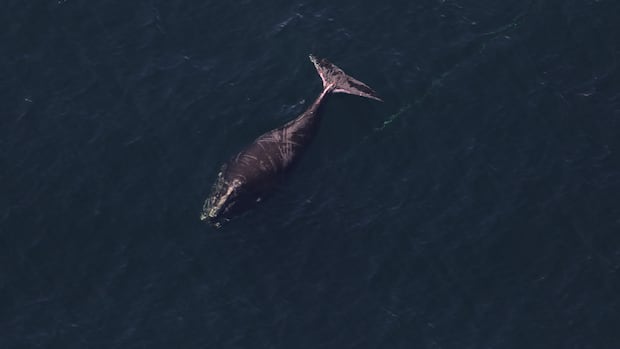
An endangered North Atlantic right whale was spotted entangled in fishing gear earlier this week and again on Wednesday in the Gulf of St. Lawrence.
When the whale was observed from an aerial surveillance flight, a response was immediately triggered through the marine mammal response program, said Andrea Morden, the manager of the whales team with the Department of Fisheries and Oceans.
“Partners have been working with the department, looking at the aerial surveillance and at-sea surveillance to try and relocate it,” Morden said.
“And if it’s safe to do so, they will attempt a disentanglement.”
The first sighting of the five-year-old male whale was off of Shippagan on Monday, and the second sighting was near the Magdalen Islands, also via a surveillance flight.
Conservation and protection officers from the islands went out on the water, but because of weather conditions, they were unable to attach a satellite tag to the trailing gear, Morden said.
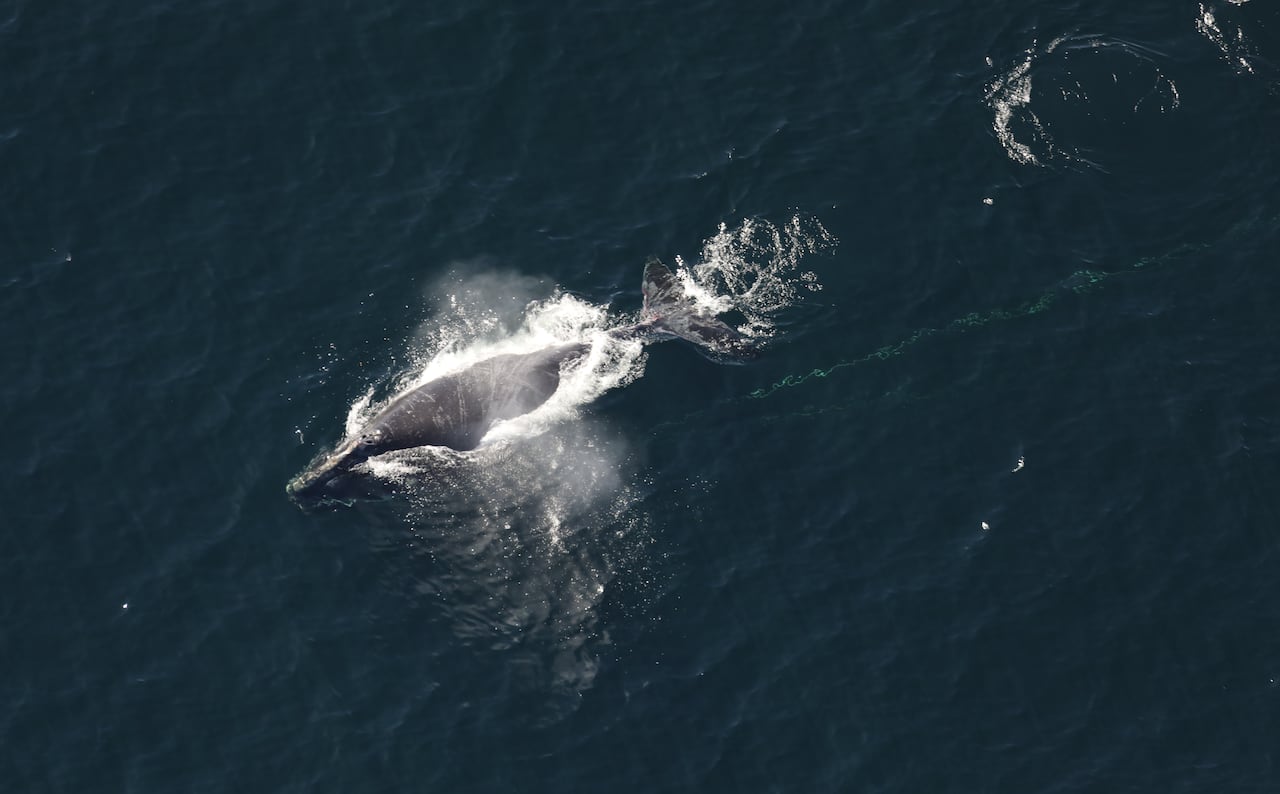 The North Atlantic right whale known as No. 5192 was spotted Monday in the Gulf of St. Lawrence, entangled in fishing gear. (NOAADFO Science Joint Aerial Survey team – MMPA permit No 27066)
Satellite tags help scientists to better follow the whale and to get people in position for a disentanglement.
Once it has gear in hand, the department can do an analysis to determine which fishery the gear came from.
Mackie Greene, the director of whale rescue with the Canadian Whale Institute on Campobello Island, was among those who responded to the sighting in Shippagan.
When he first got the report, his team went to the last known position of the whale before beginning a search pattern — just as if it were a man overboard, he said.
If they see a whale, they check to see if it has fishing gear on it. If there’s a pod of whales, his team will use a drone to survey the whales for an entanglement to avoid being too invasive.
Greene, who is on his way back to Campobello, said there has to be really good weather to attempt a disentanglement. There are two or three days of bad weather in the forecast, so his team will regroup after that.
He said rope can be seen coming out of the left side of the whale’s mouth, trailing two to three body lengths behind it on the left side. On the right side, there appears to be weighted rope coming from the whale’s mouth, Greene said.
“I’d say it’s a great risk, you know, it’s starting to embed, starting to cut into the whale, and you know, usually then they become prone to infection and things like that,” Greene said. “It definitely has to be removed.”
Heather Pettis, a senior scientist with the New England Aquarium’s Anderson Cabot Center for Ocean Life, said the entanglement appears to be recent. She said the whale was last seen on April 21 in Cape Cod Bay, off Massachusetts, and wasn’t entangled.
She also said the evidence of rope rubbing — which refers to marks across the animal’s back from the rope shifting — is indicative of a recently entangled whale.
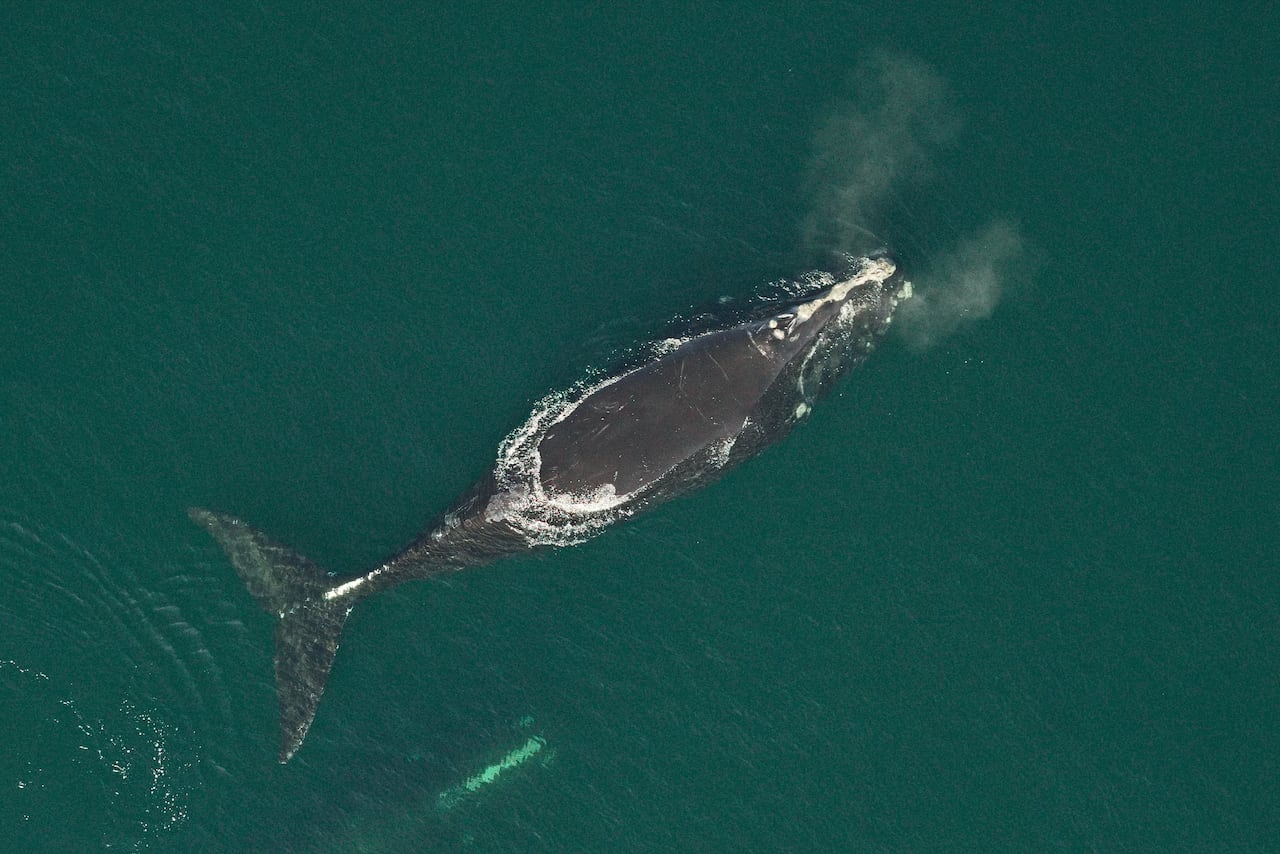 Senior scientist Heather Pettis said the entanglement of the whale appears to be recent because it was last spotted in Cape Cod Bay in April, shown here, gear-free. (New England Aquarium, taken under NOAA permit #25739-01)
As well, she said, “there are wounds on the fluke,” — located on the whale’s tail — “that are actively bleeding, and so we really only see that in pretty fresh, recent entanglement events.”
Despite appearing to be a bad entanglement, Pettis said that because it’s recent, the impact hasn’t set in.
“That animal hasn’t been fighting this for a long time, trying to feed and expending energy on dealing with the entanglement while doing that,” she said.
“So if disentanglement teams can get to the animal relatively soon and relieve the animal of that gear, the prognosis may be quite good.”
Pettis said there have been six documented entanglements in 2026 to date. As well, a right whale that was spotted entangled in 2025 died this year. This is an increase from the zero number of documented deaths in 2025.
She said the latest population estimate for the species is 384.
Ben Grundy, a California-based oceans campaigner with the Center for Biological Diversity, said for as long as he’s been working on right whales, it has been like a “seesaw.”
For example, he said, there was a lot of optimism when the calving numbers for the season were announced — 23 new mother and calf pairs were sighted, which is the fourth-highest count ever, according to the New England Aquarium.
And he said it was great to see the release of Canada’s five-year Whalesafe Fishing Gear Strategy, which looks to reduce the risk of harm to whales from fishing gear entanglements.
But the good news can be coupled with sad news.
“It’s really this balancing game of being able to cautiously celebrate the wins when we are seeing good signs of recovery, but recognizing that all it takes is one bad year,” Grundy said.
“But I think through good regulations, through continued commitment by all of the stakeholders, by states, by countries, I think that’s what’s going to lead to a successful recovery for this species.”