
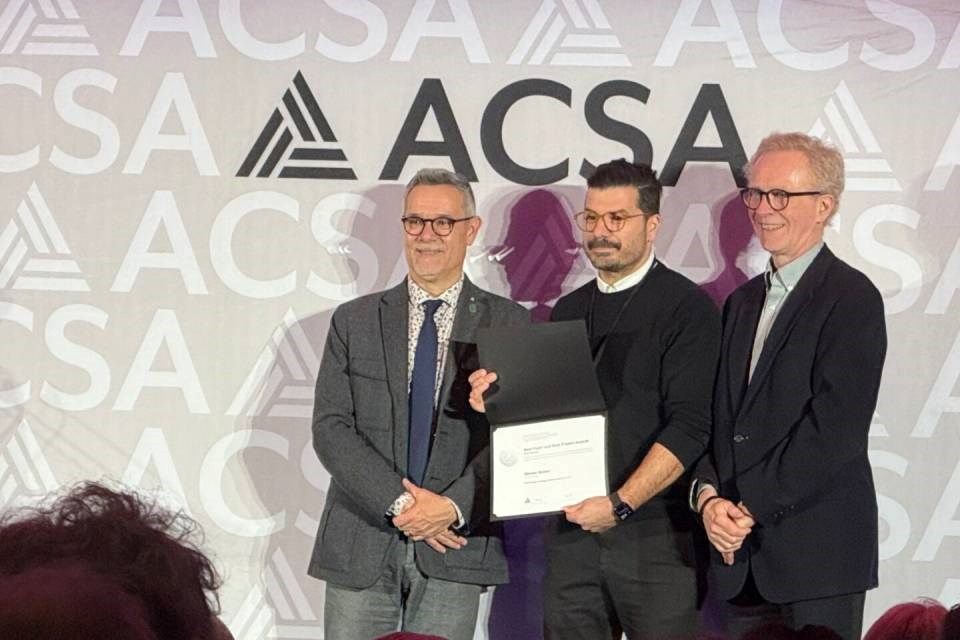
Association of Collegiate Schools of Architecture recognizing Steven Beites for sustainable design work
A Laurentian University architecture professor is being recognized for his research in sustainable design.
Steven Beites, an assistant professor at Laurentian’s McEwen School of Architecture, has received an award for his paper, “Technology, Ecology and the Housing Crisis.” It explores how advanced technologies, robotics, and sustainable bio-based materials can fundamentally reshape modern design and construction.
Beites received the award from the College of Distinguished Professors and the Association of Collegiate Schools of Architecture during the ACSA’s annual convention in Chicago in March.
Beites’ work looks at how innovative approaches to design and construction — including using robotics and digitally fabricated systems to move production into controlled manufacturing environments — can help address housing challenges in rural and remote communities in Northern Ontario.
One of his projects is the development of a cable-driven parallel robot, which could be assembled on site and used to 3D print housing components. It’s designed to be easy to operate, with fewer skilled workers required.
“The goal is not to replace skilled labour, but to augment it, allowing smaller teams to build more efficiently and with greater precision,” Beites said in a news release.
“By integrating local low-carbon, bio-based materials with automation and prefabrication, we can develop housing systems that are not only faster and more affordable to construct, but also better suited to northern climates and long-term sustainability.”
Last year, Beites was named director of the newly launched Institute for Northern Housing Innovation (INHI), which is scheduled to open this fall.
Laurentian said the institute is currently prototyping a low-carbon, prefabricated panel system tailored for Northern Ontario.
“Designed from the ground up with automation and robotics in mind, this building system aims to drastically reduce material waste, accelerate construction timelines, and lower overall housing costs,” the news release said.
“Crucially, it is built for real-world application, providing local industry with a scalable, realistic pathway to adopt advanced prefabrication methods.”