

Listen to this article
Estimated 4 minutes
The audio version of this article is generated by AI-based technology. Mispronunciations can occur. We are working with our partners to continually review and improve the results.
Robin McPherson’s grandfather used to tell her tales of life working as an electrician inside the gigantic Thompson Products auto parts plant in St. Catharines, Ont., after he returned from serving in the Second World War.
“I have many stories,” the St. Catharines city councillor said. “Especially the one where he fell off the ladder and broke both his elbows.”
But like most people who grew up in and around St. Catharines, McPherson had never stepped foot inside the cavernous structures now known as Rhythm Automotive Canada Ltd. – there are actually two plants joined by an underground tunnel on each side of Louth Road totalling about 450,000 square feet – until June 8.
She was there as part of a media tour of the two buildings dating back 97 years and 72 years, to get a preview of one of 19 properties and districts across the city that will open their doors to the public on Saturday, June 13 for the city’s 2026 Open Doors event.
Part of city’s history, though few have stepped inside
Paul Stever, North American director of operations for Rhythm Automotive – which has about a dozen plants in Canada, the U.S., Europe and Asia – said the facility that was also known as TRW for years has played a major role in the city for generations.
The company kept operating during the Great Depression in the original plant building known as ‘The Forge,’ and switched to producing artillery shells as part of the Allied war effort in Europe during the Second World War, he said.
“A lot of multi-generational families have worked here,” said Stever. “It’s got great heritage.”
Kathleen Powell, supervisor of historical services for the City of St. Catharines, said at Tuesday’s tour that despite its impact in the city, few residents have stepped foot inside.
“People probably drive by all the time and just don’t realize the history that this particular site has in our community,” she said.
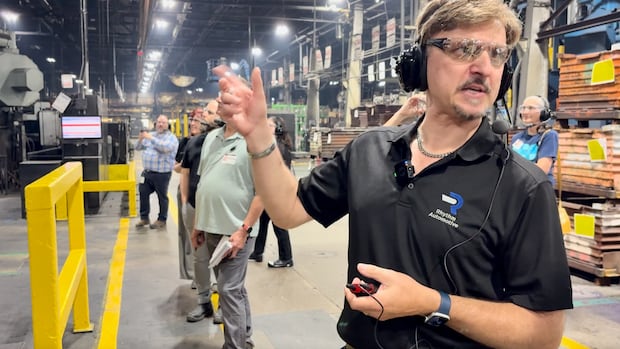
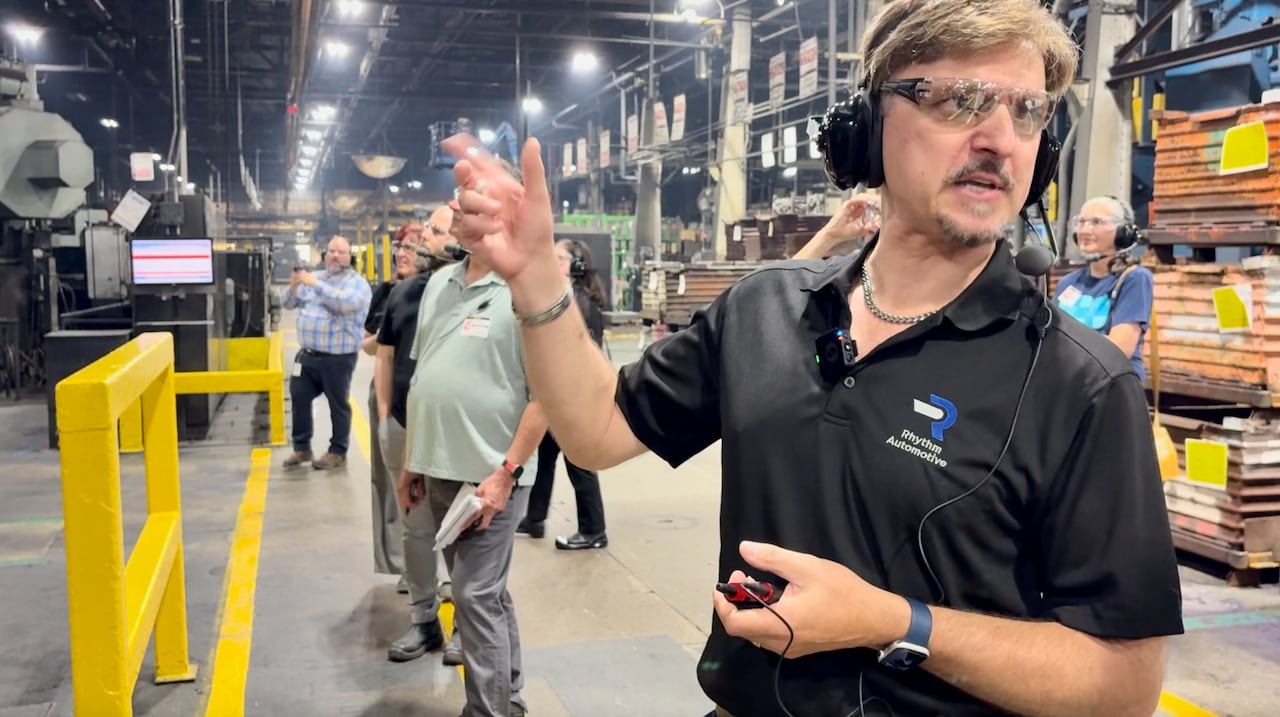 Paul Stever, North American director of operations for Rhythm Automotive Canada, leads a tour of the company’s plant in St. Catharines on June 8. An investment of nearly $80 million will go to two giant presses weighing 300 tonnes apiece, added to the company’s auto parts manufacturing capabilities. (Paul Forsyth/CBC)
In a time of political and economic turmoil arising out of ever-evolving tariffs coming out of the United States, Stever said Rhythm Automotive has a bright future in St. Catharines.
Its parent company is investing close to $80 million in improvements in the plant including two massive, 300-tonne forge presses being built in Italy to develop a high-capacity aluminum forging line that are so big that the roof on one of the plants will literally have to be raised to accommodate their size.
“They’re massive presses,” Stever told CBC News. “It’s a major investment in the site. There’s a lot of confidence in this workforce to make it happen.”
Rhythm primarily makes suspension and steering components for customers such as a Toyota truck plant in Texas, Ford plants in Canada and the U.S., Honda, Stellantis, Mercedes and BMW.
The company’s new parent company, as of June 1., is Tokyo’s, Advantage Partners.
Many of the components manufactured at the plant, most of which are destined for automotive assembly plants in the U.S., are tariff exempt under the Canada-U.S.-Mexico free trade agreement.
But Stever said his company has been impacted by other U.S. tariffs such as the steep 50 per cent tariff on Canadian steel and aluminum exports.
“There’s some tariffs we can’t get around so there is an added expense to us. But it’s down to about one per cent of our costs so it’s much more manageable.”
While uncertainty remains over the long-term impact of tariffs on the Canadian auto parts sector, Stever said his company felt investing in the local plant was simply good business.
“This is a facility that’s been running 97 years and we have the confidence to make a huge investment and be here for many more years,” he said.
Stever said the expanded product line that the investments will deliver, as well as provincial and federal programs the company hopes to tap into, could mean the current workforce of 282 could expand by up to 75 people in the next few years.