

Listen to this article
Estimated 3 minutes
The audio version of this article is generated by AI-based technology. Mispronunciations can occur. We are working with our partners to continually review and improve the results.
Ian Bridge remembers the darkness of Estadio León’s tunnel before the stadium’s light shone down on him and his Canadian teammates in León, Mexico. He remembers standing next to the French squad who were Canada’s first opponent at the 1986 FIFA World Cup in Mexico.
The Team Canada alum also remembers the heat on the pitch, the skill of the French players and the tenacity of his Canadian squad, which lost 1-0 in its first-ever World Cup match.
“We weren’t in awe of them,” Bridge, now 66, said of a French side that featured legendary midfielder Michel Platini. “But we were in awe of the situation.”
Bridge said the match on June 1, 1986, may be “the highlight” of his soccer career.
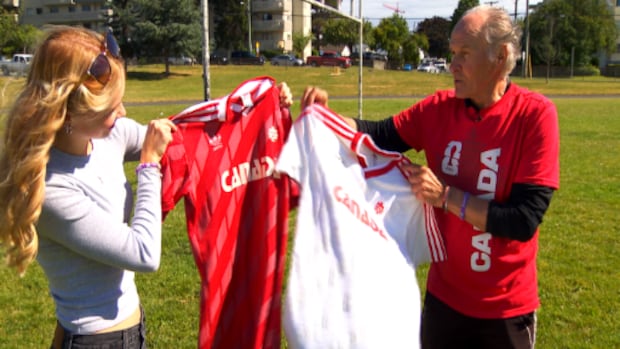
 Ian Bridge says playing at the 1986 World Cup was a blur at the time, but a wonderful experience looking back on the tournament. (CBC News)
Forty years later, Jonathan David headlines a Canadian side primed to make history in its third World Cup.
Canada earned its first ever point in a World Cup tournament on Friday after their match with Bosnia-Herzegovina ended in a 1-1 draw.
George Pakos, a fellow South Island native, made his World Cup debut against the USSR in Canada’s final match at the 1986 World Cup.
“My relatives in Poland rented a coloured TV to watch me play against the Soviet Union, which wasn’t on good terms with Poland back then,” Pakos said.
Like Bridge, he describes the moment as surreal.
“Once you step on the field, it’s like, ‘Oh my God,'” Pakos said. “A local guy from Esquimalt High School who works for the City of Victoria’s waterworks — an amateur player — to get to play in the World Cup is just unbelievable.”
Pakos scored the goal against Honduras in 1985 that clinched Canada’s first World Cup berth.
“It was a tremendous thrill,” he said.
Bridge, who is an assistant coach with the University of Nebraska’s women’s soccer team, believed Canada’s men’s side would continue to qualify for the World Cup after their 1986 debut.
“I thought from that ‘86 team we’d go on from strength to strength and be in Italy in the 1990 World Cup,” Bridge said. “But we fell in one of the earlier qualifying rounds in 1990.”
Pakos believes Canadian soccer is going in the right direction.
“The women [national team] obviously really helped in the women’s end of it,” Pakos said, citing the Northern Super League and Canadian Premier League as evidence of soccer’s growth in the country.
“There’s just so much [soccer],” he added. “Everywhere you go on a Saturday in Victoria, every field is occupied with kids, boys and girls of all ages and every weekend, every night, it’s really gone crazy.
“I think it’s the most popular game in Canada now instead of hockey.”
 A George Pakos custom autographed soccer card commemorating his time at the 1986 World Cup in Mexico. (Alex Wauthy/CBC)
Bridge served as the assistant coach of Canada’s women’s national team from 1997 to 2008. During that time, the Canadian squad qualified for the FIFA Women’s World Cup three times (1999, 2003, 2007) — the same number as the men have in their history.
Back-to-back World Cup qualifications for the men and the growth of the Northern Super League show that Canada soccer is on the rise, he says.
“It’s really come a long way,” Pakos said.