
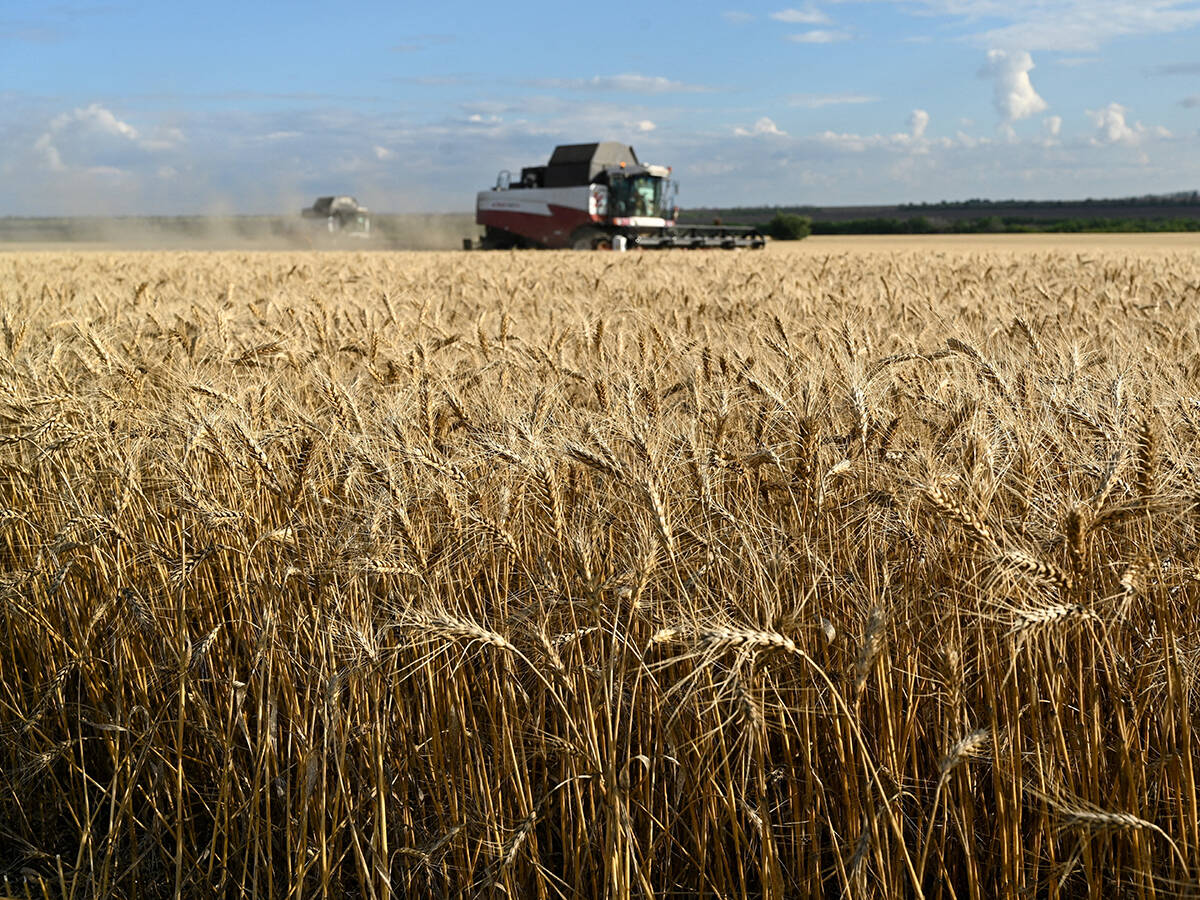
SASKATOON — Good looking Black Sea crops will likely keep the wheat market from rallying this summer, says an analyst.
The U.S. Department of Agriculture is forecasting 88 million tonnes of Russian wheat production and another 23.5 million tonnes from Ukraine in 2026-27.
DTN market analyst Rhett Montgomery wouldn’t be surprised if Russia’s crop keeps getting bigger and ends up around 90 million tonnes. The country’s record output was 92 million tonnes set in 2022-23.
“We have enough supply there to bridge the gap or at least keep the market afloat until we get to the Southern Hemisphere crops,” he said during a recent webinar about the USDA’s latest World Agricultural Supply and Demand Estimates report.
He believes the Southern Hemisphere crops provide the only hope for a supply-based market rally because they were planted after the Middle East war caused a spike in crop input costs.
The wheat market needs a crop disaster somewhere to spark another rally.
Russia’s forecast comprises 64 million tonnes of winter wheat and 24 million tonnes of spring wheat.
Read Also

The USDA said precipitation has been above average since Russia’s winter wheat crop emerged from dormancy.
“Moderate to heavy May rainfall provided consistent and sufficient moisture for the developing crop,” the USDA stated in its World Agricultural Production report.
Crop vigour is well above average as the crop enters the filling stage across southern growing regions. Maintaining adequate soil moisture reserves will be essential for crops in the northern growing regions over the next couple of weeks.
Russia’s winter wheat harvest begins in July.
Spring wheat has been planted on only 19.76 million acres out of the initially projected 27.42 million acres as of early June, according to the USDA.
“Farmers are beginning to consider shifting to alternative summer grown crops such as oilseeds or even corn that generally can be planted later than grains,” the USDA stated.
SovEcon analyst Andrey Sizov echoed those concerns in a recent X post.
“Russian spring wheat area is coming in more than 10 per cent below last year and likely well below most expectations,” he said.
“The reason is not just weather. Farmers in the Volga region and Siberia are actively shifting to sunflower and rapeseed. This is a structural story, not a one-season.”
Winter wheat accounts for 97 per cent of Ukraine’s total wheat production. The key yield formation period is early to mid May. The crop reaches maturity in mid to late June.
“Favourable May rainfall supplied ample soil moisture during the aforementioned critical developmental window, enhancing crop vigour and boosting this season’s yield prospects,” stated the USDA.
Montgomery said the bountiful Black Sea crops could offset what appears to be a disaster in the United States.
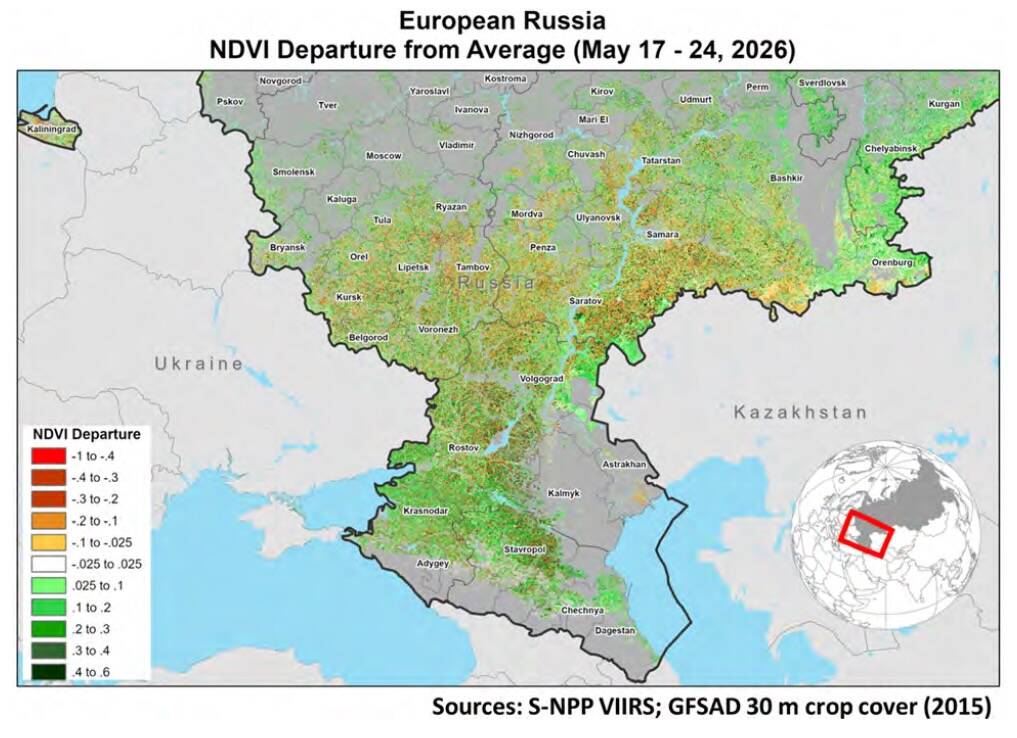
This satellite-derived normalized difference vegetation index map shows that crop vigor is well above average in the European part of Russia, where the country’s winter wheat is primarily grown.
Photo:
USDA/Foreign Agricultural ServiceRussia is expected to produce 88 million tonnes of wheat this year
U.S. winter wheat production is forecast at 1.03 billion bushels, down from 1.40 billion bu. last year. That would be the smallest winter wheat crop since 1965.
The USDA is also forecasting smaller crops for Australia and Argentina, two other key exporters.
Australia’s production is forecast at 28 million tonnes, down 22 per cent from last year’s bumper harvest.
The outlook could get worse for Australia if a super El Nino develops as many forecasters are predicting.
Argentina’s production is estimated at 21 million tonnes, down 25 per cent. Its outlook could improve under a super El Nino.
For now, world wheat ending stocks are forecast at 275 million tonnes in 2026-27, down just 20 million tonnes from 2025-26.
“Overall, we’re just not seeing a whole lot of supply pinch in the USDA’s numbers yet,” said Montgomery.
“I still think there’s some risk in this market here as we move forward, but overall, I think the near-term supplies are more than comfortable to at least get us through the summer of 2026.”