

Listen to this article
Estimated 4 minutes
The audio version of this article is generated by AI-based technology. Mispronunciations can occur. We are working with our partners to continually review and improve the results.
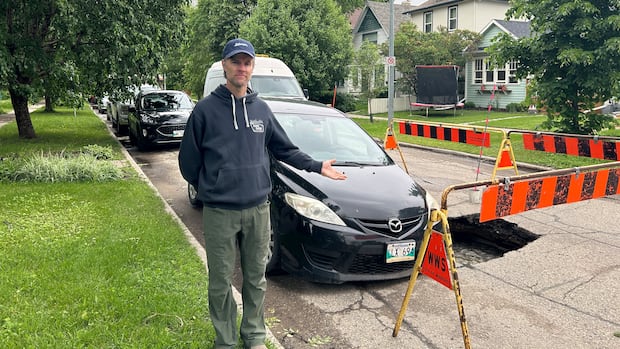
Michael Burkholder woke up to find his car slumped into a sinkhole outside his home in Winnipeg’s Wolseley neighbourhood on Saturday morning.
“I was surprised … you’re never expecting these sorts of things,” he told CBC News near the hole on Newman Street, which was filled with water and surrounded by orange construction barricades.
Burkholder said a neighbour texted him about the situation around 7:30 a.m. and put up pylons to warn others on the street. Just before 10 a.m., he said he was still waiting for the city to let his family know when the car would be pulled out of the hole.
“I’m kind of concerned about possible damage to the car,” Burkholder said.
He’s also worried that someone could get hurt.
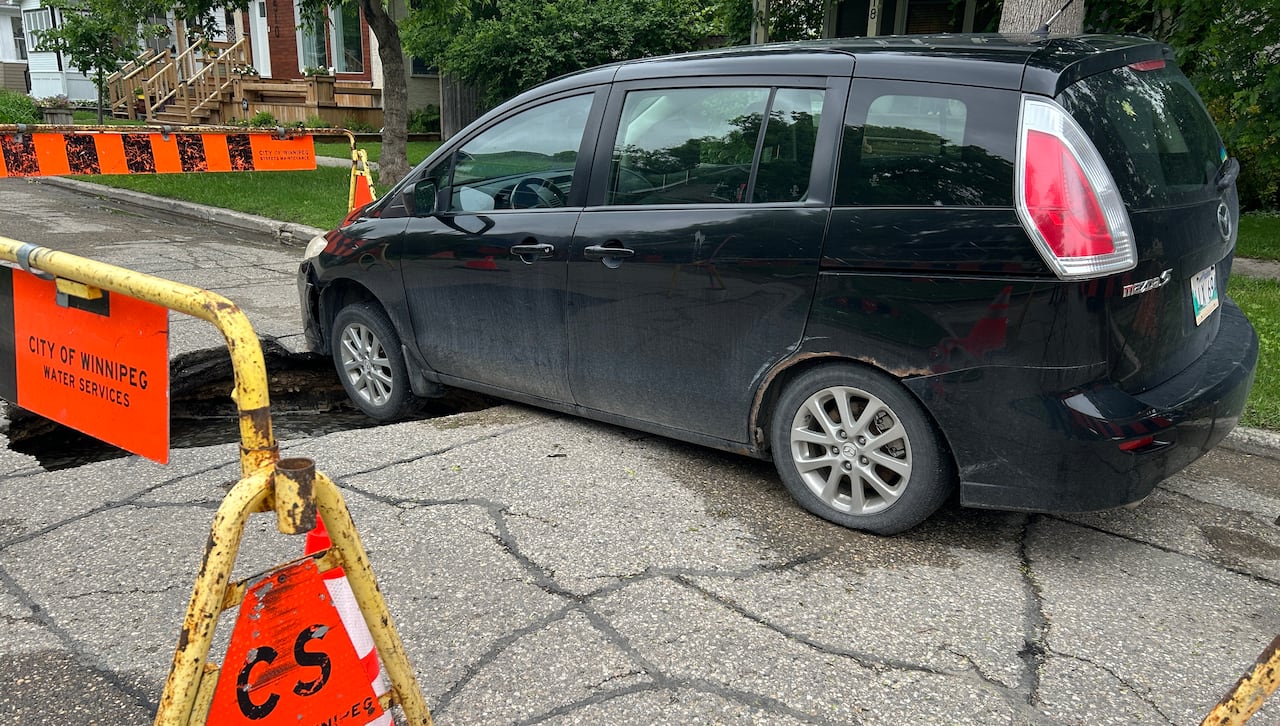 A sinkhole opened up on Newman Street in Winnipeg’s Wolseley neighbourhood on Saturday morning. (Gavin Axelrod/CBC)
He’s also worried that someone could get hurt.
“We were on the phone quite a bit this morning with the city to get them out there because obviously it’s a hazard,” he said.
It’s not the first time Newman Street has been the site of a sinkhole, he said. An earlier hole caused a dip in the residential street and has become somewhat of a “speed bump,” he said.
Sinkholes are a problem both in the neighbourhood and across Winnipeg, he said.
In late April, a woman fell into a hole as it caved in outside her home on Lipton Street in Wolseley. Just a few days before that, a large sinkhole opened up on Washington Avenue in East Kildonan due to a water main break.
“This seems to be an issue with this city,” Burkholder said. “I think there needs to be maybe a quicker reaction by the city in regards to these [sinkholes] because I think people could get seriously injured.”
CBC News has reached out to the city for comment.
The cause of the sinkhole had not been confirmed as of early Saturday afternoon.
Utility failures a prime cause: U of M prof
Ahmed Shalaby, a professor of civil engineering at the University of Manitoba, says the majority of sinkholes he’s seen in the city are caused by infrastructure failure beneath the road.
This can happen when utilities, such as a water main or sewer pipe, get damaged. The soil above the pipe can then fall inside, leading to a growing void below the road’s surface that can cause a collapse.
“Most Winnipeg streets have some utilities running under them,” Shalaby said.
“Typically as these utilities get older, they are more prone to damage by the traffic running on the road and by severe weather events, just like the storm we just had in Manitoba in the last week,”.
Sinkholes happen quickly and are often very difficult to prevent, he said.
“It’s very difficult and challenging for cities to know when a pipe has filled until we see the evidence showing up on the surface,” Shalaby said, adding more sinkholes in a certain area could indicate that replacements are needed.
WATCH | How Winnipeg’s winter thaw can lead to sinkholes: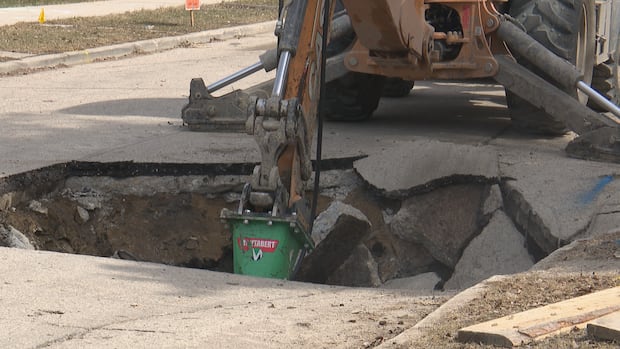
Sinkholes and falling into the boulevard: How thawing affects Winnipeg’s underground
After stories of a woman falling into a boulevard hole and a huge East Kildonan sinkhole, U of Manitoba engineering Prof. Ahmed Shalaby talks with Marcy Markusa about how spring thaw impacts underground utilities.
Older neighbourhoods with aging infrastructure might see more frequent sinkholes, he says.
“The best solution is always being proactive in terms of maintaining the network and ensuring that it is not in the condition where there will be a prevalence of sinkholes appearing,” Shalaby said.
However, he added, that can be costly.
“There is always a gap between the funding available for infrastructure and our ability to repair and replace and renew this underground infrastructure in time,” he said.
In the meantime, drivers and other road users should keep an eye out for sudden dangers ahead of them, he warned. In many cases, sinkholes can appear as heavier vehicles, such as trucks or buses, pass over the road.
“It is a hazardous situation. It is something that we do need to be careful about and avoid distractions and scan the roads ahead,” he said.