

Listen to this article
Estimated 4 minutes
The audio version of this article is generated by AI-based technology. Mispronunciations can occur. We are working with our partners to continually review and improve the results.
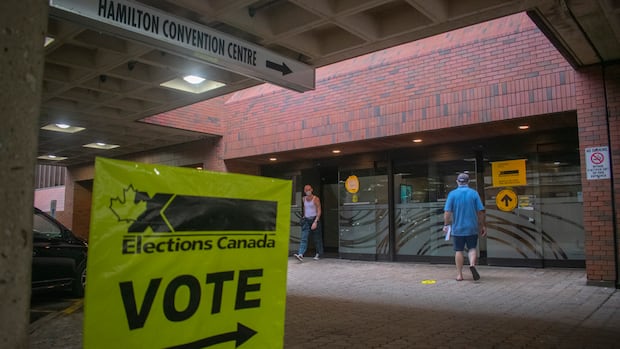
The Commissioner of Canada Elections (CCE) has fined a Hamilton poll worker $1,250 after he was found to have voted twice in the 2021 federal election.
A report on the penalty published in February says Elections Canada discovered that a person with the same name, birthday and address voted in advance, on Sept. 17 of that year, and then again on election day — Sept. 20 — at the polling place where he was working.
The agency referred the case to the CCE, which investigates such infractions, and the fine was increased from $1,000 to $1,250 because the recipient was a poll worker.
The process shows how closely Elections Canada monitors the provenance of each ballot in a system where voter fraud is extremely rare, says a politics expert.
“Our elections are quite secure and the data management protocols at Elections Canada are very strong,” Andrea Lawlor, associate professor of political science at McMaster University, told CBC Hamilton on Friday.
“At no point have we ever seen any data that shows this type of activity is widespread … or even represents a tiny fraction of the vote.”
Maintaining public confidence in elections
The CCE investigation found that the election officer received a special ballot on Aug. 26, and that Elections Canada received his signed outer envelope — used to identify that someone has voted while being separate from the actual ballot — on Sept. 17.
On Sept. 20, the same person’s name was added to the voter’s list at the poll where he was working in the Hamilton-Centre riding, using a transfer certificate, a mechanism that allows someone to switch their polling place.
“The failure of those involved in the electoral process to comply with the rules adopted by Parliament to ensure a fair election can contribute to a loss of public confidence in the integrity of the election,” states the decision.
6 people sanctioned since 2021: CCE data
Myriam Croussette, senior communications advisor with CCE, said it is “not unusual” for enforcement measures to be imposed several years after an infraction, as in this case, where the infraction was made public five years after it happened.
“The time required to complete that work can vary depending on the time it took to receive the referral, the complexity of the file, the information available to our office, and the investigative steps required to establish the facts,” she said in an email on Friday.
“Illegal voting is considered one of the most serious violations because it can undermine the integrity of the electoral process,” she added. “As a result, these violations carry higher baseline penalty amounts.”
Such penalties are indeed rare. This was the only penalty for voting more than once issued this year, according to lists on the CCE’s website, with none issued in 2021 and 2023; one in 2022; two in 2024; and three in 2025.
 Political science professor Andrea Lawlor says data management protocols at Elections Canada are very strong. (Submitted by Andrea Lawlor)
Lawlor said that despite the reality of how rarely these incidents occur, the idea of voter fraud is an “issue of high concern with voters,” possibly because of how much it is alleged south of the border in the United States.
However, the U.S. has a fragmented system in which each state runs elections in its own way, she says, while federal elections in Canada are centrally run and standardized, making irregularities easier to spot.
“We don’t hear about it a lot because there’s not a lot of evidence that it happens with much frequency,” she said.