

Listen to this article
Estimated 4 minutes
The audio version of this article is generated by AI-based technology. Mispronunciations can occur. We are working with our partners to continually review and improve the results.
The World Cup has arrived in North America, and with it comes one of the sport’s most dependable arguments.
Is it soccer? Or is it football?
For many fans around the world, the answer is obvious: it is football. Full stop. Debate over. Some will even say the word “soccer” is an American invention — or mistake. But history says otherwise.
Stefan Szymanski, a professor of sport management at the University of Michigan, has studied the origins of the term. He says the word “soccer” was first used in England.
“The word was coined in Oxford sometime in the 1880s,” Szymanski said.
How soccer became soccer
In 19th-century Britain, there were different kinds of football. There was rugby football and association football — the latter is the version being played at the FIFA World Cup.
At Oxford, Szymanski says students had a habit of turning words into slang by shortening them and adding “er” at the end. For example, rugby football became “rugger.” But shortening association football was more awkward.
Cross Country Checkup is asking: Is hosting the World Cup worth the billion-dollar price tag for Canadian taxpayers? What does the World Cup mean to you? Leave your comment here and we may read it or call you back for Sunday’s show
“The theory is that they sort of picked on the three letters in the middle — ‘soc’ — and added the ‘er’ on to that,” Szymanski said.
The Oxford link was also being discussed in the British press by the end of the 19th century.
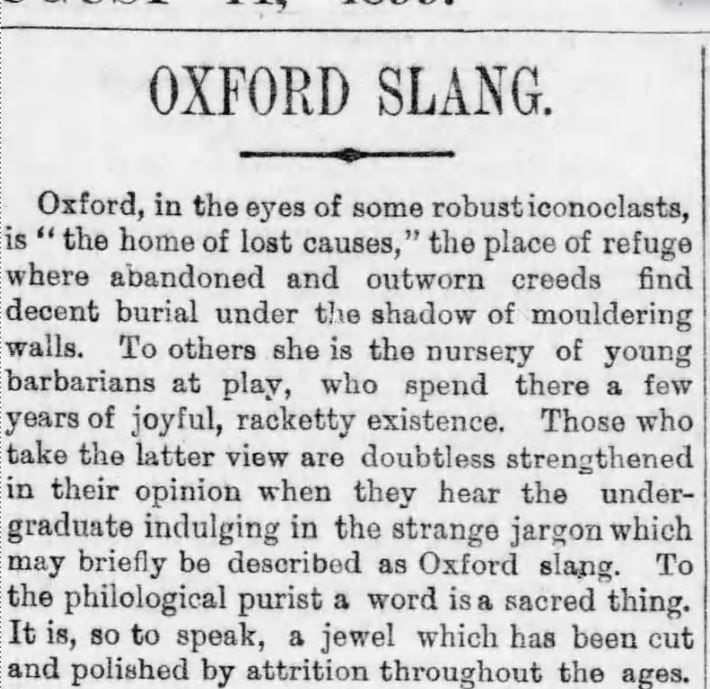 An 1899 article in The Daily Telegraph described ‘Soccer’ and ‘Rugger’ as examples of Oxford slang, noting the terms came from association and rugby football. (The Daily Telegraph, via Newspapers.com)
In an article on “Oxford slang”, the Daily Telegraph described “soccer” and “rugger” as abbreviated forms of association and rugby football, calling soccer “an excellent example of Oxford minting.”
Szymanski said that from the 20th century onward, the word was in regular use across Great Britain. Books published in England about how to play the sport sometimes used “soccer” rather than “football.”
Why the word stuck in Canada and elsewhere
The word travelled during the 20th century and stuck in places where “soccer” was useful because “football” already meant something else.
In Canada, football can mean Canadian football. In the U.S., it usually means American football. In Ireland, it can mean Gaelic football. In Australia, it can mean Australian rules football, rugby league or rugby union.
So “soccer” became a useful way to differentiate the sport from others. That helps explain why the word still appears in everyday speech in North America — and why the Australian men’s national team is still nicknamed the Socceroos.
However, in Britain the nickname became less useful as rugby football became rugby and association football became football.
Why do people argue about it?
For Szymanski, the argument about soccer versus football is less about historical accuracy and more about culture and identity.
“The first thing to say is this is obviously on its face a completely pointless argument,” he said.
Americans have been using the word for generations. Canadians use it too. And in parts of the world where football can mean more than one sport, “soccer” has and continues to serve a useful purpose.
According to Szymanski, the heated debates today are more to do with “relations between the United States and Britain and even other parts of the world.”
For decades, the United States has dominated much of Western popular culture, from music and film to television. But soccer — or football — is one place where the U.S. has not traditionally led the world.
Szymanski says the sport is one cultural area where British fans feel they have ownership.