
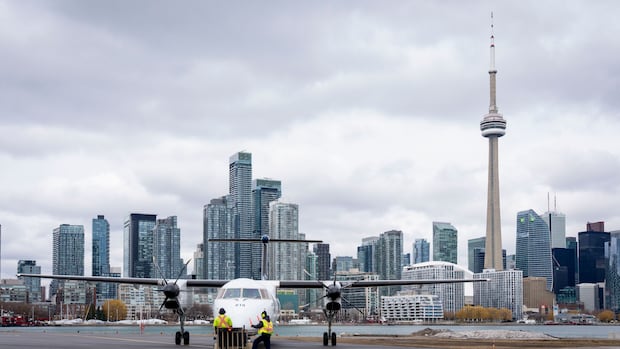
As the federal government begins consultations on the future of Billy Bishop Airport, some experts say they’re skeptical the Toronto Port Authority, which owns the airport, will be able to fund the proposed expansion.
Last month, Toronto Port Authority CEO RJ Steenstra pegged the cost of the expansion at $4 to $5 billion.
While he says taxpayers won’t be on the hook, the port authority has not released a business case, or any details about financing. Some experts say it’s unlikely a project of such scale would see a return on investment, given what the port authority’s financial statements reveal about the airport’s revenues, which are relatively small compared with the hefty borrowing that would be needed.
“To me the answer is it’s not viable,” said John Gradek, a faculty lecturer in supply networks and aviation management at McGill University.
A spokesperson for the port authority said a financing model will be developed after a plan is completed and costs are confirmed.
A look at the airport’s financials
The $4 to $5 billion estimate was revealed last month, when Steenstra spoke to members of the province’s standing committee on heritage, infrastructure and cultural policy.
While Premier Doug Ford previously mused about the province contributing — and expressed hope that the federal government would chip in — Steenstra said the port authority is not expecting provincial money and hasn’t asked the federal government for any either.
The port authority is an arms-length agency of the federal government and financially self-sufficient. Steenstra told reporters the expansion would be funded through revenue such as user fees.
 John Gradek says he doesn’t think a $5-billion investment makes financial sense for an airport the size of Billy Bishop. (Submitted by John Gradek)
But the port authority’s 2025 financial records call into question how long it would take to pay off money borrowed for the project, and just how much the fees charged to passengers would increase.
The Toronto Port Authority’s 2025 financial report indicates Billy Bishop Airport brought in a total of $58 million in revenue last year, the vast majority of which came from fees, including the $29 airport improvement fee charged to each departing passenger.
Altogether after operating expenses, the port authority’s net income for 2025 was $16.9 million.
Gradek believes even if the port authority doubles or triples user fees, “it’s a stretch” to imagine $5 billion would be a viable investment.
“[It’s] a lot of money to put into a small regional airport, which is what Billy Bishop is,” Gradek said.
Fred Lazar, an associate professor of economics at York University with expertise in the aviation industry, agrees. While terms of the potential financing are not yet clear, Lazar estimates the port authority would need to bring in at least an additional $250 million net revenue each year in order to repay the borrowed funds.
Lazar says that would technically be possible through increased user fees, if indeed the expansion leads to 10 million passengers a year (up from 1.7 million last year), as the province has touted.
 Fred Lazar predicts higher travel costs for passengers, since user fees would likely need to be increased in order to fund the Billy Bishop expansion. (Joe Fiorino/CBC)
But, he said, there’s a difference between “the spreadsheet” and “reality,” and he’s skeptical that passenger numbers will actually reach those levels.
“If the Port Authority is considering raising landing fees or airport improvement fees or both, that will be a negative in terms of increased operations at that airport,” Lazar said.
CBC News asked the port authority how much user fees would need to increase to fund the expansion. In an email, vice-president of communications and public affairs Deborah Wilson said it’s “too early to confirm any impact.”
Calls for transparency
While Billy Bishop Airport is owned by the Toronto Port Authority, the passenger terminal is owned by private company Nieuport Aviation. The company’s website describes it as being “owned by institutional investors advised by J.P. Morgan Asset Management, an arm of American bank JPMorgan Chase & Co.
The province’s lobbyist registry shows the company has been lobbying the Ford government. That’s led to concerns from opponents of the expansion, including city councillor Josh Matlow.
“It does beg the question, why is this all happening and on whose behalf?” said Matlow.
He said he wants to see a “real plan” from the port authority about how the project would be financed.
“Who are they paying back? Is it the banks? Is it J.P. Morgan? Is it the Ontario government? Is it taxpayers? We need those answers.”
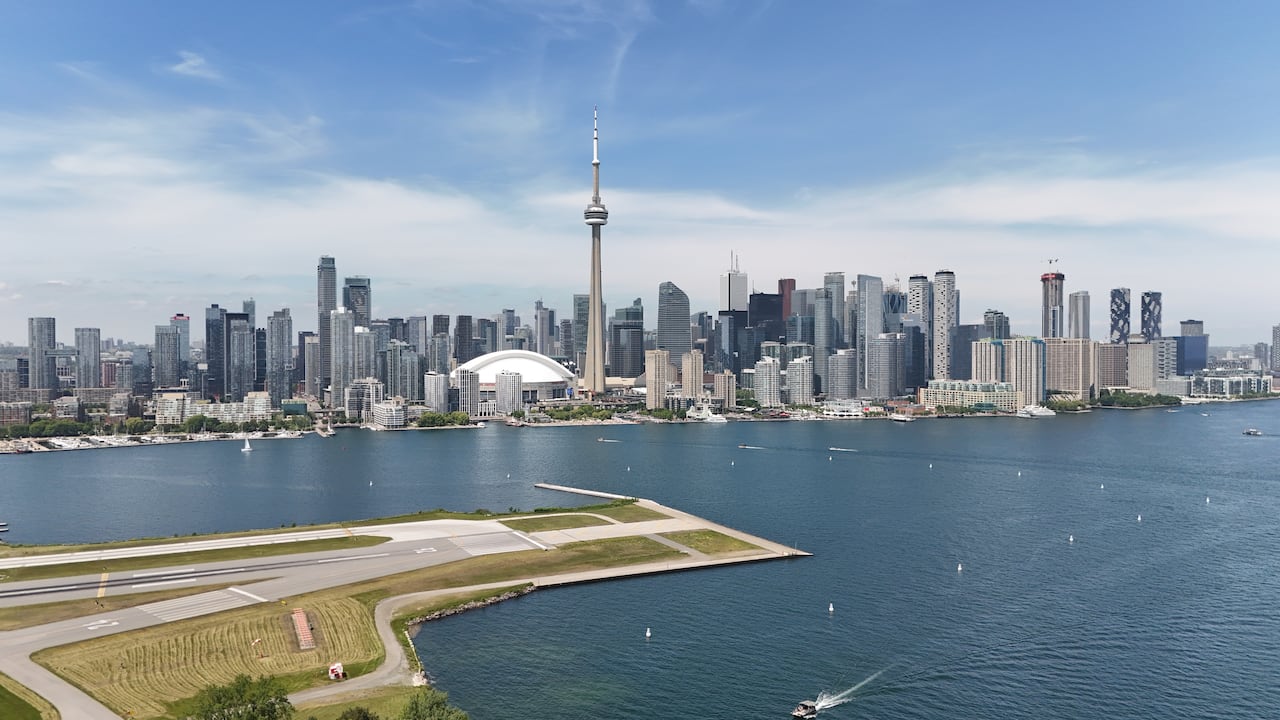 Expanding Billy Bishop airport to accomodate jets would cost $4 to $5 billion, according to the port authority’s CEO, though the agency has yet to release a detailed plan. (Patrick Morrell/CBC)
Wilson, with the port authority, said “it is our expectation that future changes will be self-funded by the airport,” but did not entirely rule out potential contributions from Nieuport.
“Until a plan is finalized, we cannot say how any of the active and important tenants and operators at the airport, such as Nieuport Aviation, intend to participate or finance any future operations at the airport,” wrote Wilson.
CBC News asked Nieuport Aviation if it plans to contribute to the cost of the expansion. Communications manager Ryan White said questions should be directed to the port authority.
Lazar says if his predictions about lower passenger numbers are correct, the port authority will be “in for a shock.”
“They’re only going to have three options. One: go to the federal government to be bailed out, two: increase these [user] fees, or go through some bankruptcy restructuring. None of them are attractive options.”