
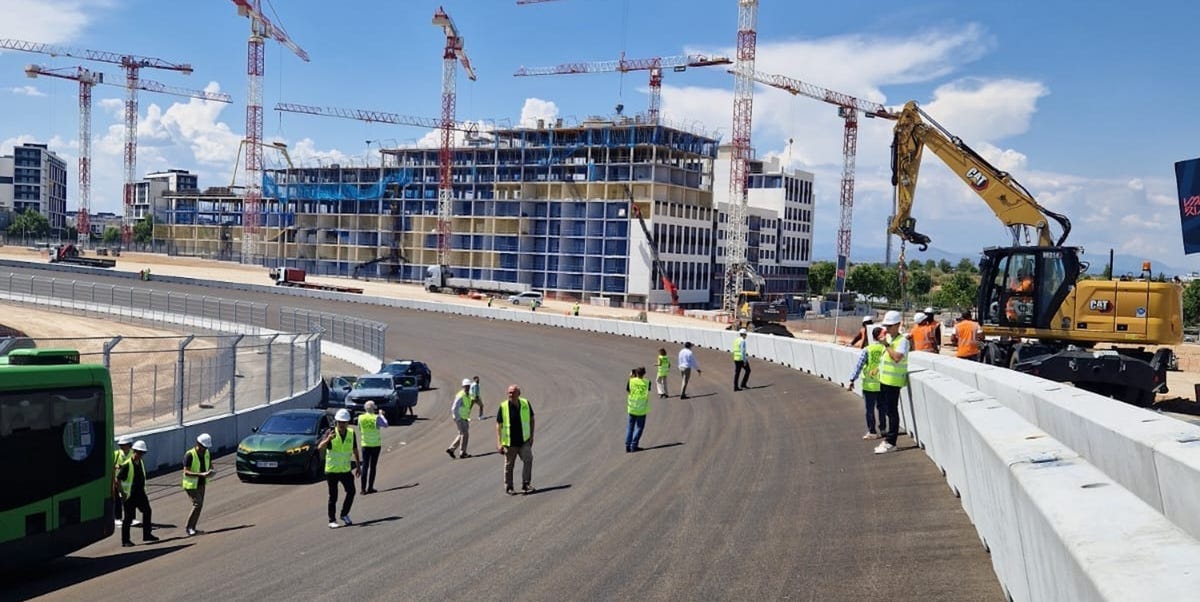
Organizers of the Madring, the new home of Formula 1’s Spanish Grand Prix, held an unveiling event on Tuesday in Madrid to showcase the new circuit. Autoweek rounds up some of the main takeaways.
La Monumental will be impressive
The 3.3-mile circuit features 22 corners, and there are other challenging sections, most notably Turn 5—a fast left-hand kink that comes after a lengthy full-throttle section that gradually bends right, while Turn 20 is also expected to provide a challenge as one of the heaviest braking zones and tightest sections.
It is likely to be a high-speed layout, with the only uninspiring sections of track being the final couple of corners, which are simply flat and forgettable 90-degree bends given the limitations of the landscape. The 90-degree left-hand Turn 1/2 section also has the potential for track limits and corner cutting arguments given its layout and tarmac run-off – akin to the first complex at Saudi’s Jeddah circuit.
But already there is one corner that is being talked about, which will be the showpiece of the circuit, and indeed among the most revered sections on the championship’s calendar.
 VIEW GALLERYTHOMAS COEX//Getty Images
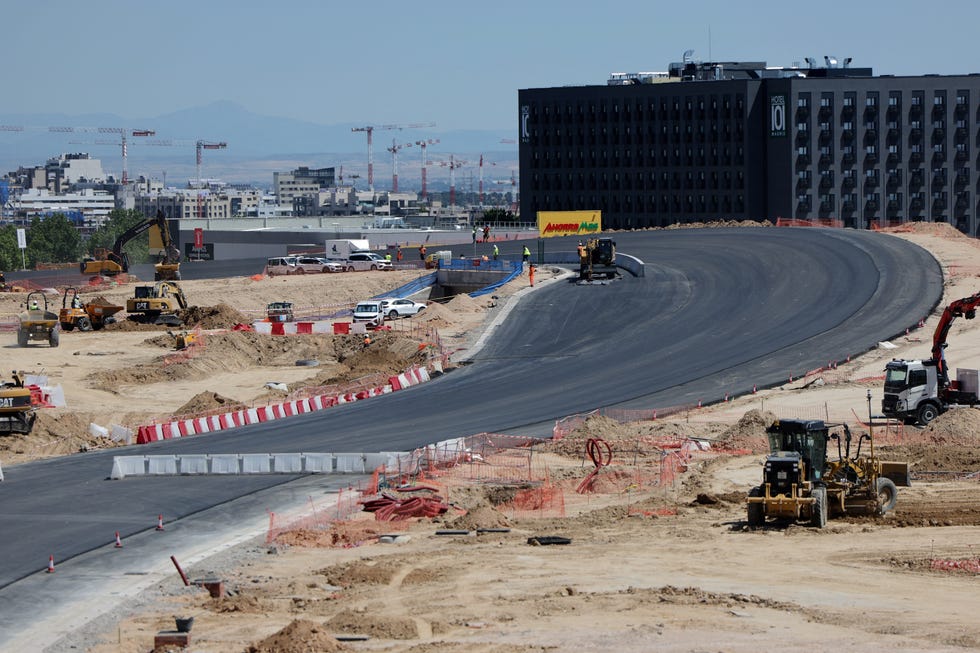
Madring’s La Monumental under construction last month.
At the far end of the circuit, La Monumental stretches out for about 1,805 feet (550 meters) at an angle of 24 degrees at its steepest, and it is quite the climb from the bottom to the top of the 39-foot (12-meter) -wide track. The exit of La Monumental is also angled, nearly blind, and effectively fires the drivers skywards and then swiftly down into the next undulating section of the circuit, a medium- to high-speed blast between the walls with little room for mistakes. Multiple lines are also expected through La Monumental while it will place an extreme stress on the tires owing to the speed and duration of the corner.
Split sections using IFEMA’s structure
IFEMA is one of Europe’s largest exhibition centers, hosting dozens of conferences each year, and the existing structure is being repurposed to cater for Formula 1. Naturally, officials at IFEMA know how to host events—similar to when Formula 1 rocked up at Miami’s Hard Rock Stadium in 2022.
A large cavernous paddock will be stretched out across multiple areas, including the usual European motorhomes, while naturally given this is modern Formula 1 there will be several VIP areas. The facility is effectively split in two by a highway, with the sections on IFEMA’s land connected to the higher-speed permanent parts of the track on the surprisingly undulating Valdebebas area of land that is owned by the organizers—which even features some Spanish Civil War bunkers above Turn 9 that are protected by law. It means that the grand prix ticketing will effectively be split in two, the IFEMA and Valdebebas section, and the two cannot overlap. The fan zone in the Valdebebas district is expected to be among the largest of the year, with grandstands lining each side of the circuit.
Event organizers intend to heavily leverage IFEMA’s location close to Madrid’s Barajas Airport—just two metro stops away—and its proximity to downtown Madrid. The split nature of the facility means those on the IFEMA side are encouraged to use the metro while those on the Valdebebas side will use the main railway line, reducing the need for cars and traffic jams usually associated with motorsport events, and helping Formula 1’s sustainability ambitions.
And, if you’re a fan of flags, the largest flag in Spain was unveiled, which will be located on the outside of the first complex.
It will be ready…
One takeaway from a tour of the venue and circuit is simply the volume of personnel and relentless noise of construction ongoing—as well as the visuals of what looks like a circuit winding its way through an enormous building site on barren land. The circuit itself is fundamentally completed, the tarmac has been laid, and the largest areas of work are being placed on the fan areas on the Valdebebas side of the venue.
Officials have stressed that there is no doubt they will be ready in just under three months’ time.
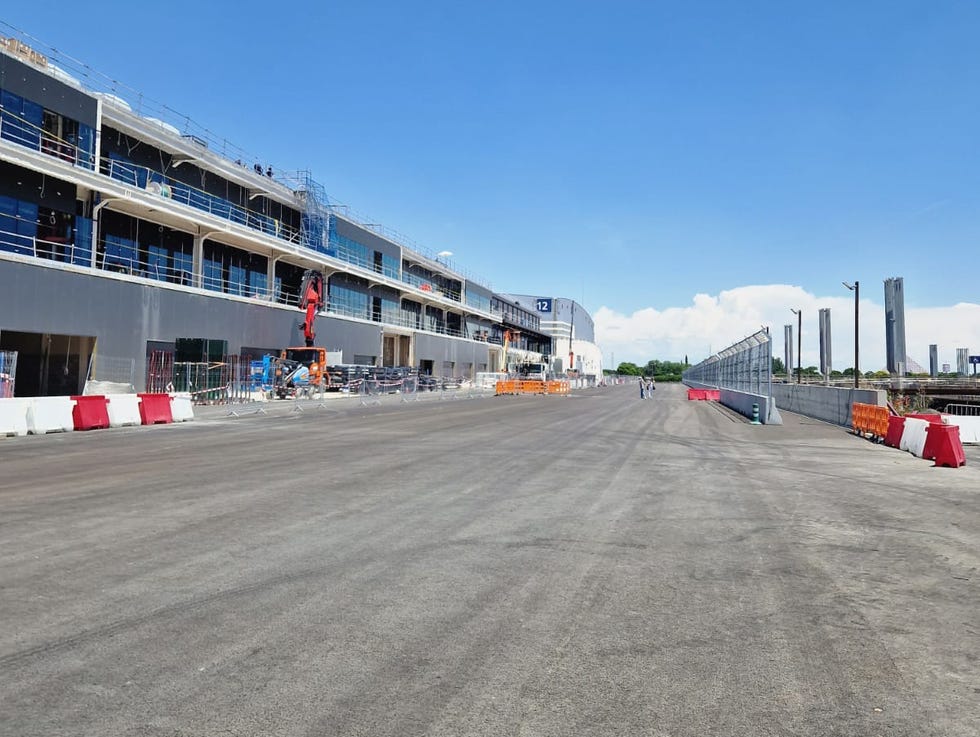
There is also a significant amount of work being undertaken on the permanent pit buildings, which are located either side of the main IFEMA entrance. That means there will be a gap between the teams in the pit lane, while the length of the pit lane itself will influence race strategy, owing to the pit lane loss time expected to be high—though some of that time will be made up by the pit lane feeding drivers back onto track after the exit of Turn 3.
Phillip Horton
Event organizers are planning to hold a Formula 3-level test event in late August, a couple of weeks ahead of Formula 1’s arrival, in order to check systems and ensure as smooth a running as possible. Officials have stressed that there is no doubt they will be ready in just under three months’ time. Suggestions that the facility won’t be ready to host Formula 1 were rubbished and, while it might be a bit rough around the edges in places, some previous new venues were in a far less ready state at this stage of development, and every deadline set so far during the build process has been met.
Long-term vision—and Barcelona wants back
The Madring has a contract to hold Formula 1’s Spanish Grand Prix through 2035, and it is clear organizers are already thinking about what can be evolved for 2027, 2028, and beyond, aware that there will be natural teething issues and lessons learned from 2026’s impending event.
But what Madrid’s arrival has done is force Barcelona into action; it hosted Formula 1’s Spanish Grand Prix from 1991 through 2025, and last weekend held one last event under its existing contract under the Barcelona-Catalunya name. It holds a contract for 2028, 2030, and 2032, effectively alternating with the Belgian Grand Prix, fitting F1 CEO Stefano Domenicali’s idea for some venues to rotate. But it is understood that Barcelona is already exploring ways to return on an annual basis, an ambition that won’t be straightforward given the return of Portugal and Turkey in 2027 and limited calendar space.

U.K.-based Phillip Horton started covering Grands Prix while still at university and swiftly deemed that writing about Formula 1 and the behind-the-scenes machinations was much more engaging than reading centuries-old novels. Degree gained, he went on to cover the sport full-time from 2014 and is as intrigued and excited by the destinations Formula 1 visits during its lengthy annual world tour as the racing itself. Phillip joined Autoweek in 2021 and while he has just about learned to spell in American English he has yet to find anywhere in America that makes a proper cup of tea.