
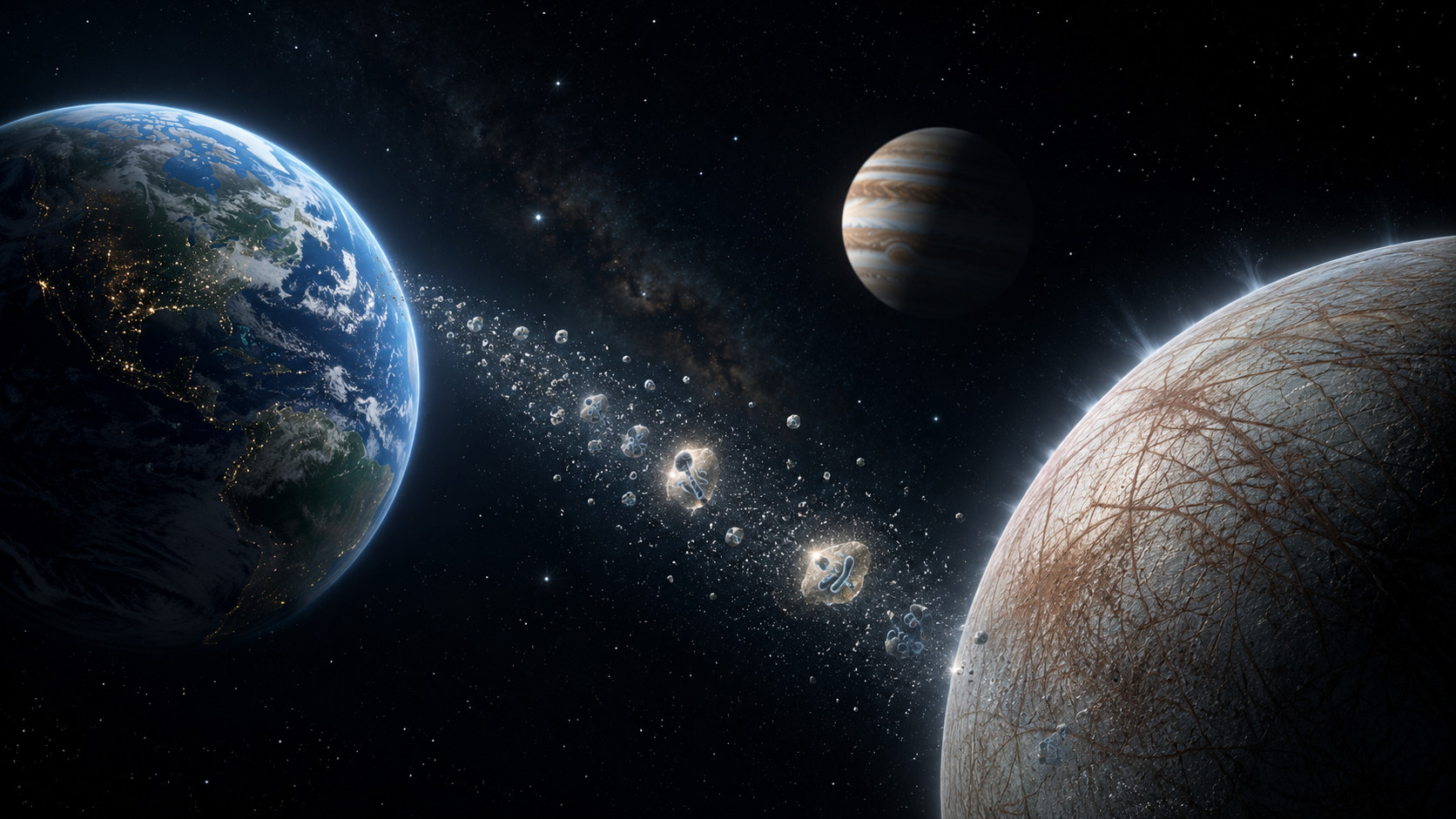
 AI-generated illustration. Credit: ZME Science.
Every second, hypervelocity collisions may be blasting tiny flecks of Earth into space. Some of those grains, small enough to ride sunlight against gravity across the Solar System, may once have carried bacteria. A new study asks an audacious question: Could any of them have traveled all the way to Europa, the ice-covered moon of Jupiter, survived the crash, and eventually slipped through the cracks of its giant ice sheet and into its buried ocean?
The answer, according to Zaza Osmanov, a physicist at the Free University of Tbilisi in Georgia, is yes — at least in principle.
In a new paper just published in the International Journal of Astrobiology, Osmanov argues that Earth could have theoretically delivered vast numbers of bacteria-bearing dust grains to Europa over tens of millions of years. If Europa’s ocean can support Earth-like life, he writes, that makes the presence of life there “highly plausible.”
That is a provocative claim. Europa has long ranked among the best places in the Solar System to search for alien life, precisely because it may have everything life needs: a global ocean, a rocky seafloor, chemical energy, and protection under a shell of ice. This interpretation assumes a second genesis of sorts, where life may have independently appeared there as it did billions of years ago on Earth. But the new study raises a stranger possibility. If Europa is alive, its life may not be fully alien. It may be distantly related to us.
An Unlikely Route Across a Huge Solar System

What Osmanov is alluding to belongs to a family of hypotheses called panspermia — the possibility that life can move between worlds.
Usually, panspermia is discussed in the other direction. Some scientists have wondered whether life on Earth may have started elsewhere, perhaps on Mars, then arrived here inside rocks blasted into space by impacts. Meteorites from Mars are surprisingly common and years before humans mastered metallurgy, some fashioned iron objects from such impactors. One famous example is Tutankhamun’s meteorite dagger, although this one probably didn’t come from Mars.
Osmanov’s perspective is a bit of reverse panspermia: not life arriving on Earth, but hitching a ride elsewhere.
“Life on Earth originated at least 3.55 billion years ago, which implies that for approximately that long, Earth has been shedding life-bearing particles into surrounding space,” Osmanov wrote in the study. “Hence, if favorable conditions exist elsewhere in the Solar System and can be accessed by dust particles, the transport of life from Earth appears plausible and may have been occurring over the course of several billion years.”
×
Thank you! One more thing…
Please check your inbox and confirm your subscription.
The proposed vehicle is not a meteorite. It is dust.
Dust grains about a micron wide — roughly the size of many bacterial cells — can carry microbes. Osmanov’s model begins high in Earth’s atmosphere, around 150 kilometers up, where collisions with incoming cosmic dust could jolt local particles to speeds above Earth’s escape velocity. In the study, such grains could leave Earth at up to about 14 kilometers per second, fast enough to break free from the planet’s gravity.
Once loose, the grains would be slightly pushed by sunlight and tugged by the gravity of nearby objects, including the Sun and Jupiter. Sparse material in interplanetary space would slow them slightly. Osmanov modeled these forces and found that some grains could reach the region of Jupiter moving at about 20 kilometers per second relative to the planet.
Could It Really Happen, Though?
 Fractures on Europa’s ice sheet. Credit: NASA/JPL/University of Arizona
Europa is not an easy place to land. It’s even harder to penetrate its 18-mile-thick ice sheet.
A dust grain arriving from Earth would strike the surface at tremendous speed. Most impacts would sterilize whatever the grain carried. Osmanov estimates that bacteria could survive only if the grain hit at an extremely shallow angle, about one degree relative to the surface.
In his calculation, only about three in every thousand potentially life-bearing grains would survive the impact. Already slim odds are diminishing. And that’s not all.
Even then, survival on Europa’s surface would be temporary. Radiation from Jupiter bombards the moon’s ice.
So, the dust grain would need a second stroke of luck. It would need to land in a place where Europa’s ice breaks, shifts, melts or overturns quickly enough to carry it downward before radiation destroys it.
Many Ifs and Many Particles
If all the stars and planets align, such places may be possible. Europa’s surface is scarred by ridges and cracks where blocks of ice appear to have fractured and moved. In the study, Osmanov points to potentially helpful terrain, which may cover 20 to 40 percent of Europa’s surface, and to earlier work suggesting that parts of the ice shell can fracture on time scales of thousands to tens of thousands of years.
If a surviving bacterium-bearing grain landed in the right place, it might be sealed into the ice and eventually transported toward liquid water below.
That is a lot of “ifs.” But Osmanov’s argument depends on large numbers. Earth sheds so many dust grains, over so much time, that even unlikely events may happen eventually.
After accounting for direction, timing, Jupiter’s gravitational reach, Europa impact probabilities and shallow landing angles, the paper ultimately estimates that about 320 million dust grains carrying potentially surviving bacteria could hit Europa every second. Over 30 million to 80 million years, that adds up to roughly 300 sextillion to 800 sextillion grains.
That brings us to a grand total of about 3 × 10²³ to 8 × 10²³ particles — close to a mole of particles, the scale chemists use when counting atoms and molecules.
Why You Should Remain Skeptical
 An artist’s interpretation of liquid water on the surface of the Europa pooling beneath chaos terrain. Credit: NASA/JPL-Caltech
The study does not show that Earth life reached Europa. It shows that, under a set of assumptions, the route may not be impossible.
Panspermia, while a plausible route for the dissemination of life across different planetary bodies, rests on many assumptions.
Other researchers have reached more pessimistic conclusions regarding the prospects of transferring life from Earth to Europa.
In 2019, H. Jay Melosh, a Purdue University geophysicist and a leading expert on impact processes, modeled the transfer of rocks from Mars to icy moons such as Europa and Enceladus. His results suggested that very little material reaches those worlds, and that transit times and impact speeds create severe survival problems.
“So, the bottom line: If life should be found in the oceans of Europa or Enceladus, it is very likely that it’s indigenous rather than seeded from Earth, Mars or (especially) another solar system,” Melosh said during a presentation at the American Geophysical Union, according to Space.com.
It’s true however that Melosh focused on rocks blasted off planets by impacts, while Osmanov focuses on microscopic dust grains lifted from Earth’s upper atmosphere. Dust is far more abundant than rocky fragments, and the grains in this model can arrive in a steady stream rather than as rare meteorites.
Still, the largest uncertainties have to do with the survivability of life across such a treacherous journey. The study assumes that bacteria can be packed inside dust grains and protected enough to survive the journey and the landing. It also assumes that Europa’s ice can move some of those grains into the ocean before radiation kills them. Each step is plausible enough to calculate some odds, but not yet proven enough to settle the question.
A Moon that Invites Bigger Questions
Before the space age, the search for life elsewhere focused mostly on worlds with ample sunlight and signs of potential surface water. Europa offers another model: a dark ocean sealed beneath ice, warmed and stirred by tides raised by Jupiter’s gravity. If hydrothermal activity exists on its seafloor, Europa could resemble parts of Earth’s deep ocean, where ecosystems thrive without sunlight.
That is why this moon has become a central target in astrobiology. Perhaps one day it may show whether life needs an Earth-like surface — or only water, the right chemistry, energy and time.
But if scientists one day find microbes in Europa’s ocean, how alien would they be?
If Europan life used DNA, RNA, proteins or a genetic code similar to Earth’s, researchers would face a puzzle. Similarity could mean life shares deep chemical rules across the universe. It could also mean Earth and Europa exchanged biology long ago. Or, more worryingly, it could raise concerns about recent contamination from spacecraft, which is why planetary protection rules are vital during missions to other worlds.
If Europan life looks completely different, the implications may be even larger. A true second origin of life in one Solar System would suggest that biology emerges readily when conditions allow. It would be a certainty that the galaxy and the universe at large must be teeming with life.
For now, no mission is ready to answer that directly.
NASA’s Europa Clipper launched in 2024 and is traveling toward Jupiter, where it will make dozens of close flybys of Europa after arriving in 2030. It will study the moon’s ice shell, ocean, composition and geology. But it is not a life-detection mission, and it will not land or drill.
The European Space Agency’s JUICE spacecraft is also on its way to the Jupiter system, though its main target is Ganymede. It will fly by Europa and other icy moons after arriving in 2031.
A mission that lands on Europa, drills through its ice and samples the ocean remains might happen in the future, but there’s no word for certain of one for now.