
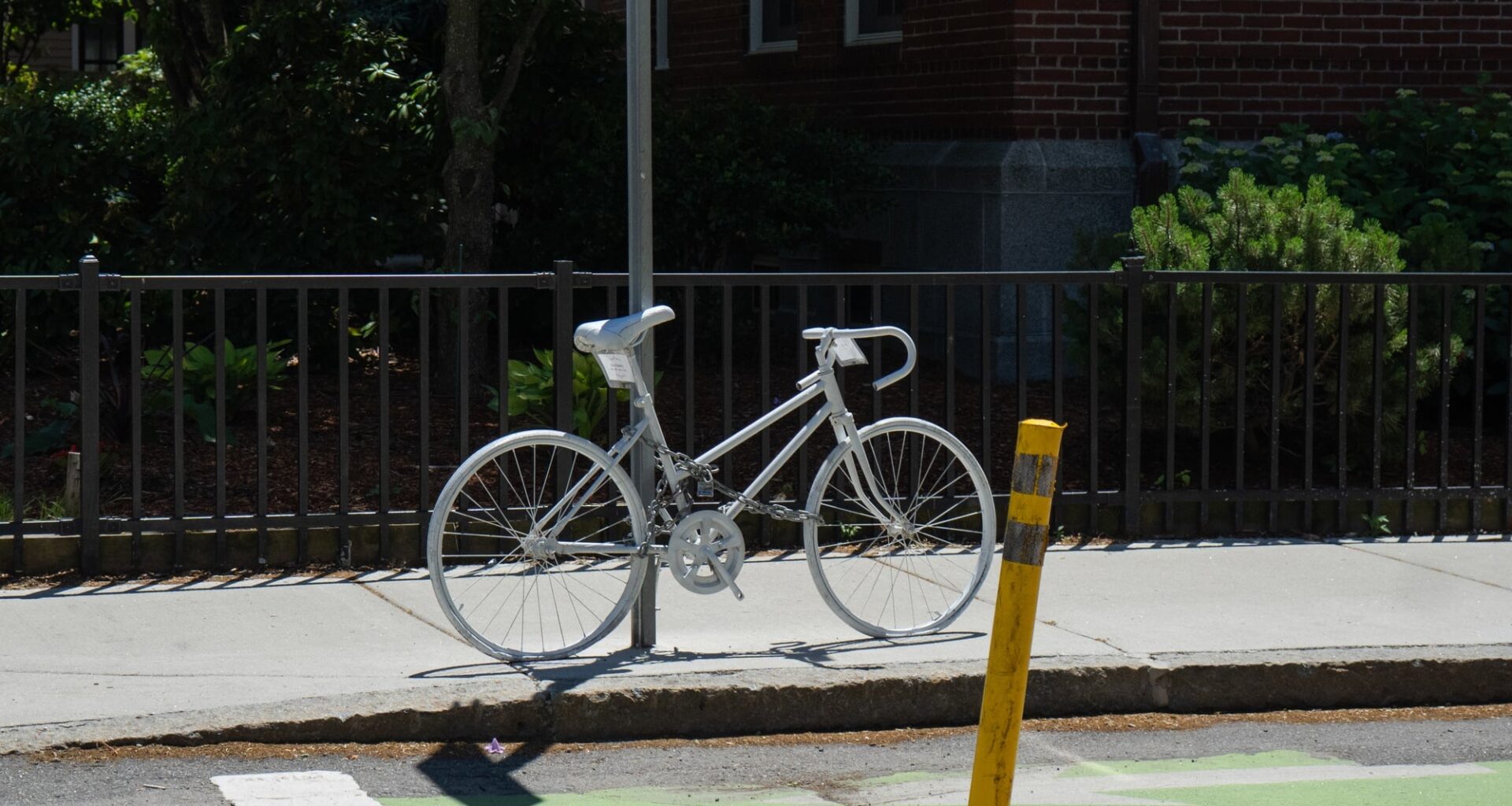
A white “ghost bike” memorial was installed at the intersection of DeWolfe Street and Mount Auburn Street last week, marking two years since cyclist Kim Staley was struck and killed by a truck there.
The memorial — a bicycle painted entirely white and placed near the site of the crash — honors Staley, a 55-year-old woman from Florida who was killed while biking in June 2024. It is the second ghost bike installed near Harvard Square.
Peter B. Cheung, a bike safety advocate who made Staley’s memorial, said he installed the bike to mark the two-year anniversary of her death. Though ghost bikes are often accompanied by unveiling ceremonies, Cheung said he placed the bike without one to draw attention to the intersection.
“We thought that this intersection is a very dangerous intersection, a very high-profile intersection,” Cheung said.
Cheung said ghost bikes are meant to memorialize cyclists and to push for safer streets, drawing attention to locations where advocates say safety concerns persist.
“We want to remind all cars to share the road for all vulnerable road users, and to be aware of cycling and the infrastructure — to get any awareness to enhance the infrastructure to make things safer,” he said.
Staley was one of three cyclists killed in Cambridge in 2024, a series of deaths that intensified calls for bike safety improvements. Two weeks after Staley was killed, Minh-Thi Nguyen, a 24-year-old MIT graduate student, was struck and killed by a truck while biking near Kendall Square. Both of their deaths remain under investigation.
In September 2024, John H. Corcoran ’84 was killed after an SUV struck him while he was biking on Memorial Drive.

Get The Crimson in your inbox.
A ghost bike was installed near the site of Corcoran’s death days later. The driver, 26-year-old Junming Zhu, has pleaded not guilty to vehicular homicide and negligence, and a trial has yet to be held.
The three deaths drew renewed calls from advocates and city officials for safety improvements in the city, including separated bike lanes. At the intersection where Staley was killed, the city later added signage allowing cyclists to turn right on red and an additional bike signal for turning cyclists.
For many advocates, the memorials are a reflection of the personal experiences that draw people into bike safety work.
Michael A. Rogove, a Cambridge cyclist and safety advocate, said his own advocacy is rooted in his childhood.
“My own father suffered a traumatic brain injury when I was a child because of bad street infrastructure,” Rogove said. “As a kid, after that point I became terrified of riding a bike, and it wasn’t until I became an adult that I started doing it again.”
Rogove said ghost bikes serve a dual purpose: calling attention to dangerous road conditions while creating a lasting monument for cyclists who were killed.
“It’s definitely an awareness thing, and it’s also a form of memorializing and respecting the dead,” he said.
Though memorials for bike deaths have appeared in the Boston area for decades, Galen M. Mook, a bike advocate who helps coordinate the memorials, said local advocates have spent the last 15 years building a more organized network around the memorials.
Mook said his involvement with ghost bikes began in 2012 after the death of Chung-Wei “Victor” Yang, a 21-year-old Boston University student who was killed in a collision with a bus in Allston.
“I personally came upon the crash scene walking in Allston while he was being literally put into the ambulance,” he said. “His bloodied Red Sox baseball cap was still on the street.”
Staley’s memorial is the second ghost bike installed in Harvard Square and among at least a dozen in Cambridge, according to a Cambridge Bicycle Safety tracker. The first in the Square was installed in 2020 after Darryl Willis was killed in a collision with a tractor-trailer on Massachusetts Avenue, across from the Smith Campus Center.
Cheung said the ghost bike ceremony became the only memorial service held for Willis.
“He never had a proper funeral or ceremony, and we had our ghost bike ceremony,” Cheung said. “They had flowers and balloons and everything, and that was the only service this person had when he passed away.”
Mook said families and friends often return to the white bicycles years after a crash, leaving flowers, tending the memorials, and gathering on anniversaries. In that way, he added, the ghost bikes become more than symbols of advocacy.
“That’s probably the most important thing,” he said. “That it’s actually used as a tool for grieving and processing for those who are close to the victim.”
—Staff writer Shawn A. Boehmer can be reached at [email protected] and on Signal at shawnb.18. Follow him on X @ShawnBoehmer.
—Staff writer Risha Sinha can be reached at [email protected] and on Signal at rishas.13.