
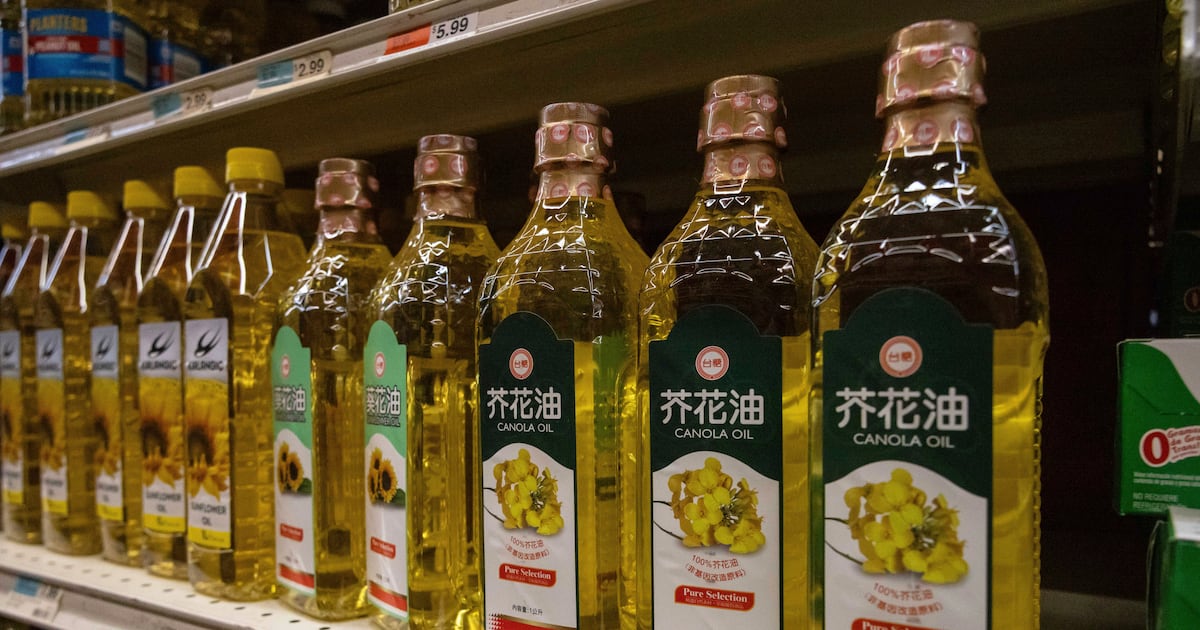
As China begins subjecting Canadian canola to new tariffs, industry leaders are calling for Canada to diversify trade of the crop. Allison Bamford reports.
Long before China imposed its anti-dumping duty on Canadian canola seed and 100 per cent tariffs on canola oil and meal, industry leaders had been looking to diversify away from the unpredictable market.
A big opportunity lies in the biofuel market both in Canada and the United States.
“Canadian canola is a terrific feedstock for producing renewable fuels,” said Chris Vervaet, executive director of the Canadian Oilseed Processors Association.
Canada’s clean fuel regulations are driving demand for low carbon renewable fuels, such as biodiesel and renewable diesel, Vervaet said.
Domestic production is growing, but canola isn’t the preferred feedstock.
Used cooking oil and other waste oils – products that are cheaper to source – make up the bulk of the biofuel feedstock.
“Currently, canola has a piece of that pie. It’s not the size of the pie that we want,” Vervaet said.
If canola were to capture half of the biofuel market, in terms of being the preferred feedstock, Vervaet said that would equate to roughly 2.5 million tons of canola, which is nearly half of the seed that is exported to China annually.
“We’d go a long way in addressing the concern that’s in front of us right now,” he said.
Vervaet said the industry would like to see the federal clean fuel regulations implement guardrails to prevent the use of “questionable” feedstock and imported used cooking oil in biofuel production.
“The imported used cooking oil that’s coming into our biofuel market is eating canola’s lunch. It’s taking market share away from us when we need it most,” he said.
Canola prices have dropped since news of the Chinese anti-dumping duty hit. Millions of dollars in canola value have already been wiped out.
Martin Reaney, the Chair in Lipid Quality and Utilization at the University of Saskatchewan, said dropping prices could increase the appetite for canola-based biofuel.
“There’s a greater capacity to handle more of that canola oil should it become available at a more approachable price,” Reaney said.
There’s also potential for canola to tap into the sustainable aviation fuel (SAF) industry, according to North Vector Dynamics Chief Operating Officer Omar Saleh.
Canola can be used to produce SAF, which is chemically identical to conventional jet fuel, Saleh said.
“It would function on existing airport infrastructure in terms of refueling infrastructure. It would function with the same engines that we have today,” he said.
SAF is already being used by the U.S. Air Force. Australia is manufacturing it, and Air Canada purchased this country’s first commercial batch last year.
“We’re already producing it. We’re just doing it on a really small scale, and so is the U.S. and so is the EU,” Saleh said.
Saleh said Canada would need to expand its canola crushing capacity and upgrade some of its facilities to manufacture canola-based SAF, but the infrastructure is already there.