
“Imagine Midjourney for CAD, but with fully editable results and a smoother, more intuitive human-to-computer interface.”
This is Engineering Paper, and here’s the latest design and simulation software news.
Autodesk has published new details on neural CAD, its AI models for 3D design first announced at Autodesk University 2025 last September.
“Autodesk is building these professional-grade, AI foundation models specifically to reason about and generate precision 2D and 3D CAD information,” wrote Mike Haley, leader of Autodesk’s Research group, in a new paper on neural CAD.
In it, Haley describes how neural CAD could radically change the current 3D design paradigm (a CAD revolution, if you will).
“With neural CAD, you will be able to launch your ideas by speaking about them, typing them, drawing them, or uploading images. You will watch the neural CAD engine reason through your request and produce highly detailed CAD objects and assemblies,” Haley wrote.
Sounds intriguing, right? Unfortunately, it remains hypothetical. The nearly 3,000 word paper on neural CAD is scant on new information. Embedded videos show off AI features we’ve known about for ages, such as Fusion AutoConstrain, which has been live since early last year, and Forma Building Layout Explorer, an experimental feature in Forma Site Design (and one that’s reminiscent of a generative design application Autodesk was touting back in 2017). There was also a mention of text-to-CAD with reference to 2024’s Project Bernini.
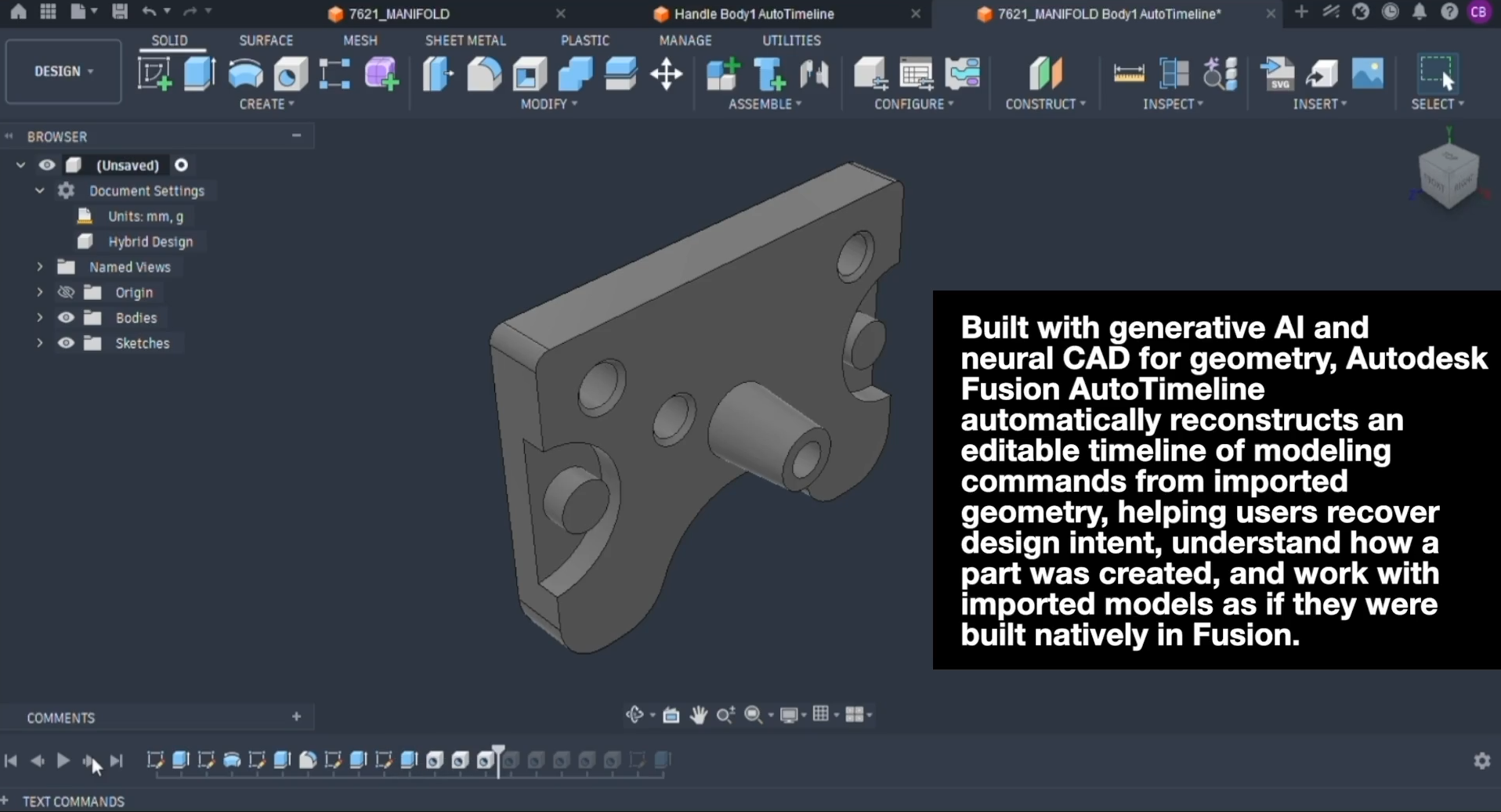 Screenshot of Fusion AutoTimeline. (Image: Autodesk.)
There were two AI features I hadn’t seen before. One was called Fusion AutoTimeline, which generates a parametric history tree for a dumb solid. That would be useful for imported parts, but there was no mention of when it will be available. The second was called Project Quill, which lets users turn rough sketches and text annotations into nice sketches and renders. AI image generation isn’t exactly novel, but it looked like a nifty interface. Again, no word on availability.
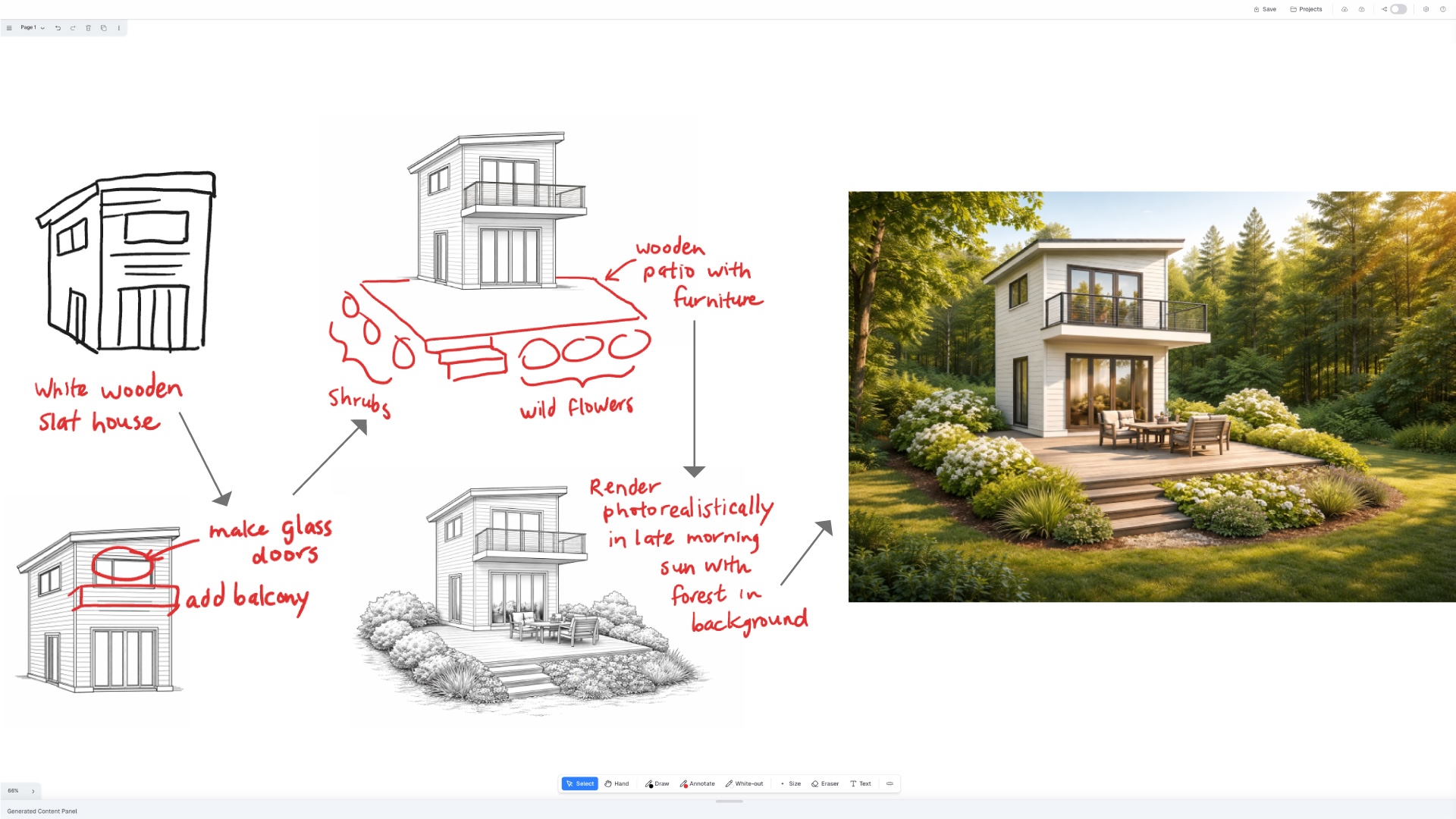 An example of Autodesk’s Project Quill. (Image: Autodesk.)
When it was first announced, I asked whether neural CAD was worth getting excited about. Then, and now, the answer is not yet. Until these capabilities exist on users’ computers, neural CAD is nothing more than—to borrow a term from Haley—AI washing. But I look forward to seeing them if and when they’re released.
On demand: Design and Simulation Week 2026
Last week was Engineering.com’s third annual Design and Simulation Week, a series of webinars exploring the latest in engineering software.
I gave a quick overview of the five presentations last week. If you missed any of them, they’re now all available on demand.
Thanks to all the speakers and to everyone who tuned in.
Quick hits
IMSI Design has released TurboCAD Mac 17, the latest version of its 2D and 3D CAD suite for macOS. Along with interface improvements and new modeling tools, the release augments the Copilot plugin with Copilot Render for generative rendering and Copilot Part Finder, which uses natural language to search for parts.
PTC has launched PTC Orbit, a new “cloud-native asset intelligence solution” that connects “PLM, ERP, CRM, IoT, EAM, and FSM systems into a single, unified asset record.”
Leo AI is now available as an app within Onshape, according to Leo CEO Maor Farid.
One last link
Sports fans aren’t the only ones enjoying the World Cup. Simulation fan Ed Fontes, VP of development at Comsol, analyzed the 2026 match ball in Modeling the Beautiful Game: From Ball Design to Power Trivelas.
Got news, tips, comments, or complaints? Send them my way: [email protected].