
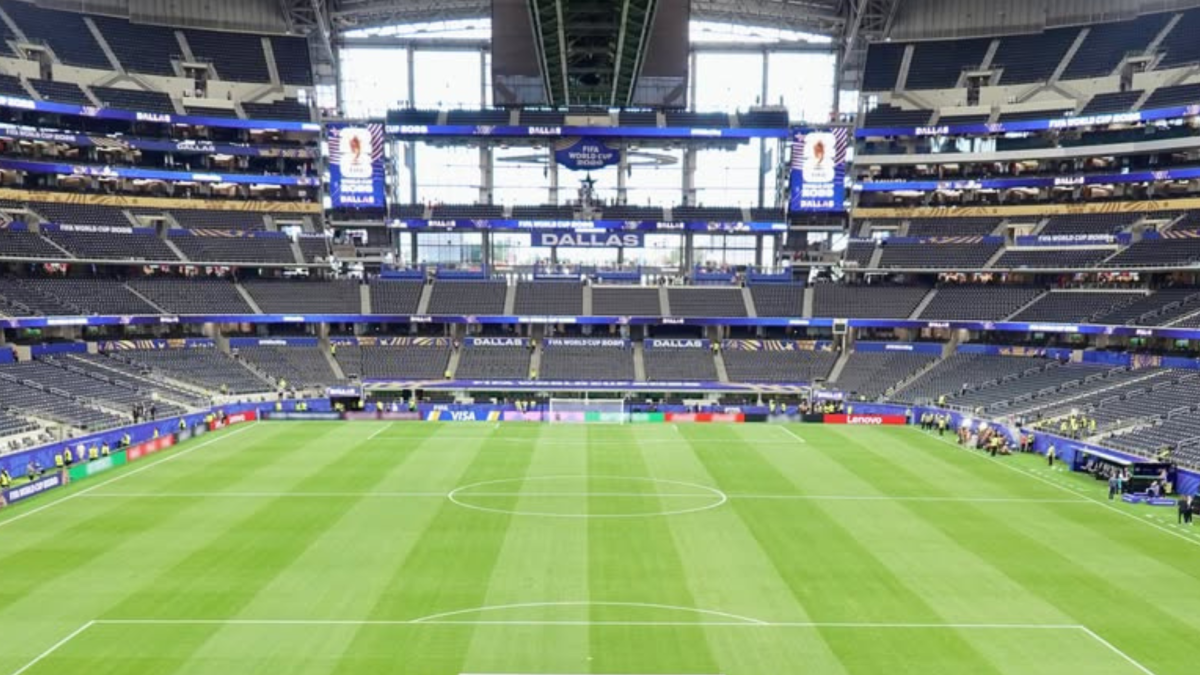
While some of the world’s best soccer players are competing on natural grass installed specifically to meet FIFA standards, many of those same stadiums will remove that grass once the World Cup ends and return to the artificial turf used during the NFL season.
The question is unavoidable: if those stadiums can provide natural grass to protect players during a World Cup, why not do the same for the NFL players whose talent generates billions of dollars every season?
Patrick Mahomes dropped a subtle clue about who he’s backing at the World Cup
The turning point that changed nothing
The debate intensified in 2023 when Aaron Rodgers suffered a torn Achilles tendon on just his fourth snap as a member of the New York Jets while playing on the artificial surface at MetLife Stadium. Days later, the NFL Players Association (NFLPA) once again called for all NFL stadiums to switch to natural grass, arguing that players overwhelmingly prefer it and that the data shows it is the safer surface.
A study published in 2024 in the Orthopaedic Journal of Sports Medicine, which analyzed 718 injuries during the NFL’s 2021 and 2022 seasons, found that lower-extremity injuries occurred more frequently on artificial turf than on natural grass. The study also found that injuries requiring season-ending surgery were significantly more likely to occur on artificial surfaces.
Data collected by the NFLPA shows that players suffer 28% more non-contact lower-extremity injuries on artificial turf. Non-contact knee injuries occur 32% more often, while non-contact foot and ankle injuries are 69% more common compared to natural grass. Researchers believe the difference is largely due to the greater traction and resistance provided by artificial turf, which places additional stress on joints and ligaments during sudden changes of direction.

Kansas City Chiefs safety Deon Bush is carted off the field after an injury
Despite that evidence, nearly half of NFL stadiums still use artificial surfaces. Ironically, several of them were required to install natural grass for the 2026 World Cup, including MetLife Stadium, which will host the tournament final.
During the World Cup, 11 NFL stadiums will host 78 matches on high-quality natural grass fields installed specifically to satisfy FIFA requirements. Once the tournament ends, many of those same venues will return to artificial turf despite an NFLPA survey showing that 92% of NFL players prefer natural grass.
The contradiction is difficult to ignore: if these expensive field conversions are considered worthwhile for a tournament lasting only a few weeks, why aren’t they worth it for the players who compete in those stadiums year after year?
The NFL’s justification
Owners often argue that artificial turf is more cost-effective and makes it easier to host concerts and other events throughout the year. However, that argument becomes less convincing when considering the scale of the business. The NFL generates more than $23 billion in annual revenue, and industry estimates suggest replacing every artificial surface in the league would cost roughly $12 million, a relatively small amount compared to the league’s overall earnings.
Furthermore, maintaining natural grass could prove less expensive in the long run if it helps reduce injuries. Every injured player represents millions of dollars in salary paid to athletes who are unable to perform, along with the competitive damage to franchises and the loss of entertainment for fans. When a star player misses months because of an injury, teams lose, fans lose, and the league loses.
FIFA did not hesitate to require natural grass to protect players during the World Cup. The tournament has shown that the change is possible. Now the NFL faces an increasingly difficult question: if it can be done for soccer players, why are NFL players still waiting?