
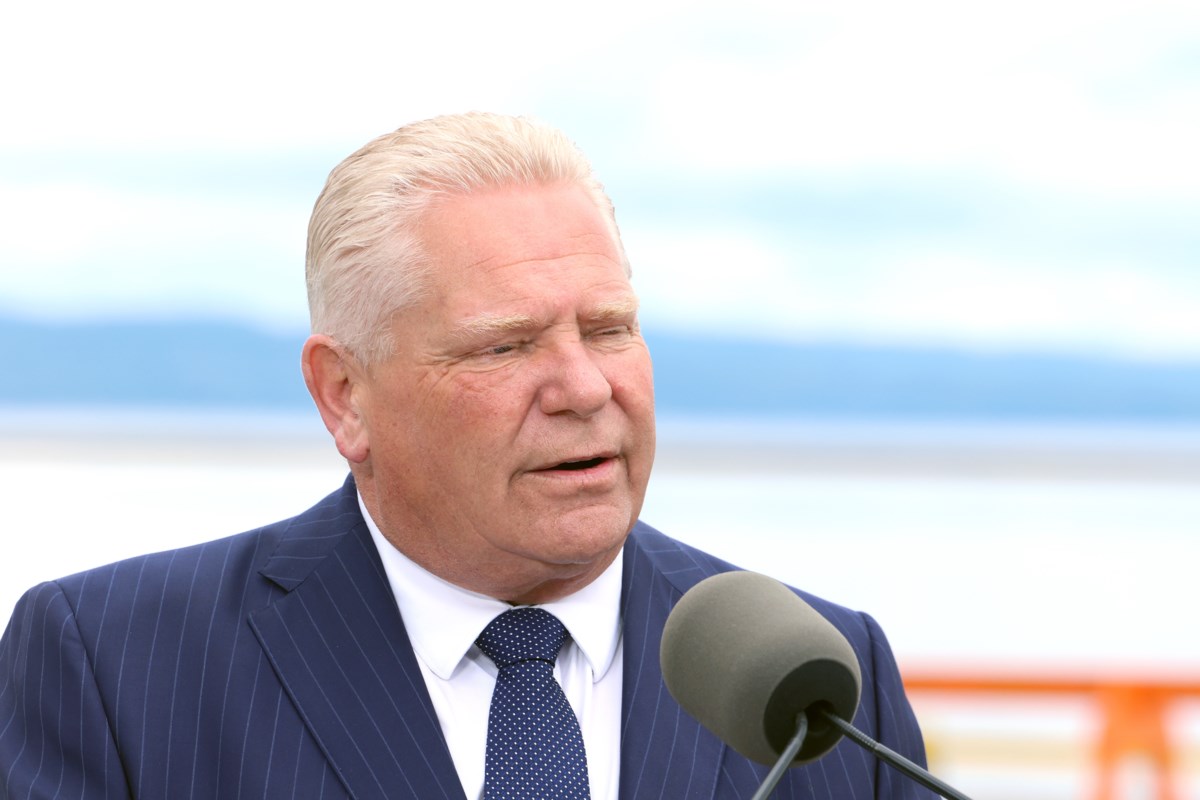
First Nations’ drinking water is a federal responsibility says Doug Ford, responding to a question about calls to shut down the Dryden mill.
THUNDER BAY – The call to shut down the Dryden mill over the ongoing impact on mercury contamination downstream is “a big responsibility on the federal government,” said Premier Doug Ford on Tuesday.
“We do more for the First Nations than the feds. Ten times more,” he said at a press conference in Thunder Bay. “On reserve, the federal government should be supporting the Indigenous communities.”
“Number one priority is to have clean drinking water for everyone in Ontario, but again, where are the feds? Where are they?” he said.
“We’re pouring money into First Nations. I’d love to support them any way we can,” said Ford.
In the 1960s and 1970s, the then-owners of the Dryden mill dumped nine to ten metric tonnes of mercury into the Wabigoon River, contaminating the fish that the community consumed, and leaving generations of people from Grassy Narrows First Nation (Asubpeeschoseewagong Anishinabek) and Wabaseemoong Independent Nations with Minamata disease.
Today, the contaminants in the mill’s effluent are reacting with the mercury that is still there and forming methylmercury, the most toxic form of the chemical. This was discovered in 2024 after biologists with Western University conducted a study commissioned by the province.
“The chemistry of water that’s being discharged from the mill in Dryden today is amplifying the mercury problem above what we would expect it to be if that discharge were not occurring,” said biologist Brian Branfireun at the time.
The two communities have continue to protest the mill’s ongoing contamination of the river system since the study was released.
Ford made his comments the same morning the federal government reintroduced its First Nations Clean Water Act, Bill C-37.
Last year, Ontario and Alberta’s environment ministers wrote a letter suggesting the act, then dubbed Bill C-61, should be dropped to support economic development.
When asked by a reporter if his position has changed, given his comment that clean drinking water is a number one priority, Ford said that both economic development and clean water can coexist.
“I’d have to look into it, but we believe in having clean drinking water for everyone, including First Nations. So that’s a priority, but I haven’t seen that bill,” he said.
“Let’s have clean drinking water and let’s move fast to create more economic development. It can be done, both.”
He added that he may have more to say after looking into the newly proposed bill.
On Wednesday, Grassy Narrows protesters brought their message to Ottawa, calling on Prime Minister Mark Carney to apologize for comments he made when protesters disrupted a press conference in April and carrying the photos of loved ones who have died of mercury poisoning.
“We’re hoping the government sees how many people we’re losing,” said Grassy Narrows Chief Sherry Ackabee in a Facebook video recoded on Parliament Hill.
“How young they are,” she continued. “They’re dying from a lot of sicknesses due to the mercury poisoning.”
Absorbed through the digestive tract, methylmercury distributes throughout the body including the brain, where it can stay, according to Health Canada. Through the placenta, or through breast milk, methylmercury builds up in the tissues and brains of fetuses and babies.
According to Health Canada, “A child’s developing nervous system is particularly sensitive to methyl mercury. Depending on the level of exposure, the effects can include a decrease in I.Q., delays in walking and talking, lack of coordination, blindness and seizures.”
“In adults, extreme exposure can lead to health effects such as personality changes, tremors, changes in vision, deafness, loss of muscle coordination and sensation, memory loss, intellectual impairment, and even death,” it continues.
People, including young people, are getting sicker, Ackabee said. “It’s very sad that the mill is still running.”
“We need justice for Grassy Narrows, for our children,” she said. “They are our future.”