
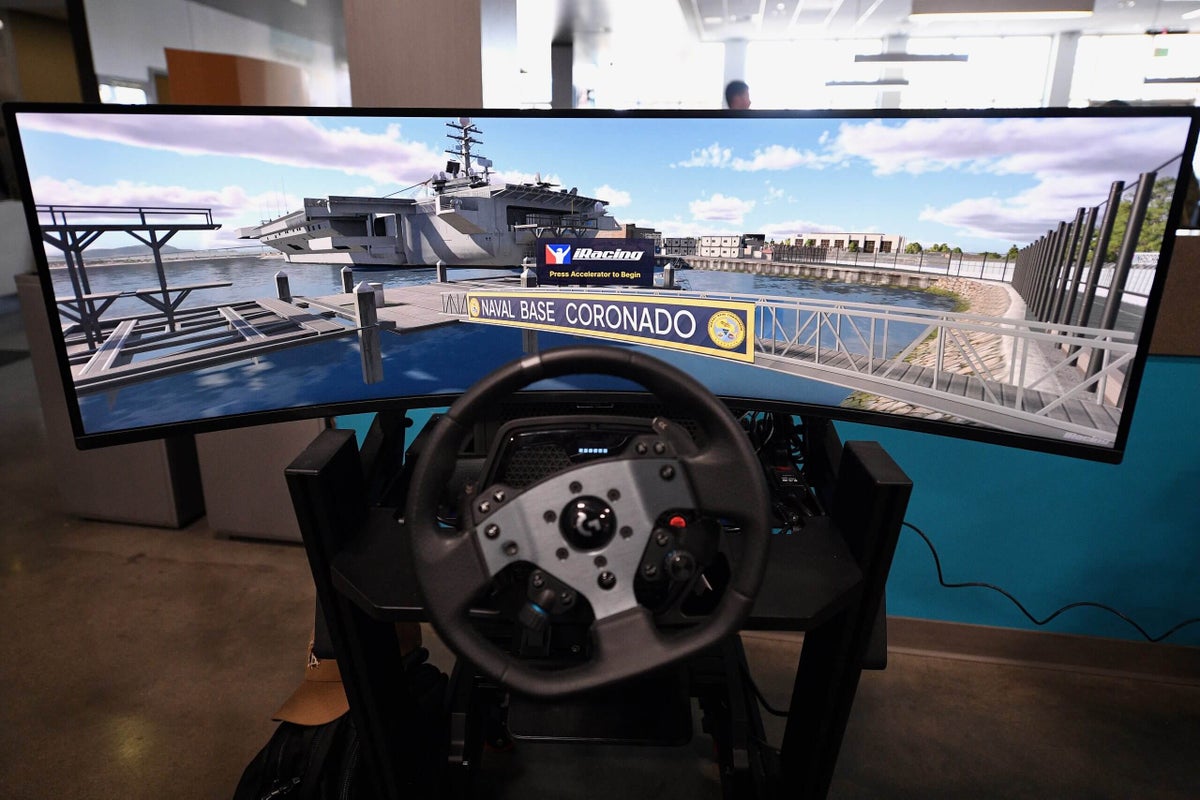
SAN DIEGO — Denny Hamlin pauses, then chuckles as he contemplates how to answer a question asking the Joe Gibbs Racing driver to reveal his process to prepare to race on a track he has never seen before. That’s the dilemma facing Hamilin and the rest of NASCAR’s drivers this weekend when the sport’s three national series compete on the temporary circuit constructed on Naval Base Coronado, across the bay from San Diego.
“My process is my secret sauce,” said Hamlin, who then provided a peek behind the curtain. “I just spend hours in (the simulator) just going half-speed to just get used to the corners. But even after I got home, I found myself that night trying to replay the lap in my head, and I forgot like the last three-quarters of the track. So it’s a process, and I feel like I’ve got it down pat now.”
Most everyone within the garage would love to know how Hamlin prepares, especially since he’s heading into San Diego riding a three-race winning streak — even if all those victories have come on ovals, while this week’s track consists of 16 turns spanning 3.4 miles in length, making it the longest on the NASCAR schedule.
Denny Hamlin scores three Cup Series victories in a row for first time
Adding to the complexity is that there is no direct comparison between San Diego’s track, the first-ever NASCAR race on a military base, and any other on the NASCAR schedule. The San Diego course is new, so taking laps in a different type of vehicle, be it a racecar or a street car, simply isn’t an option. For one thing, the circuit wasn’t completed until this week. And with it being an active base, a driver can’t just show up to inspect the layout.
Still, advances in technology have helped drivers to overcome these hurdles.
All manufacturers have huge, specially built simulators at NASCAR’s Charlotte, N.C., hub where drivers and their teams will spend time running virtual laps. The downside to this is that getting time in the simulators beyond a normally slotted session is challenging, as there can be more drivers and teams wanting access than available simulators, sometimes leaving little opportunity to fully hone in on the various aspects of a new track.
However, you don’t need a manufacturer-specific simulator to prepare. Drivers have smaller-scale simulators at home or at team shops, similar to an arcade-style racing game, allowing them to expand when and how they prepare. With custom-built sim rigs equipped with top-of-the-line wheels and pedals, the process of figuring out a new course is more streamlined than ever before.
Sim time is essential due to how little time drivers will have on the actual track before the race. NASCAR’s premier Cup Series and second-tier O’Reilly Series will each have a single 50-minute practice, while the third-tier Truck Series will have two 40-minute sessions. To just show up at the track without any sim time would leave a driver well behind their competitor.
According to Anthony Alfredo, Hendrick Motorsports’ simulator and reserve driver, that sim preparation has allowed him to shave several seconds from his initial laps to the lap times he now consistently posts at various tracks. It all happens on iRacing, an immersive virtual racing platform that allows users to closely replicate what it is like driving an actual racecar, with a level of authenticity to their virtually replicated tracks that many drivers credit for helping them develop.
“To have products that serve me as a legitimate training tool when I’m at home is pretty awesome,” said Alfredo, who also drives full-time in the O’Reilly Series for Viking Motorsports. “For this weekend, I can be at home running laps at this track that no one’s ever seen before on iRacing with a Logitech steering wheel and pedals, which is pretty neat. So, unlike other sports, you’re not necessarily going to be playing Madden and then go become the quarterback of a Super Bowl team, whereas we’re at home on our simulators … trying to prepare for the real thing because it’s the next best thing.”
NASCAR is racing on a Naval base! Check out my first lap on the new Naval Base Coronado street circuit on @iRacing with @dboxtech 🇺🇸 #nascar #racing #motorsports #race #cars pic.twitter.com/k3jvy9d7Ig
— Anthony Alfredo (@anthonyalfredo) June 10, 2026
Although every driver has their own process on how to best acclimate to a track they’ve never raced on before, there seems to be one universal first step. What they focus on initially is site markers, establishing visual cues around the track to help them know when to accelerate, brake, prepare for a particular corner, and find the right apex through said corner.
Differentiating one corner from another can be difficult, as many corner entry points offer few, if any, distinguishing features due to how the track is constructed.
“At the street courses, you have barriers on both sides, so it all looks similar,” Hamlin said. “It’s very difficult to understand the corners that you’re in, and it just takes lots of reps to really get it.”
After understanding the layout, the next step is to gradually gain comfort so drivers can begin to push themselves to make quicker laps. It is usually at this point that drivers and teams begin fine-tuning chassis setups to optimize lap times. Little by little, they go faster.
“It is usually a minimum of 30 minutes to an hour on the sim for the last three weeks,” 23XI Racing driver Bubba Wallace said. “And it doesn’t sound like much at all, but when it’s a brand-new track, that is a lot of time just to get acclimated. It took me probably the third session to finally remember what corners came after what, but now I can tell you like, ‘Oh yeah, this one’s that, this one is that.’
“I don’t know the corner numbers because there are so damn many, but just knowing which way the car and the track flow, that was really big. And so the first two times you’re trying to get a decent lap laid down without crashing, and now that you can do that, you can focus on just trying to extract more lap time out of the car.”
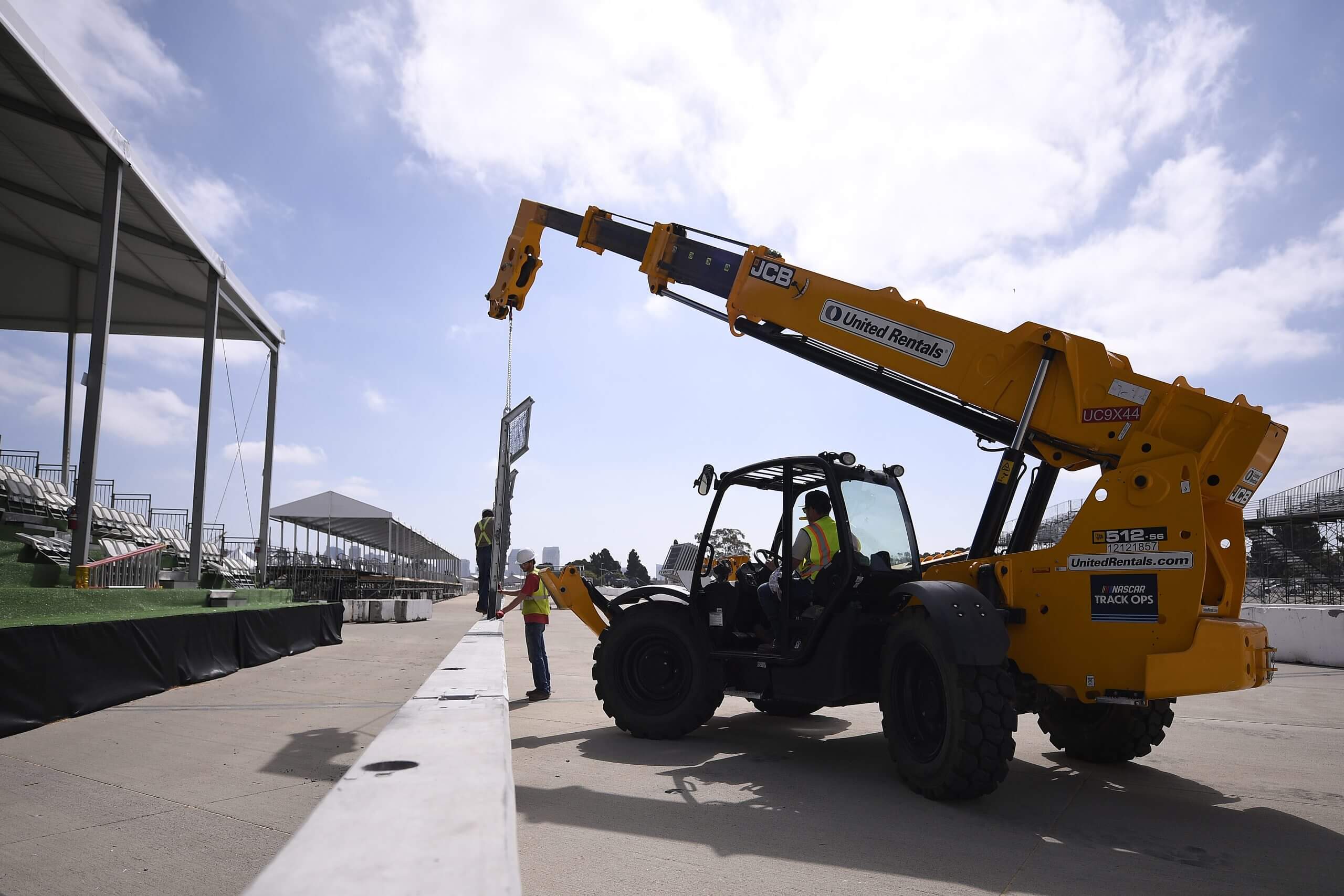
The Naval Base Coronado course was under construction until recent days, meaning the drivers’ first live look at it is coming this weekend. (Orlando Ramirez / Getty Images)
Every race week entails teams focusing on sim prep, but the difference for San Diego is just how blind drivers truly are as to what they’ll experience in real-world conditions. Several of NASCAR’s other tracks have been around for decades, and drivers have turned thousands of laps at them.
“It takes multiple times at a track to feel comfortable and feel confident going in,” Wallace said.
While San Diego is a new entity, there are some similarities to other road courses that NASCAR has raced on previously. The most comparable is the temporary street circuit built in downtown Chicago that NASCAR raced on from 2023 to 2025, though it’s not a direct comparison. Chicago featured more 90-degree turns, while San Diego has more flowing corners.
Still, Chicago is the track drivers most often compare to San Diego, in part because they had zero familiarity with that layout when it was introduced and also because of the bumpiness. The exit off Turn 1 leading into Turn 2 has particularly caught their attention, as that section features a notable dip.
“It’s definitely a jump,” Alfredo said. “I get air in the simulator across it, for sure. You come out of Turn 1, which is also really fast and really bumpy on exit, and if you hit it right and you’re carrying enough speed, you can certainly catch air as you kind of go slightly uphill … and then you drive downhill into Turn 2, which is actually really cool.
“It’s flowy, it’s got a lot of character and it’s really fast, but the way you kind of come up as the racetrack starts to fall away from you puts the car in the air for a split second — or at least makes it light as you transition across it.”
The runway meets the race track on the @Qualcomm Circuit. pic.twitter.com/cyXuruCsKY
— NASCAR (@NASCAR) June 16, 2026
What drivers experience in the sim is often nearly identical to what they’ll experience in real life, but not always. This was an issue at the first Chicago Street Course race, Hamlin said, where the banners hanging on the walls were different from those in the sim.
Why it may seem inconsequential to some, for him it was a critical difference as he was using those banners as a site markers to brake. He then had to go back and re-learn his braking points based on the signage that was actually hung.
“We’re training ourselves for weeks now that that’s our (braking) spot,” Hamlin said. “I remember going to Chicago, walking that track for the first time and saying, ‘The sign’s not there that I’m used to,’ and I started taking pictures to figure out my new mark.”
Because the track incorporates part of the tarmac used by Navy jets and helicopters, there are some portions that are much wider than a traditional street-course configuration. Some areas are also considerably narrow, increasing the likelihood for some havoc for all three series.
“Based off our sim models and what you see from the iRacing footage, the feel you get through that is that it’s definitely rough,” Wallace said. “But that’s all based off scans, and it could be better, it could be worse.”
Between the many bumps and tight confines, drives commonly used the word “sketchy” to describe the San Diego track. The prevailing thought in the garage is that a successful weekend will be as much about not making a mistake as going fast. And the best way to avoid being mistake-free is through constant repetition to better learn every facet of the course.
“It’s a long studying process,” Hamlin said. “It’s no different than studying for a final, and really your result is essentially your grade.”