

Listen to this article
Estimated 4 minutes
The audio version of this article is generated by AI-based technology. Mispronunciations can occur. We are working with our partners to continually review and improve the results.
The federal government has been advised to consider closing the snow crab fishery off eastern Cape Breton after a recent stock assessment showed the population there is in the “critical zone.”
Jae Choi, a Department of Fisheries and Oceans scientist studying the species for 20 years, said the number of small young crabs has decreased, possibly due to a combination of factors, like more predation, water temperatures, and the lack of coverage in the area for crabs to hide in.
“What we see right now is that recruitment from stages of the size of a loonie to that 95 millimeters is quite low and it shouldn’t be, but it is,” he said.
The stock assessment , which uses data up to 2025, says the models show a continued decline since 2022 in the snow crab fishing zone off Cape Breton between Dingwall and Louisbourg.
This does not surprise Neil MacMullin, a life-long fisherman in the area. He has known about the low snow crab numbers in those early stages for a while, and was an observer to the stock assessment.
He worries that a complete closure would further impact him and his employees’ pocketbooks, but says other management measures, like reducing the number of licenses for the area, could take some pressure off of the snow crab population.
“There’s no way of putting a spin on it. There’s just too many boats with not enough snow crab habitat to support us,” said MacMullin, who has been fishing for snow crabs since the 1980s.
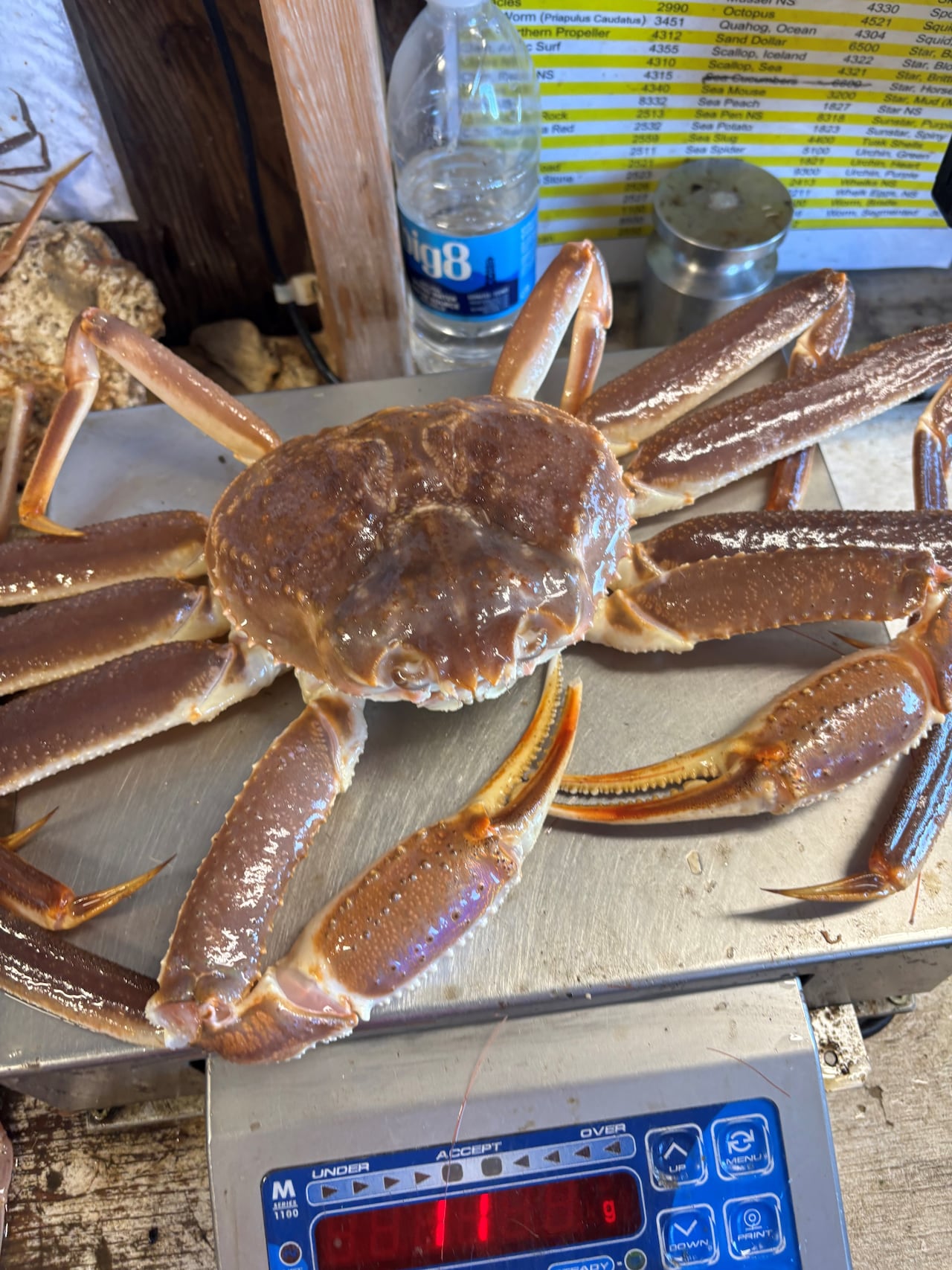 A male crab photographed during the survey. (Kate Christie/DFO)
Last year, the total allowable catch for the population in the area was 697 tonnes , compared to this year’s 200 tonnes, an already significant decline.
In 2025, snow crab exports across Nova Scotia were valued at about $256.4 million, making snow crab the second-most valuable commercial species in Nova Scotia after lobster.
Choi says water temperatures in the north of the province have actually become colder in the last two years, which should be an improvement for species there.
However, he says other cold-water predators like skate, halibut and cod could be going there for those favourable conditions, and finding a buffet of small snow crabs to feed on.
In a statement, the Department of Fisheries and Oceans said advice given in stock assessments is part of the factors that influence the decision-making for management measures.
“At this time, it would be premature to speculate on potential [total allowable catch] decisions for next year’s fishery,” said a spokesperson for the department.
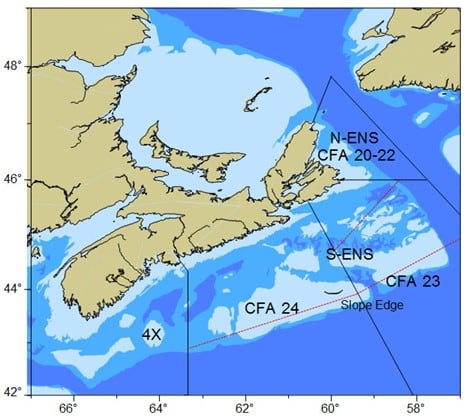 The stock assessment report for the Department of Fisheries and Oceans used data from different snow crab fishing areas across the province. (DFO)
The stock assessment also looked at other parts of the province where fishermen catch snow crabs.
The agency said in its assessment that the habitat in southwestern Nova Scotia, which includes waters off Lunenburg, Queens, Shelburne and Yarmouth counties, appears to have seen an increase in competitors and predators but noted an increase in the stock for the first time since 2020.
It advises multiple “strategies for consideration,” ranging from keeping fishing on the lower end to a fishery closure in the most extreme case.
But Allan Smith, a snow crab fisherman in Cape Sable Island for 30 years, said he disagrees with this advice. He was an observer for this stock assessment but thinks the advice doesn’t match what he has been seeing on the water.
He adds that his business and others in the area are already hanging by a thread, and that he already had to sell one of his vessels in the past due to reduced quota.
“Our season opened up in November and had record catches,” said Smith.
The silver lining seems to be the snow crab fishing area off the Eastern Shore which runs from Halifax to southern Cape Breton.
Its population is in the “healthy zone” due to a mixture of positive factors, like better recruitment and more hiding spots for vulnerable crabs, the stock assessment says.
MORE TOP STORIES