
Perhaps not surprisingly, the overall verdict on the first part of the new Cadillac F1 team’s rookie season is mixed – it could be much worse, but it could also be better. In the modern era, it was never going to be easy to start an F1 team from scratch, even with a lot of collective experience in the camp. Teams are now hugely complex beasts, even compared to when Haas became the last newcomer to join, with a lot of support from Ferrari, in 2016.
There is so much reliance on past data and IP that to start from a clean sheet is a huge task, even with everyone else also facing new regulations, as was the case with 2026. Just getting the first car together and ready for testing in January was the initial major challenge, and Cadillac did a better job than incumbents Aston and Williams, both of whom ran late.
Then came the shock of the first race in Australia, and running two cars on track for the first time and within the tight confines of the weekend schedule. With the season now properly underway and the races coming thick and fast it is not just about getting to the races and fighting problems as they arise but also doing so while a flow of new parts goes from design, to production and to the race track.
All the R&D has to be conducted with one eye on the FIA’s cost cap, and another on the aero test restrictions that limit wind tunnel running and oblige teams to prioritize which projects they pursue. All of that process involves lessons constantly being learned.
Cadillac has arguably done better than many expected, and Sergio Perez deserves some praise for that. After being dropped by Red Bull, he returned from his enforced 12-month break refreshed, and in his own words, the Mexican driver has often outperformed the car.
NurPhoto//Getty Images
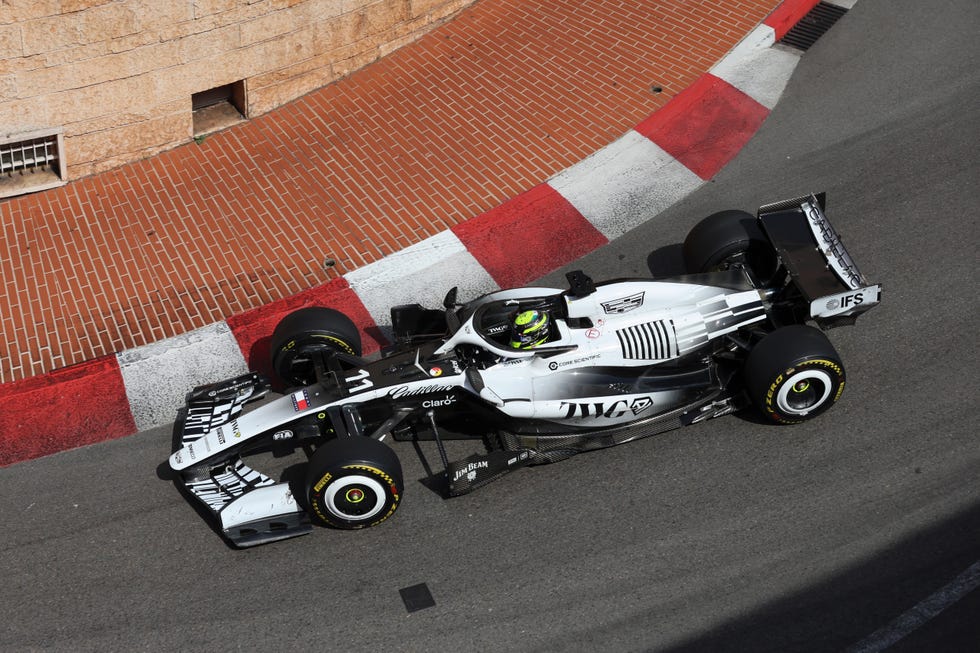
The streets of Monaco allowed the former winner to shine. The best qualifying performance to date saw him just miss making Q2, and he then survived a chaotic race and benefited from retirements and penalties for others to finish P10 on the road – only to lose a precious point to a penalty of his own for not lining up on the grid properly for the late red flag.
Monaco was an outlier, but recently the new team has regularly outpaced the struggling Aston Martin at several venues. However the gap to the main midfield runners, never mind the front of the field, remains significant at “normal” tracks. Inevitably, there have been operational and reliability challenges, and the last three races have produced several examples of how much can only be learned by coming across real world issues, and tackling them one at a time.
In the Montreal race, Perez suffered a very public right front suspension failure, caught by his onboard camera. The team later determined that it was due to a one-off error in the garage, rather than a design fault that had to be rectified.
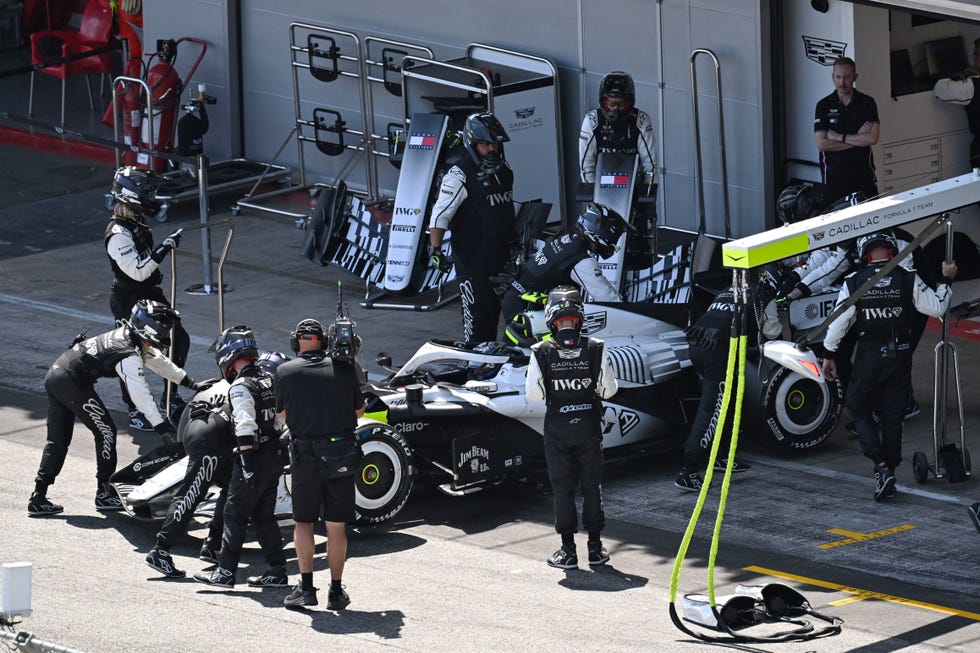
Both drivers suffered with brake overheating during the Monaco weekend, something that emerged at a track where there are lot of big stops, and not many straights for effective cooling. That led to some hastily improvised brake duct mods for qualifying, and while that seemed to work for Perez his team mate Valtteri Bottas retired early amid a cloud of smoke from the front of the car.
Mark Sutton – Formula 1//Getty Images
Bottas was in the wars again in Barcelona. He has taken more time than Perez to get up to speed, but he was happier with his car on Friday in Spain. The smile was wiped off his pace when in FP3 a brake issue sent him off the road, fortunately at a point on the track where was penalty of gravel.
Floor damage meant that the Finnish driver had some older spec aero parts fitted for qualifying and the race, in which he was an early retirement for an unspecified precautionary reason.
“The weekend started well,” he said when asked by Road & Track. “I was pretty happy on Friday, thought finally we’re going to have a nice clean weekend with the car feeling 100%. But that just kind of fell off with first the issue we had in FP3. Two DNFs now in a row, so it’s not ideal, and so it seems like reliability still is a big, big topic for us.”
The key is always to learn from mistakes and failures, and do better. The choice of veteran drivers has helped with the education process, as both have so much knowledge.
In Barcelona Perez logged another race distance to finish 14th and the last car still running – although to be fair he would have finished ahead of the Aston Martin drivers, both of whom retired.
“I think whenever we have a stint longer than 15 laps, we seem to struggle a lot with a massive cliff,” he said when asked by Road and Track about his race. “We understand pretty well where that’s coming from, and we have a good idea on where we need to fix it, and how, but it will just take a bit of races from now on. The good thing is that we know, and obviously Barcelona is the greatest place to show you where you are lacking. So that was that was positive for us.”
As the races stack up, the team is logging valuable data, and thus every finish is useful. It all feeds into that all-important flow of new parts.
“Definitely, it’s good information for us, for the team,” said Perez. “And we just have to make sure that we are able to come up on top. We are bringing a big package for Austria. I hope that will bring us back in into the middle group.”
Bottas is also anticipating a step from the latest upgrades, but he still has one major concern.
“We’ve got some new stuff coming for next race, so hopefully it’s going to be better.” He said last weekend. “It should be decent. And so far, what we put on the car, it worked, so I’ve got hopes that we can be closer again in Austria. But the main concern is now, again, like in the very beginning of the year, the reliability. Like I said, two DNFs in a row. It doesn’t matter how quick the car is if you can’t finish the race.”