


Listen to this article
Estimated 3 minutes
The audio version of this article is generated by AI-based technology. Mispronunciations can occur. We are working with our partners to continually review and improve the results.
Public health officials are warning residents across Quebec’s Montérégie region and parts of the Eastern Townships to be vigilant as a rapidly growing raccoon rabies outbreak expands into urban areas.
The province has recorded 170 cases of raccoon rabies since an outbreak began in 2024.
The disease is quickly spreading among wildlife, particularly raccoons, increasing the likelihood of human encounters with infected animals, officials say.
The province’s 2026 enhanced surveillance zone showing the distribution of cases now covers almost all of the Montérégie region, as well as southwestern parts of the Eastern Townships.
So far this year, 76 rabies cases have been confirmed in Quebec, including 55 in Montérégie, compared with just one case in 2024, in Saint-Armand, Que., located near Vermont.
“The spread is fast among the animals,” said Dr. David-Martin Milot, Santé Québec Montérégie’s director of public health.
Health officials are particularly concerned that residents may still associate rabies with remote areas.
“People may think that rabies is something that happens in forests or in rural areas,” Milot said. “But no, especially right now people everywhere in the rural and urban areas, they need to be aware of that risk and make the right decisions.”
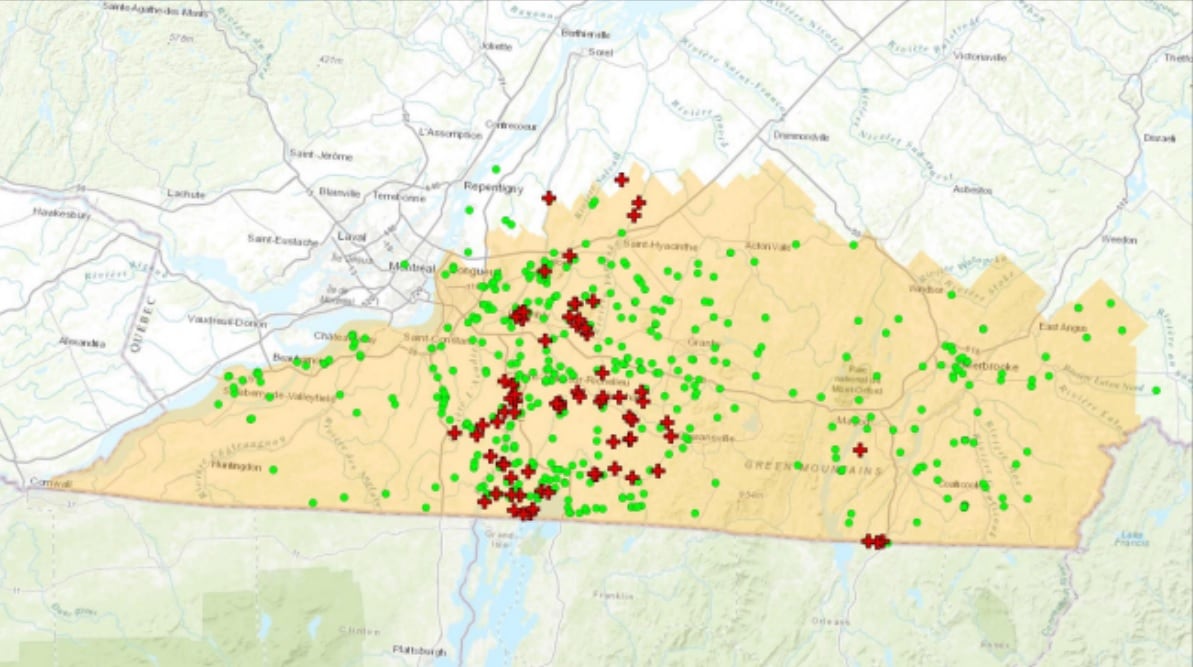 A map of the distribution of specimens collected as part of raccoon rabies surveillance in Quebec. The red dots indicate the presence of raccoon rabies cases in 2026, while the green dots indicate the specimens collected this year. The region highlighted in yellow indicated Quebec’s enhanced surveillance zone. (Santé Québec Montérégie)Increased chance of summer exposure
Rabies is transmitted through the saliva of infected animals, usually through scratches and bites. While rare, the disease is almost always fatal once symptoms appear.
Anyone who is bitten, scratched or exposed to an animal’s saliva should immediately wash the affected area with soap and water for 10 to 15 minutes and contact 811 or a health-care professional for an assessment.
Officials are also encouraging pet owners to ensure vaccinations are up to date and to report wild animals displaying unusual behaviour.
“At all times there is a risk with bats, but now there is also a risk with these cute little raccoons and cute little baby skunks that we might be seeing,” said Dr. Isabelle Samson, director of public health for the Eastern Townships health authority.
“People just need to know that this summer, the chances of encountering a rabid animal are higher.”
Residents are urged to avoid contact with wild animals and unfamiliar pets, even if they appear healthy, injured or dead.
Children should also be reminded not to approach wildlife and to notify an adult if they encounter an animal.