

Listen to this article
Estimated 4 minutes
The audio version of this article is generated by AI-based technology. Mispronunciations can occur. We are working with our partners to continually review and improve the results.
An artificial intelligence expert says building an AI data centre should not be P.E.I.’s priority; instead, the province should focus on developing local expertise in the technology.
Frank Rudzicz, a professor in the computer science department at Dalhousie University and an expert in AI and machine learning, said much of the recent anxiety around data centres comes from how people picture them.
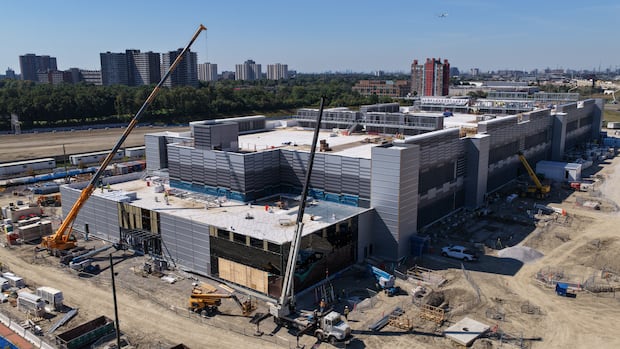
“When people hear … ‘data centre,’ they tend to have an image in their mind of something that’s the size of, you know, 100 Walmarts in the middle of the … desert, gobbling up water and electricity,” Rudzicz told Island Morning host Mitch Cormier.
That image came up on P.E.I. recently after a hypothetical question from Charlottetown Mayor Philip Brown about whether the city had enough water capacity to support an AI data centre sparked online speculation that one was already in the works.
LISTEN | AI’s future on P.E.I.:
Island Morning8:01AI Datacentres
While P.E.I. does not have the water or electricity to host a giant AI datacentre, a computer scientist from Dalhousie University says we have plenty of brain power.
Brown has since stressed there is no project in the works, saying he was only asking city staff whether Charlottetown had the water and electrical capacity if such a facility were ever proposed.
“They were just questions,” Brown said at a council meeting last week. “There was no request on building or looking for a developer for this type of project. None. Zero.”
AI data centres have been controversial, facing public pushback in Canada and the United States. Much of that is due to the demand for water and electricity needed to run those centres.
Rudzicz said modern AI facilities are very different from traditional data centres, which historically could “fit in a closet in an office” with sufficient cooling.
The shift has been driven by the explosion of data — not just spreadsheets, but video and audio — and the rise of large AI language models that require lots of electricity and extensive cooling, he said.
Rudzicz said those large, resource-intensive facilities are typically operated by tech giants, often for their own purposes rather than direct public benefit.
“These things are very large … they generate a lot of heat, noise, they require a lot of cooling and energy,” he said.
“I don’t see that happening in most of the three Maritime provinces. Something could be done in Newfoundland and Labrador that could service all of us, because they have space and they have hydro.”
Putting AI to work on Island challenges
Rudzicz said places like P.E.I. should focus on using artificial intelligence in targeted ways that improve life on the Island, especially in areas like health care.
He said many useful AI systems like that don’t need hyperscale infrastructure.
“We don’t need a massive large language model that requires all this heavy computation in order to fit on a smartwatch that can tell you if you’re going to fall or if you’re going to have a cardiac event,” he said.
“Those are very specific small models.… They can’t write poetry, they can’t write your emails for you, but they can do one thing very well and work very effectively. And you don’t need massive data centres for that.”
 Dalhousie University professor Frank Rudzicz says he doesn’t see the possibility of a massive, industrial-scale AI data centre being built in any of the three Maritime provinces. (Frank Rudzicz)
For P.E.I., the real opportunity, he said, is building local expertise in AI rather than providing land, water and power to outside companies.
Rudzicz said he wants to see more “domestic talent” developed in the province, with more Islanders learning how AI systems work, how to adapt them and how to ensure privacy and safeguards are built into the technology.
Those are “potentially high-paying jobs,” he said, that could keep both expertise and money in the province instead of sending them to multinational companies that sell access to large AI models through subscriptions.
Ultimately, Rudzicz said P.E.I.’s focus should be on using AI in ways that reflect the Island’s own needs and strengths, including in sectors like agriculture.
“As we increasingly digitize our lives, we need to also just remember … what makes our cities, our provinces unique, and try to hold on to that too.”