

Listen to this article
Estimated 4 minutes
The audio version of this article is generated by AI-based technology. Mispronunciations can occur. We are working with our partners to continually review and improve the results.
It’s been nearly 16 years since James Larsen’s life changed forever.
At age 43, he suffered a stroke and lost his ability to speak.
After years of hard work, Larsen, who lives in Langley City, B.C., can speak again. But he still suffers from aphasia, a language disorder that affects his ability to communicate.
“When you try to say anything, I get frustrated inside the brain, even though they say I’m intelligent still, but my speech does not want to work,” he told CBC’s On The Coast.
It’s people like Larsen, and the challenges they face navigating services that are run by automated systems, that prompted the development of the Listening Equity Project. It’s led by non-profit SPACE (Stuttering, People, Arts, Community, Education), which offers listening workshops to service providers so they know how they can better assist people with communication disabilities.
We’ve all been there — say there’s an unexpected charge on a bill and you have to call your utility company’s customer service to get it changed.
You call, and the automated system prompts you: “For billing, say ‘billing.'” If you’re someone with a communication disability who requires more time to take in that information and process it before you respond, the automation may send you to the wrong department.
Or maybe you need to book a medical appointment and call a busy doctor’s office. The staff there are moving quickly, and when they don’t get a fluent response right away, they hang up, thinking the call is dead.
According to Communication Disabilities Access Canada, more than 440,000 Canadians have significant speech, language and communication disabilities not caused by hearing loss.
Those disabilities can stem from a range of conditions, including (but not limited to) cerebral palsy, autism spectrum disorder, Down syndrome, brain injury, aphasia, dementia, ALS, Parkinson’s disease and multiple sclerosis.
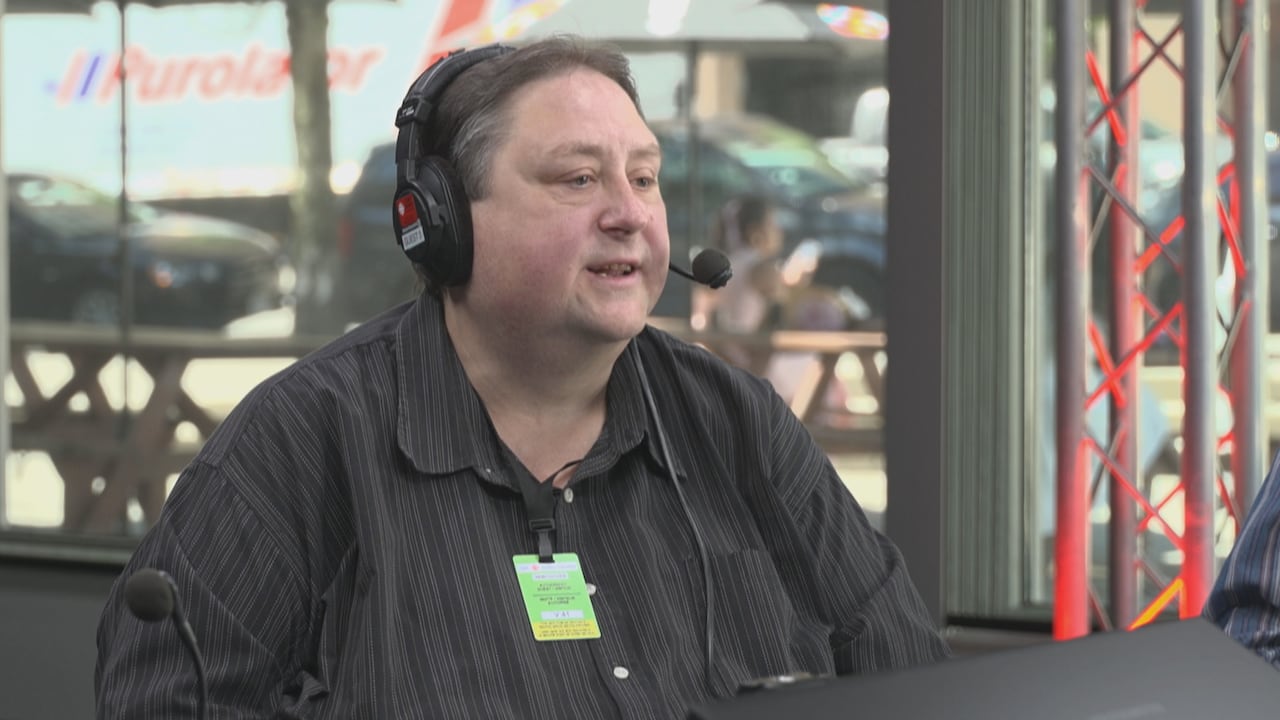 James Larsen, who has aphasia, says when he speaks with someone, he prefers it be face-to-face, with no distractions. (CBC News)
Having surveyed people in Canada and the U.S. living with communication disabilities like aphasia or stuttering, Aidan Sank, executive director and co-founder of SPACE, said time is key.
“Folks are being interrupted, they’re having their sentences finished, they’re finding that they’re sometimes even hung up on when they’re making phone calls,” Sank said. “Unfortunately, there are moments when folks are being ridiculed or laughed at as well.”
He said anyone who speaks a little differently ends up navigating a system set up for people who are fluent, and can listen and speak quickly.
“If you’re somebody who needs a little extra time, it can be really hard to get access to that time.”
Listening Equity Project workshops cover things like using AI on phone systems, Sank said.
Automated phone systems are particularly difficult for Larsen.
“It takes us that second to understand what the computer is saying to us,” he said. While he’s coming up with an answer to a question, the automation has already moved on to something else, causing further confusion.
Larsen said it’s easier for him to speak to someone — a real human — in person or over a video chat, and with no distractions on either side.
“Turn off the radio, turn off the TV, turn off all the sound so you can just talk one to one,” he said. “When you’re talking one to one, you’re focusing one to one.”
Offering these workshops and hopefully encouraging service providers to create better listening experiences will ideally benefit all, not just those with communication disabilities, Sank said.
“Our belief is that better listening is a universal design practice, and then when you make environments more accessible for folks with communication disabilities, you make them more accessible for everyone.”