
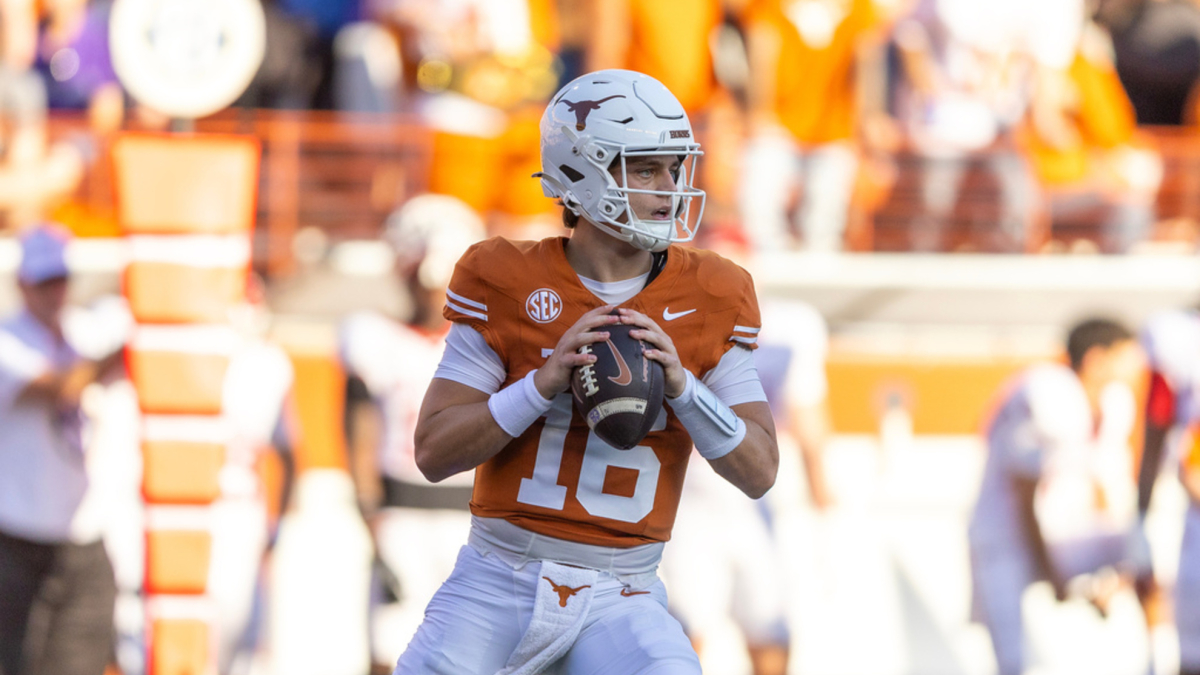
Arch Manning’s trajectory in college football has become one of the most debated storylines in the sport, with expectations that he could eventually become the top selection in the 2027 NFL Draft.
However, recent scouting evaluations suggest that his development has not followed a straightforward upward path, raising questions about whether he is truly progressing at the pace many anticipated.
Aaron Rodgers sparks reactions with strange stare while confirming final NFL season
Former NFL scout Daniel Kelly highlighted noticeable regression in Manning’s 2025 film study, pointing to a drop in completion rate from 67.8% to 61.4%.
He attributed the decline to struggles moving beyond his first read, suggesting that defenses are increasingly forcing him into longer progression reads that expose inexperience.
“What happened?” Kelly wrote. “He struggled getting past his first-read and completing passes to his second and third reads. That’s a problem. That’s a real problem when it comes to the NFL. It’s something to watch for this season when you watch Manning.”
Kelly also noted a slower processing time, with Manning taking 2.88 seconds on average to release the ball compared to 2.74 the previous season.
Mechanical breakdown and rising NFL concerns
Beyond the numbers, analysts have raised concerns about Manning’s mechanics and how they translate under pressure.
FOX Sports analyst Joel Klatt observed that against UTEP, Manning often initiated his throwing motion too early, before receivers had fully completed their routes, which led to rushed decisions and inconsistent timing.
Evaluators also point to footwork issues, including overstriding and jumping into throws rather than driving through his hips, which disrupt balance and accuracy.
These technical flaws appear to intensify when the pocket collapses, contributing to a perception that his internal clock is still developing at the college level.
The mental side of the game has also been a factor, as Texas entered last season with enormous expectations for instant success.
In high-profile games such as the 14–7 loss to Ohio State, where he threw for just 170 yards and a touchdown, and the more difficult outing against UTEP with 11 completions on 25 attempts for 114 yards, Manning showed flashes but struggled to sustain rhythm.
Despite those inconsistencies, he still produced a strong overall season statistically, finishing with 3,163 passing yards and 26 touchdowns, keeping him in early 2027 draft conversations.
Even with these concerns, Manning’s long-term outlook remains highly regarded across scouting circles. ESPN analysts Matt Miller and Jordan Reid still project him as a potential No. 1 overall pick in the 2027 NFL Draft, citing his arm talent, pedigree, and flashes of elite decision-making.
This summer, he will also serve as a counselor at the Manning Passing Academy, an annual four-day event founded by Archie Manning at Nicholls State University, where top college quarterbacks work with high school prospects and compete in skill drills.
The 2026 edition features several notable quarterbacks, including Julian Sayin, CJ Carr, and other rising names expected to factor into future Heisman discussions.
While participation in the camp adds further visibility and pressure, it also provides a platform for development and mentorship.
Evaluators believe Manning’s ceiling remains intact, but his ability to refine his mechanics and speed up his reads will determine whether he can meet the expectations placed on him in an increasingly competitive quarterback landscape across college football nationally.