

Listen to this article
Estimated 5 minutes
The audio version of this article is generated by AI-based technology. Mispronunciations can occur. We are working with our partners to continually review and improve the results.
Ontario tenants accused of being behind on rent may soon have to fork over half of what their landlord claims they owe if they want to raise other issues about their unit at a tribunal hearing.
The change is one of several ushered in by the provincial government’s Bill 60 that lawyers and advocates say will make life harder for tenants accused of being in arrears. The bill received royal assent in November, the final level of approval in Ontario’s legislature, though the province would not say when the new payment rules will come into force.
Other changes to how arrears are handled at the landlord and tenant board will come into effect this summer and fall.
Dania Majid, a lawyer with the Advocacy Centre for Tenants Ontario, says the ability for tenants to raise health and safety issues with their unit is key because it can sometimes show a landlord is in violation of the Residential Tenancies Act and actually owes their tenant compensation.
“Nowhere else in our judicial system do we require someone to put down cash on the table before they raise legal arguments, especially before they’re even proven to owe this amount,” she said.
Majid says that prior to the amendments, the act already required tenants give seven days of advance notice to the board if they intended to raise other issues about their unit at a Landlord and Tenant Board hearing.
WATCH | New tenant union launches across Toronto: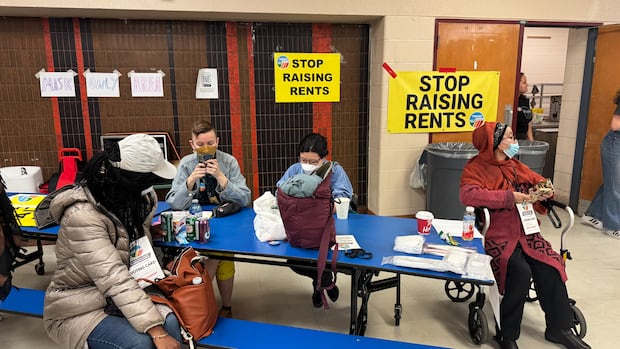
New tenant union launches across Toronto
Tenants and housing advocates from across Toronto gathered on Saturday to launch a new, city-wide tenant union. Organizers say the goal is to build a collective power to address rising rents and push for stronger protections for renters. CBC’s Naama Weingarten has the story.
The legislation says the money would be paid to the landlord or the board.
The Ministry of Municipal Affairs and Housing did not answer when asked if there are any avenues for tenants to recover that money if it is determined that they are not in fact behind on payment.
Other changes coming into effect include shortening the period tenants have to pay their rent, from 14 days to seven days, before a landlord can file for an eviction hearing. That change comes into effect in September.
Province says bill makes things fairer, advocates disagree
Bill 60 is a sweeping document that has drawn criticism from environmentalists, tenant advocates, planning experts and others. Toronto has voted to formally oppose it, with councillors raising concerns it may increase homelessness in the city.
A spokesperson for the Minister of Municipal Affairs and Housing said the province is supporting Ontario tenants by doubling fines under the Residential Tenancies Act.
“Bill 60 restores balance and rebuilds confidence in Ontario’s rental housing market by protecting responsible tenants that fulfill their responsibilities in their lease agreement while ensuring accountability for those who repeatedly abuse the system and create backlogs at the Landlord Tenant Board,” said Michael Minzak, the minister’s press secretary, in an email.
Chiara Padovani, an organizer with the Toronto Tenant Union, said a rental agreement is a two-way contract, where landlords are responsible for maintaining a unit and providing a decent place for people to live and tenants pay them in return. Padovani is running for council in York South-Weston in the upcoming municipal election.
WATCH | West end Toronto tenants push back on eviction notices:
These Toronto tenants are pushing back against eviction notices in a legal dispute
A dispute over eviction notices is escalating at a mixed-use building in Toronto’s Roncesvalles neighbourhood. CBC’s Tyler Cheese spoke to tenants who say they are fighting to keep their long-term homes, while the building’s owners say the notices are lawful.
“So one of the things that tenants often rely on when they’re getting evicted is ‘OK, yeah, I’m short on rent, but like, there is massive mould in my bedroom that’s causing my kids asthma and the landlord is refusing to address it.,” said Padovani. “And that is grounds for relief of eviction.”
Some believe move is in response to rent strikes
The Federation of Metro Tenants Association believes the payment requirement is a response to recent cases of tenants organizing in the form of rent strikes.
“A hearing is one of the few occasions where you can actually force the landlord to sit down and meet with you,” said Mason Fitzpatrick, the association’s communications director.
“So if you can’t use your economic leverage of withholding rent to force them to move on other issues, then you have a lot less power,” he said.
Daryl Chong, president of the Greater Toronto Apartment Association, said he didn’t have a comment on the 50 per cent payment change specifically, but said generally, Bill 60 “restores some faith in the landlord and tenant board for landlords.”
“There’s a lot of gaming the system, lots of bad advice online about how to delay things and delay things and basically live without paying rent,” he said.