
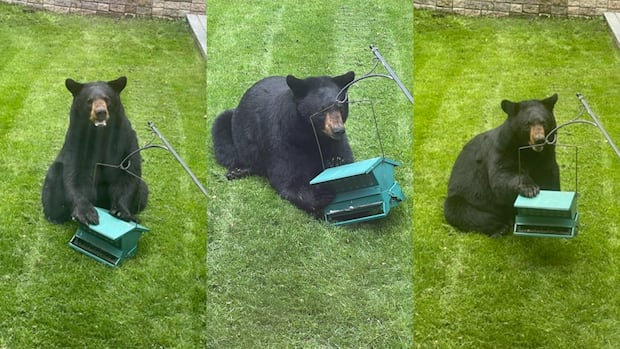
Sheila Ross watched as a large black bear with three cubs ran across her residential street in Fredericton and up into a neighbour’s tree.
It was early in the morning, and the mother bear left her cubs in the tree while she scampered into Ross’s backyard and grabbed a squirrel-proof bird feeder, bending it and banging it against the grass.
The bear wrestled with the bird feeder for an hour as she tried to get the seeds inside, while Ross and her neighbours watched from windows.
“Lots of people were coming by and taking pictures, but some people got too close and the bear was hissing, which I don’t blame her,” Ross said. “She was protecting her baby.”
Graham Forbes, a professor of forestry and environmental management at the University of New Brunswick, said it’s not common for bears to hang around in urban environments.
He said black bears have a home range of 20 to 30 square kilometres, so when they are spotted within cities they’re probably “just moving through” at a time when food can be difficult to come by.
“I call them walking garbage cans,” said Forbes, the director of a Fish and Wildlife Research Unit at U.N.B.
WATCH | Security camera captures mama bear and cubs playing in backyard: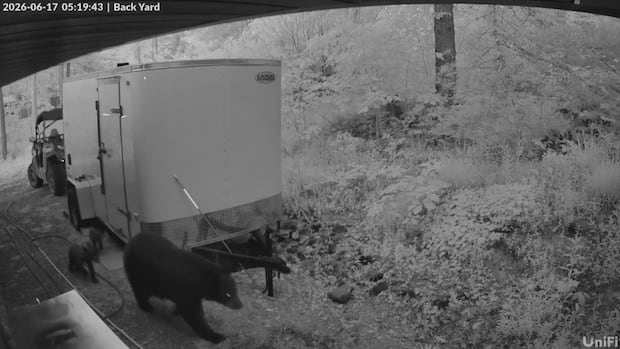
Mama bear and four cubs play in Saint John backyard
A black bear and her four cubs were captured frolicking in a Saint John backyard on June 17th.
“They eat whatever’s in season and they’re not very picky, but in the spring it’s difficult.”
In Fredericton, police issued a public safety advisory on June 12, warning residents about a bear and three cubs spotted in the centre of the city, on Mansfield Street, which runs off York Street south of Montgomery.
Residents in Grand Bay-Westfield and in nearby Martinon, on the edge of Saint John recently reported sightings of bears to social media.
This isn’t the first time Daniel Mark Wheaton has seen a mama bear and her cubs hang around his Grand Bay-Westfield home. Two years ago he watched cubs playing in a tree on his property.
This year, a mama bear and her four cubs seem to have taken a liking to his land, returning frequently, despite Wheaton’s heightened precautions against leaving food and garbage out.
“They’re not just passing through,” Wheaton said. “They’re hanging out. I’m a little apprehensive to go out in the hot tub right now because they’re basically hanging out where I tub.”
Bears are not limited to a specific type of terrain and can live anywhere, according to Forbes. Whether the animals decide to stay local depends on human behaviour.
Forbes warns that feeding bears, leaving food out, or even putting garbage out at the curb the night before pickup can attract them.
 Graham Forbes, professor of forestry and environmental management and director of New Brunswick Co-operative Fish and Wildlife Research unit at UNB, tells residents to remain diligent about food waste that could attract bears. (CBC)
So long as the bears don’t get habituated to urban areas, people shouldn’t worry too much, just proceed with caution, he said.
“The worst thing about bears,” he said. “If they associate people or housing as a place to find garbage or handouts, then you’re training up a rather smart animal.”
During the spring and early summer, berries, apples, acorns, or beechnuts are sparse, making it harder for bears to locate their next meal. Forbes said bears aren’t picky and mama bear is looking out for her cubs, foraging for food wherever she can.
While bears can cover 10 kilometres in a day, Forbes said it can be hard to know where they’re headed next.
WATCH | Black bear investigates Fredericton yard: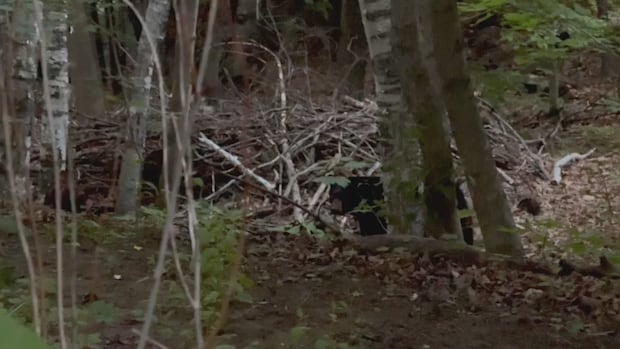
See this black bear spotted in Fredericton
A black bear was spotted outside a house on Heather Terrace in Fredericton on June 10th.
Phil Shyu, a Fredericton resident who lives less than 500 metres from where the bear and cubs were spotted recently, said he grew up in New Maryland and was used to seeing bears there, but was shocked to hear them in the city.
He has been hearing what he believes are bears rummaging through his backyard and said a giant pile of scat was the proof.
The Department of Natural Resources said anyone who finds bear scat should dispose of it in a sealed bag, using gloves, before disposing it with the household garbage.
Residents are also advised to leave the bears alone.
“Black bears will often relocate on their own once they feel safe and undisturbed,” read a department statement.
“Residents are reminded to avoid approaching or attempting to feed wildlife and to remove or secure potential attractants around their property, including garbage, bird seed, and pet food.”
Forbes said anyone who does come across a bear shouldn’t panic.
“If you find yourself close to a bear don’t run,” he said. “Instead make noise, wave your arms, make your presence known and back away from the site.
“Bears don’t want to be anywhere near us unless we’re feeding them.”