
If Friday’s NASCAR Craftsman Truck Series race looked chaotic, Saturday’s NASCAR O’Reilly Auto Parts Series event at the San Diego Street Course apparently took that as a challenge.
The trucks managed seven cautions and a brief red flag. Saturday’s field responded with eight cautions, two red flags, a manhole cover that broke free like it had somewhere better to be, a 25-car restart pileup that demolished a wall section, fuel mileage games played at full panic mode, and a finish decided by what can only be described as a very deliberate last-lap shove.
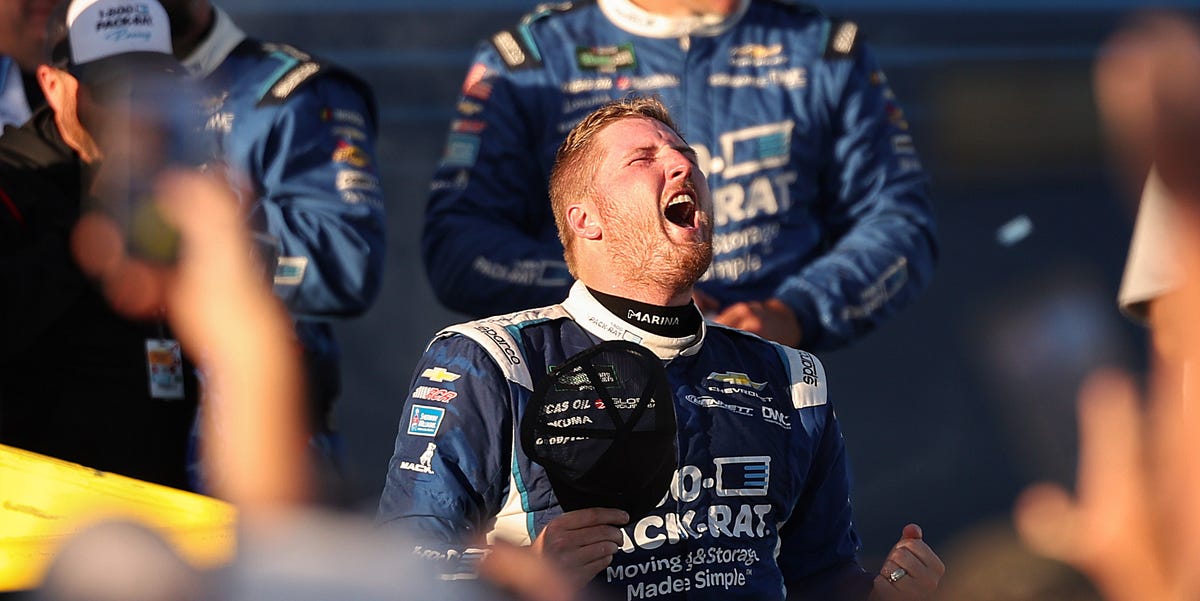
When the dust finally settled, Austin Hill crossed the line 1.1 seconds clear of Taylor Gray to score his first career road-course win and become the inaugural O’Reilly Auto Parts Series winner at Naval Base Coronado.
And fittingly, nobody really got there clean.
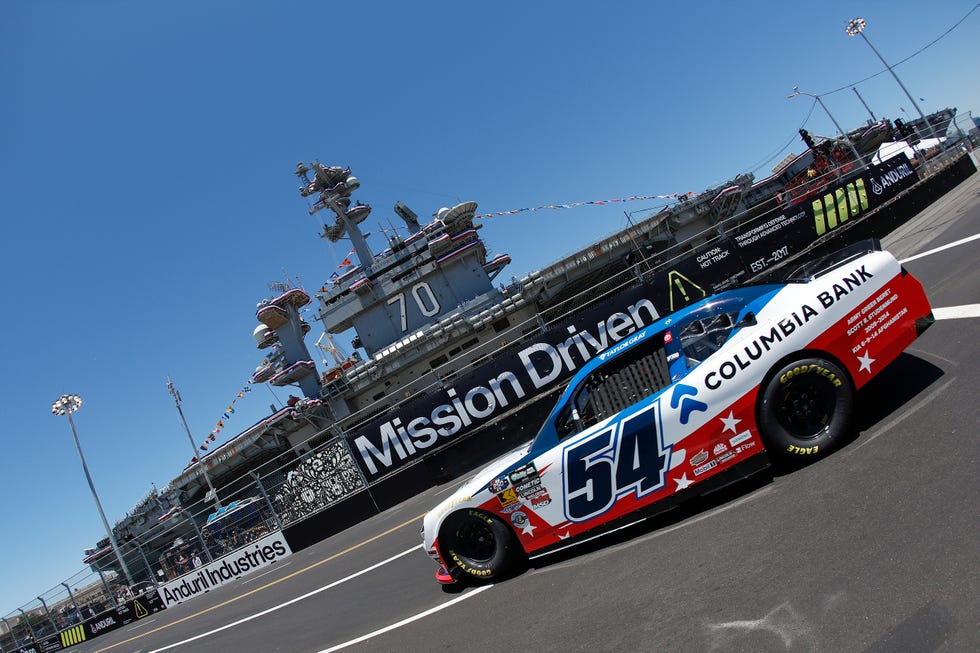
Gray had taken control late after muscling Carson Kvapil aside entering the chicane with three laps remaining. Two laps later, after taking the white flag, Hill decided the favor should be returned.
 Sean Gardner//Getty Images
Taylor Gray.
Hill got alongside Gray entering the final sequence and completed the pass after contact, then immediately checked out to deliver Richard Childress Racing an emotional victory.
“It’s extremely special just to finally check that box of getting a road-course win,” Hill said. “We’ve been so close so many times.”
The win carried obvious emotional weight for Richard Childress Racing after the recent loss of longtime organization figure Kyle Busch.
“I’m like, ‘Man, Kyle, if you’re here, give me something. Let me find another gear.’”
“I’m not gonna lie, I started talking to this guy a little bit down the straightaways,” Hill said, pointing to the No. 8 Kyle Busch hat he wore. “I’m like, ‘Man, Kyle, if you’re here, give me something. Let me find another gear.’ For whatever reason, the car started to come to life.”
Hill said once the leaders started to tangle, he knew his moment was coming.
“When there was blood in the water behind the 54, I knew it was gonna be tough to get around him, but it was gonna be a battle.”
The race had already gone off the rails long before that final restart.
On the opening lap, Corey Day struck a manhole cover that had come loose and punched a hole straight through his radiator. NASCAR immediately threw a red flag while officials re-welded the cover and inspected more than 100 others around the circuit. Day’s team was also allowed to complete repairs under the stoppage and, remarkably, he even given his lost laps back.
Once things finally went green again, Brent Crews made use of his first career pole, leading the opening 11 laps before Hill took control and claimed Stage 1.
The strategy split arrived on Lap 24.
Lavar Scott’s Chevrolet shed its driveshaft and parked it trackside, bringing out another caution. Hill and 14 others pitted. Gray and 15 more stayed out, gambling that fuel would somehow behave differently under pressure.
The end of Stage 2 nearly produced another highlight reel moment of disaster.
Parker Retzlaff and Gray fought for the stage win into the final chicane when Retzlaff got loose and tagged the wall. Gray escaped and took the stage win, while Hill salvaged eighth in the segment.
Then came the moment that basically defined the afternoon.
 Sean Gardner//Getty Images
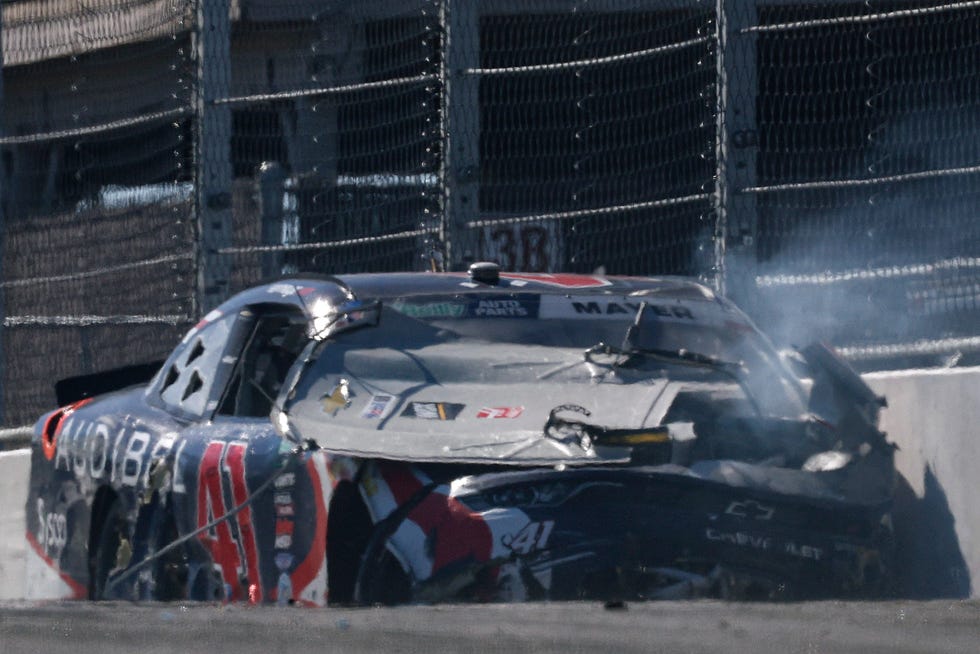
Sam Mayer’s car after meeting the wall.
On the restart to open the final stage, Sam Mayer clipped the inside wall entering Turn 1 and was launched across the track into the outside barrier. Twenty-five cars were collected in the aftermath.
The hit was severe enough that NASCAR had to replace an entire section of temporary wall before racing could continue.
When the field finally regrouped with 24 laps to go, fuel calculations turned into guesswork under pressure.
Kvapil surged forward and looked in control, opening a 1.1-second gap over Gray with 10 laps remaining while Hill lurked in third despite damage from the Mayer incident.
The final caution came with eight laps left after a tire barrier was knocked into the chicane racing line.
Kvapil led the restart with seven to go and held firm until Gray made his move for the lead with three laps remaining.
One lap later, after taking the white flag, Hill made his own move and drove away.
Gray finished second and admitted the decisive moment wasn’t exactly planned.
 David Jensen//Getty Images
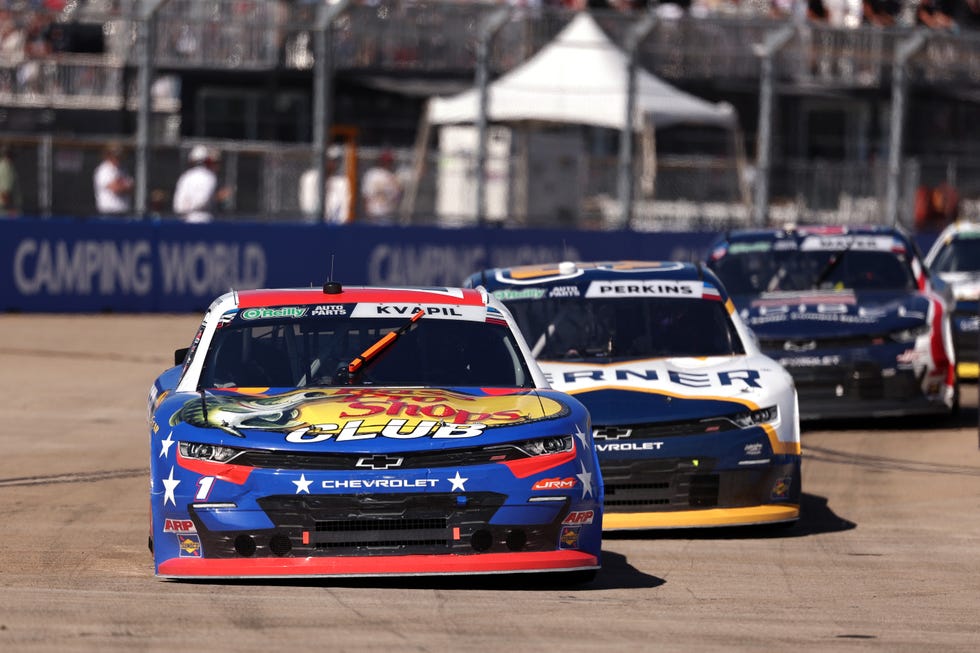
Carson Kvapil.
“I just had really bad wheel hop there at the end of my run,” Gray said. “I need to go back and look at it. That’s what it boils down to. He was racing me tight like he should and I wheel hopped underneath him.
“I hate it for JRM, but unfortunately that’s where it is.”
Kvapil, who faded to fourth after leading late, didn’t sugarcoat the frustration.
“It’s really hard to make peace with that,” Kvapil said. “We had a really fast car and put ourselves in position to win a race.
“When you’re racing for the win like that, you’ve got to put everything out on the racetrack. I’m sure that’s what he was doing and I was too. I just hate being on the wrong end of it.”
And then, after all of it—the manhole cover drama, the 25-car pileup, the fuel guessing game, and the final-lap shove that decided it all—the garage still somehow circled back to something heavier than sheet metal and tire barriers.
Austin Hill’s win marked an emotional moment for Richard Childress Racing in the wake of the recent loss of Kyle Busch, the driver and presence who had loomed over the organization as both a standard and a stabilizer. A tribute that meant far more than a number painted on the infield grass.
Asked what it meant for the team, Richard Childress paused. His voice cracked. He fought it for a second, then didn’t bother anymore.
“Great to win here,” Childress said quietly and fighting back tears. “And we all got Kyle in our hearts. You may not show it on the outside… but you do here.”

I have been around and written about the sport of NASCAR for over three decades and previously worked fulltime for the Sporting News and Scripps-Howard News Service. I am also a contributor to two Chicken Soup for the Soul books including the NASCAR edition, published in 2010 and the author of “The Nuts and Bolts of NASCAR: The Definitive Viewers’ Guide to Big-Time Stock Car Auto Racing.” I am a multiple National Motorsports Press Association award winner. Early in life I spent 23 years combined active and active reserve military service, much of that in and around the Special Operations community serving in support of Operation Just Cause, Desert Shield/Storm and ended my military career in support of Operation Enduring Freedom.