
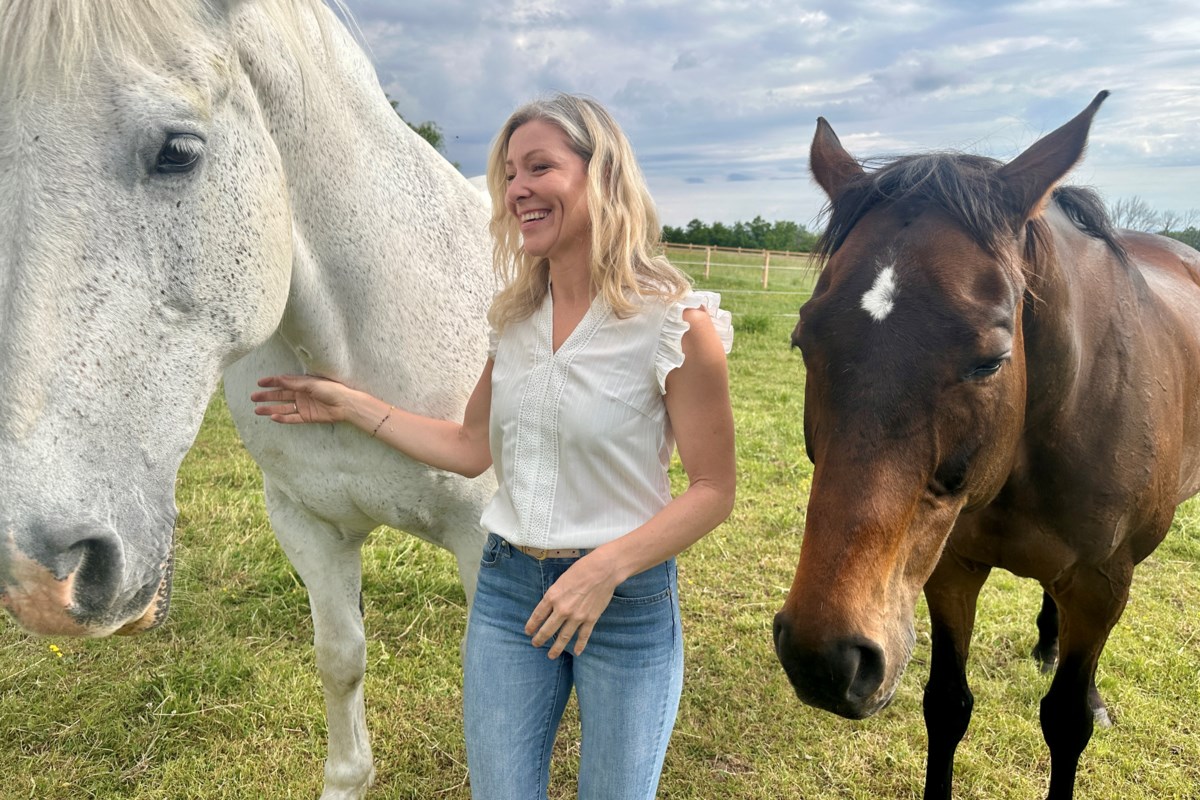
‘It adds a deeper richness, I would say, to the trauma therapy,’ says registered psychotherapist about the power of healing in the presence of horses
Nestled atop the scenic arboreal mountains overlooking Georgian Bay and Thornbury is the home of a couple horses with special jobs.
Lace and Sereno are part of the equine-assisted therapy program offered through Blue Shores Counselling. The gentle giants graze in their paddock on a sunny June morning. When a newcomer enters they succumb to their curiosity and calmly approach.
The program offers trauma counselling in the presence of horses. Although animal therapy is not a new concept, the healing power of horses is becoming more globally renowned.
The benefits of horse therapy have been more widely recognized scientifically in the past decade, says Julia Lippert, registered psychotherapist at Blue Shores.
The PTSD Association of Canada reports on the psychological benefits people experience while interacting with horses.
They include lowered blood pressure and heart rate, increased levels of beta-endorphins (neurotransmitters that serve as pain suppressors), decreased stress levels, reduced feelings of anger, hostility, tension and anxiety, improved social functioning; and increased feelings of empowerment, trust, patience and self-efficacy.
The equine-assisted therapy program was integrated three years ago by Blue Shores Counselling, which was previously known as Blue Oaks Counselling. Lippert has seen first-hand the way her patients benefit through connecting with her horses.
“People have always felt the healing power of horses and animals,” she says.
Due to their stature, some people may fear horses. Yet the animals may still provide a remedial path from traumatic experiences.
“That can also be really meaningful. To learn that you can deal with intimidating things,” says Lippert.
What happens with the horses in therapy occurs organically.
They are not trained to do anything in the therapy session, she explains.
The animals are, however, carefully scanned for temperament and only those who regulate themselves are integrated into the program. Any training is based on improving communication between horse and human.
Lippert demonstrates by asking Lace to step over, “they know how to respond to you and we have good communication going,” she says.
Contemporary neuroscience reveals that during times of trauma, people experience intense shock signals. Those sensations are frozen in the brain stem, producing a lasting impact on the body, says Lippert.
“Trauma often happens in relationships, and for many people, trauma happens in confined rooms. So, even just that, coming out here in nature and having that spaciousness and openness is a much more healing, safe environment,” says Lippert.
Birds chirping, the cool touch of wind on the skin, or the calm presence of the horse nearby add a unique element to therapy sessions, which often begin or end with somatic experiences to focus on the nervous system.
“It changes how the trauma therapy is experienced,” says Lippert, “because in the middle of visiting your trauma and processing it, when you have this animal coming in and connecting, and you experience the warmth, you’ve experienced being seen and supported.”
For a patient, experiencing something like Lace, the larger of the two therapy horses, resting her head on their shoulder while processing intense emotions can be deeply moving.
“It changes what you experience in your body,” she continues, “so that’s where it’s really powerful that people can often have this real physical experience that changes how they relate to their trauma. It adds a deeper richness, I would say, to the trauma therapy.”
Lippert and two other therapists, Andrea Foster and Christina Malley, bring a diverse background of extensive trauma training to the program at Blue Shores Counselling. Foster has a background as a paramedic, and Malley is a retired military officer.
Equine-assisted therapy takes place between June-October, weather dependent, and is suitable for ages 12 and up.
She mentions research from the HeartMath Institute that indicates how much heart rate variability can increase in the presence of horses.
“It’s an indicator of your adaptability to life stressors and internal management of stress,” she says.
This research is directly referenced in the documentary Rescued Hearts. The film is a documentary exploring the mystery and science of healing with horses.
Lippert thought the movie would help answer some of the questions she often receives about equine-assisted therapy.
“When you see it on screen, it’s much easier to get a feel for it,” she says.
In collaboration with 5th Street Creative Initiatives, a screening of the film will be held on Fri., June 26 at 6 p.m. at the Simcoe Street Theatre in Collingwood. Tickets are $15.
The evening will begin with live music and refreshments. Along with the film viewing, time is also allotted for discussion with registered psychotherapists from Blue Shores Counselling.
More information about the film and where to purchase tickets can be found here.