
Photo: Robbie Jay Barratt/Getty Images
It’s easy to forget that soccer is a difficult game. No sport is simple, of course, but soccer is the only major athletic contest where the players are forbidden from using their most effective anatomical tools: their hands. Consider the ease with which a basketball player catches a ball. Child’s play! There is no catching in soccer, unless you’re a goalkeeper; when the orb comes flying toward you, it must be “trapped” — the art of bringing it to a standstill with your feet or chest or thigh. The term captures the way a soccer ball is a wild animal forever resisting being locked in its cage and belies the common understanding of football as a beautiful game, which implies elegance and refinement. Its true essence is awkwardness, a messy negotiation with a tumultuous universe while your hands are almost literally tied behind your back. The beauty comes from the control the player is able to exert over this chaos, much the way an artist enthralls his audience with the mastery he displays over his unruly material.
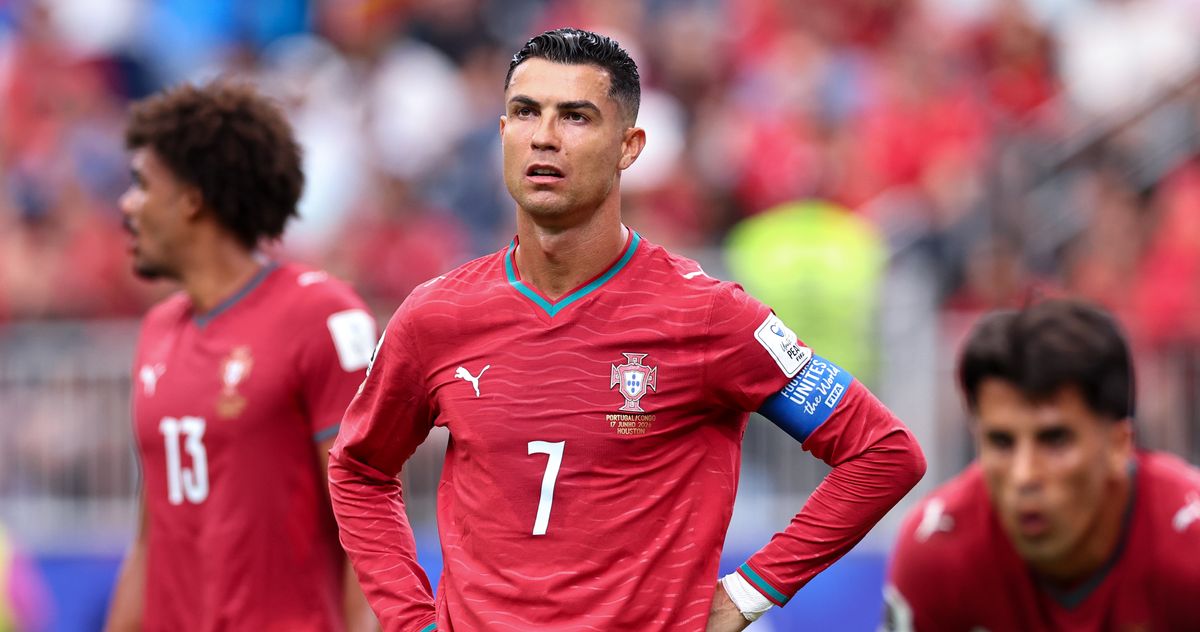
So what happens when you lose control? I realize this question has existential implications beyond merely losing control of a ball — losing control of your reputation, say, or your career or even your life. For Cristiano Ronaldo, the Portuguese icon playing in his sixth World Cup at the improbable age of 41, all those questions are hopelessly knotted together.
Portugal should be a contender to lift the World Cup trophy in July. This is a team packed with generational talent, starting with their primary playmaker, Bruno Fernandes, the bearded wizard who was the English Premier League’s player of the season. Fernandes is supported in midfield by Vitinha and João Neves, the pocket-size dynamos who recently powered Paris Saint-Germain to victory in the Champions League. There are almost too many talented players on this team to list: Rúben Dias, João Félix, Bernardo Silva, João Cancelo, Rafael Leão, Pedro Neto — all elite, all bold-faced names recognizable to soccer fans, all capable of going toe-to-toe with the English and the French and the Argentinians.
Yet Portugal struggled to impress in its opening match against the Democratic Republic of the Congo, a desultory affair that ended in a measly 1-1 tie. And everyone understands the crux of the problem: Ronaldo, uselessly occupying space up top where the team’s goal scorer should be, sucking the whole game into his stifling gravitational field like football’s version of a dying supernova. He long ago lost his speed and agility, but now he looks stiff even when he’s walking around, not unlike the way I get up after rotting on the couch for too long — the knees jerky and the spine slightly bent forward, declining to snap back into upright position.
But Ronaldo refuses to relinquish his pride of place, apparently in a quixotic attempt to singlehandedly carry Portugal, and thereby himself, to World Cup glory. It is not enough to watch from the bench and make some contributions here and there as his teammates take the stage; he is the epitome of Morrissey’s dictum that we hate it when our friends become successful. No, it must be him in the spotlight, and worse still, it seems Portugal’s manager, Roberto Martínez, is too cowed by Ronaldo’s legend to object, creating a cone of obfuscation around the blaring truth. “Cristiano must be present,” Martínez said after the game. “It doesn’t make sense to take off the greatest goalscorer in football history in a match where we need to score goals.”
Except this seemingly is the one thing Ronaldo can no longer do — a reality that must be painfully difficult to accept for a player who at his peak was a devastating goal machine, combining uncommon athleticism with a voracious, nearly pathological appetite for putting the ball in the back of the net. “Cristiano is a monster,” a corporate suit says in the documentary All or Nothing: Juventus. He meant it as a compliment.
It must really grind his gears that his fellow olds are doing rather well this tournament. The hero of Cape Verde’s 0-0 draw with Spain was the 40-year-old keeper Vozinha, who had seven saves. Ronaldo’s nemesis, the 38-year-old Lionel Messi, scored three tidy goals in Argentina’s game against Algeria. Like Ronaldo, Messi is not as pacey as he once was, but he doesn’t need to be, choosing discrete moments to grab the game by the horns and bend it to his will. Vozinha similarly seemed to extend some kind of impenetrable force field across the penalty box. This is another form of control: the ability to impose yourself on the rush and blur of events, to stretch and bend and slow down time while your opponents remain bound by temporal reality. Ronaldo, in contrast, was overwhelmed by the moment, his awkwardness laid bare. He vainly looked for openings, snatched weakly at the ball, and screamed at the sky as if to curse the football gods for forsaking him — in every way a man who has lost control of his fate.
I’m not a Ronaldo hater. Quite the contrary: I perversely want him to succeed. I have trollishly painted myself into a corner in my soccer group chat, the one person rooting for Ronaldo to propel Portugal to victory, while everyone else rightly mocks him for his hysterics and hubris — always an unbecoming aspect of his play, now heightened by the absence of results that could justify his behavior. Partly this is because I share his middle-aged angst, the sheer disbelief at the prospect of the powers you once possessed, the mastery you wielded over your own life, vanishing. And who would you be then? There is surely a graceful response to that question, one that will make itself known in time. Until Ronaldo discovers it for himself, there is only the desperate hope for one more goal, one more triumph over his doubters, one more weary turn before the crowd.
Sign Up for the Intelligencer Newsletter
Daily news about the politics, business, and technology shaping our world.
Vox Media, LLC Terms and Privacy Notice