
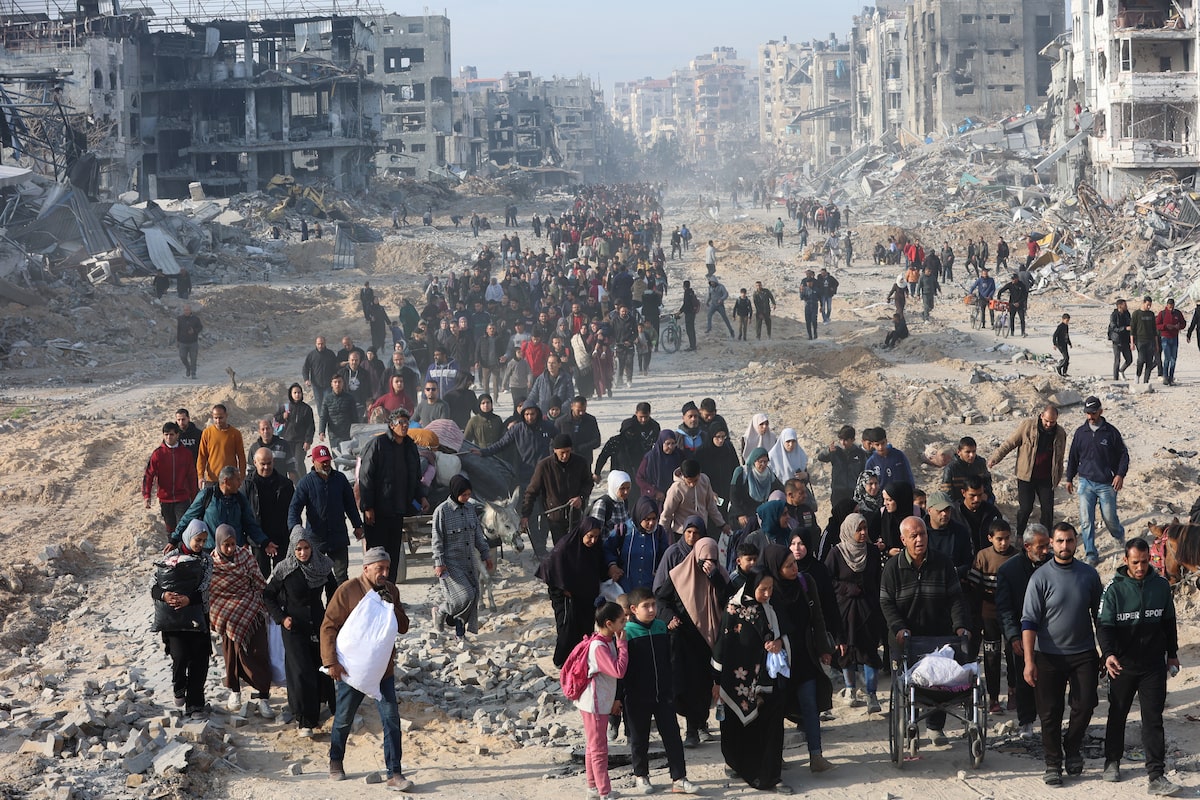
Displaced Palestinians walk along a road in Jabalia, as they leave areas near Gaza City where they had taken refuge, in January, 2025. The Canadian Museum for Human Rights’ upcoming exhibit focuses on the late 1940s displacement of Palestinians.OMAR AL-QATTAA/AFP/Getty Images
A trustee at the Canadian Museum for Human Rights is quitting the organization’s board over a coming exhibit about the late 1940s displacement of Palestinians, saying its lack of vital historical context will stir up hostility against Jewish people.
Mark Berlin submitted his resignation on Monday in a letter addressed to Marc Miller, Minister of Canadian Identity and Culture, and Benjie Nycum, the museum’s board chair. He has served as trustee since 2018.
The exhibit, opening this Saturday, focuses on people affected by the Nakba, – Arabic for “catastrophe” – when around 750,000 Palestinians were forcibly displaced between 1947 and 1949 during fighting over control of what is now Israel.
Canada pledges $100-million for Palestinians facing humanitarian crisis, increased violence
In his resignation letter, Prof. Berlin said the museum’s exhibit fails to include the expulsion of roughly 850,000 Jews from Arab states alongside its account of Palestinian displacement, even though the two events began around the same time. Jews in Arab countries were expelled or forced to flee due to harsh persecution after the state of Israel was established in May, 1948.
“The story of the Palestinian displacement should be told,” he said in the letter. “However, telling the story with a one-sided perspective chosen by the Museum serves to deepen division and contributes to further hostility toward Jews in Canada.”
In an interview, Prof. Berlin added: “There’s the Palestinian Nakba and the Jewish Nakba, and the fact is that these are not severable.”
The Winnipeg-based human rights museum is a Crown corporation set up in 2008 under then-prime minister Stephen Harper and it operates at arm’s length from Ottawa. It receives close to $30-million annually from the federal government to cover its operating costs.
Prof. Berlin is an international human rights lawyer who served as senior adviser on the Middle East to former attorney-general Irwin Cotler, and is currently a professor of practice at McGill University.
In an interview, he described himself as “pro-Palestinian” and noted when he served in the Canadian government, as director-general of international legal programs, he helped set up a prosecutorial service for Palestinians and opened and staffed an office in Ramallah.
The Globe has reached out to the museum for comment.
Mr. Miller’s office declined to comment on the reasons Prof. Berlin gave for resigning but thanked him for his contributions as trustee.
“Like all Canadians, we expect the Board of Trustees to continue its important work in fulfilling the mission of the Canadian Museum for Human Rights and to remain representative of the diversity of Canadian voices as the vacancy is filled in the coming months,” Alisson Lévesque, director of communications for the minister, said in an e-mailed statement.
Some Jewish groups, including the Centre for Israel and Jewish Affairs, B’nai Brith Canada and the Jewish Heritage Centre of Western Canada, have also raised concern that the exhibit could fuel antisemitism by not providing more historical context.
Prof. Berlin’s letter lays out what he calls the “undeniable historical facts”: the 1947 United Nations partition plan proposed separate Jewish and Arab states in what was called Mandatory Palestine at the time. “The Jewish leadership accepted the plan while the surrounding Arab states and local leadership rejected it. Five Arab states immediately launched a war against the newly established state of Israel,” he wrote. “As a result, hundreds of thousands of Palestinians were displaced as were hundreds of thousands of Jews from Arab lands.”
He said the rights museum’s mandate under statute is “explore the subject of human rights, with special but not exclusive reference to Canada in order to enhance the public’s understanding of human rights, to promote respect for others and to encourage reflection and dialogue.”
The museum’s chief executive Isha Khan last week said she’s heard the concerns but that the exhibit isn’t trying to cover the whole history of the time period.
“It’s a modest-sized exhibit,” Ms. Khan said. “It isn’t a historical retrospective of 1948 and the founding of the state of Israel.”
Like other exhibits at the museum, it tells one community’s story with the aim of creating broader awareness, Ms. Khan said.
“It’s about Palestinian-Canadians sharing their stories of forced displacement, intended to help us understand other stories.”
Prof. Berlin said he was unsuccessful in repeated efforts to convince the museum to add more historical background to Nakba exhibit. He said he had even suggested to museum leadership that they install placards outside the display area that offered more context.
“The controversy surrounding this exhibit, and my unsuccessful efforts to fight against what I believe to be institutional antizionism and to bring a more balanced perspective to the exhibit’s development, has undermined my confidence in the museum as a place the Canadian public can trust to present an accurate historical exhibit, replacing trust with ideology,” he wrote.
In his letter, Prof. Berlin said the museum has “repeatedly rebuffed requests for over two years from the Jewish community to be meaningfully consulted, despite such consultations having occurred in connection with previous exhibits.” He acknowledged in an interview that there have been conversations between the museum and Jewish groups but said these did not constitute consultations.
Opinion: The truth that Mark Carney avoided saying: Israel has become the International Jew
He said in his opinion the museum is conducting itself differently in this case then it did when it faced criticism from Ukrainian-Canadians over how it would address the Holodomor, a Soviet state-engineered famine in Ukraine that killed millions. “They were able to accommodate after two years of consultation, and it changed the look, feel and face of what had been initially planned,” Prof. Berlin said of the museum.
The Nakba exhibit, taking up about 12 metres of an existing gallery, will tell stories through video testimonies, photographs, art, objects and writing.
Ms. Khan said the museum consulted widely but that any decisions about exhibits rests with the curatorial team.
“We’re accountable to the public, and we listen and we reflect. But ultimately, those decisions are all made by us.”
She said she has also met with leaders of Jewish organizations across the country and shares their concerns about rising antisemitism.
Ms. Khan said the museum has added more programming and exhibits about antisemitism in the past two years and has committed to telling stories about Jewish displacement in the future.
“We’re actively working to combat antisemitism. We’ve been unequivocal that that is our responsibility as a museum for human rights.”
With files from Canadian Press