
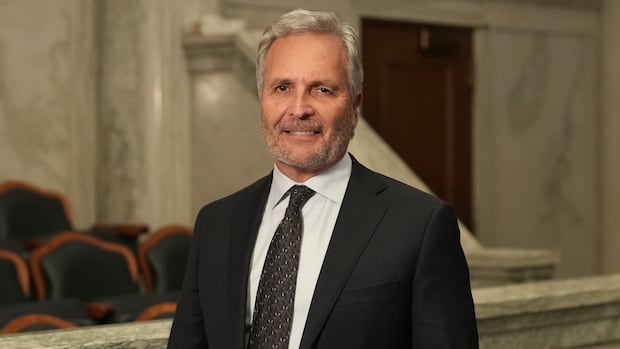
The chief justice of Manitoba’s Court of King’s Bench has been nominated to Canada’s top court to fill a role left vacant by a recent Supreme Court retirement.
Prime Minister Mark Carney announced Chief Justice Glenn Joyal’s nomination Monday morning, in a news release that said Joyal has throughout his career “demonstrated the integrity, experience, and sound judgment that service on our highest court demands.”
The long-serving judge has heard cases at all three levels of court in Manitoba over more than 25 years on the bench, including in the role of chief justice since 2011. He previously practised criminal and constitutional law and civil litigation in Manitoba.
In his time on the bench, he’s decided some of Manitoba’s most high-profile cases — from its first medically assisted death to a challenge arguing pandemic restrictions violated Charter rights to the trial of a serial killer who targeted vulnerable Indigenous women.
Joyal has also worked to improve access to justice, modernize court operations and advance reconciliation — efforts federal Justice Minister Sean Fraser said in the news release reflect “a deep commitment to the fair administration of justice.”
Joyal’s nomination comes after Justice Sheilah L. Martin retired May 30.
Recommendations for appointments to the Supreme Court — which has nine judges, including a chief justice — come from an independent, non-partisan advisory board that takes applications for the role and submits a short merit-based list of candidates to the prime minister.
That board identified “jurists of the highest calibre” who have been either a superior court judge or member of the bar in a province or territory for at least 10 years, and who were functionally bilingual in English and French — a requirement for Supreme Court justices since 2016.
The seat left empty by Martin, who previously served on the Court of Appeal of Alberta, was open to candidates from Western Canada or Northern Canada, given the convention of regional representation on the court.
WATCH | Chief Justice Glenn Joyal on improving trust with Indigenous communities: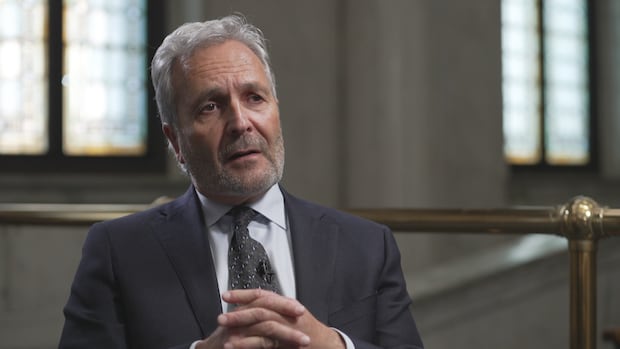
Manitoba’s top judge on improving trust with Indigenous communities
Chief Justice Glenn Joyal of the Manitoba Court of King’s Bench sits down with Information Radio host Marcy Markusa to talk about the justice system in the province. In this excerpt, Joyal is asked about reconciliation and building trust with Indigenous peoples.
It’s not the first time Joyal has put his name in for consideration for a Supreme Court role. He previously said he put his name forward in 2017, when Martin was appointed, but later withdrew.
As part of his nomination process, Joyal will now participate in a question-and-answer session before members of the House of Commons Standing Committee on Justice and Human Rights, the Standing Senate Committee on Legal and Constitutional Affairs and a member of the Green Party of Canada, the federal government said on its website.
A Manitoba court spokesperson said in an email Joyal is scheduled to appear before a parliamentary committee for official appointment to the Supreme Court on June 29.
‘Superb choice’
University of Manitoba law Prof. Bryan Schwartz said he thinks Joyal’s nomination is a “superb choice,” for reasons ranging from his “impeccable” qualifications and “impressive” work ethic to his meticulous, “immersive” decisions and overall approach as a judge.
“Clearly, you can see that when he’s been in a case, he’s considered all the materials, he’s considered all the facts, all the evidence and all the arguments before he gets to his conclusion,” Schwartz said in a phone interview Monday.
“I argue cases in court fairly often, and you always wanted a judge where you knew if you took all the trouble to finely craft an argument or really think hard about a point and do your best to express it well … you like to think that at least somebody’s going to pay close attention to all the evidence and all the arguments. And that’s certainly the Justice Joyal I know.”
Schwartz said it’s also good to see a judge from Manitoba back on the Supreme Court.
“It means as cases come from this province, we have somebody who’s familiar with local conditions and knows some of the issues and some of the judicial personalities involved in our system.”
Lorna Turnbull, a professor who helped develop a bilingual program at the University of Manitoba’s Robson Hall law faculty, said the nomination of a Franco-Manitoban judge to the country’s top court comes after decades of work on the importance of access to justice in both official languages.
That fight included several cases to reinforce language rights in Manitoba that went all the way to the Supreme Court in the 1980s, Turnbull said.
That work is now “paying off in” things such as the nomination of a judge to the top court, and “the strengthening of the community and systems here that [Joyal] did himself to try and improve access to justice,” she said.
Amateur playwright fluent in Italian
A questionnaire Joyal submitted in his application for the role gives a closer look at the man expected to become the next judge on the country’s highest court — from a childhood in French-speaking St. Boniface with a Franco-Manitoban father and Polish mother, to an education that included time at Oxford University and schools in Italy, where he became fluent in Italian.
The questionnaire includes a number of titles he had before becoming a judge, including as an amateur playwright and an employee at a landscaping company, a fishing mill, the Canadian National Railway and, briefly, the CBC.
It also provides a glimpse into what Joyal sees as the most important issues he’s addressed in his time on the bench, and some of his thoughts on the justice system’s role in reconciliation.
Those include what Joyal described as a “crisis” created by delays in addressing child protection matters in Manitoba and the Court of King’s Bench response to the Jordan case that put time limits on criminal trials — both of which he said disproportionately affected Indigenous people.
Joyal also noted a number of changes the court made during his tenure, such as creating the Trust, Reconciliation and Access to Justice Committee and formalizing a gender-inclusive pronoun policy for court proceedings.
LISTEN | Chief Justice Glenn Joyal is interviewed about the court system in Manitoba:
Information Radio – MB8:54Part 1 of a feature interview with Chief Justice Glenn Joyal about the court system in Manitoba
When the community reacts a court sentencing with cheers and then the same community reacts to an acquittal as a “gross miscarriage of justice,” how do you continue to build trust and yet uphold the law? We hear where Manitoba Court of King’s Bench Chief Justice Glenn Joyal feels gains are being made to improve trust with the Indigenous community.
He also described his time as a provincial court judge, travelling to circuit courts in First Nations, which he said “gave me a window into both the opportunities and challenges in connection with building the requisite trust and respect that will be foundational for the justice system’s future contribution to the project of reconciliation.”
That experience showed him “the potential benefits of collaborating with community elders and others to find ways, where possible, to better incorporate Indigenous legal traditions and restorative justice solutions” like sentencing circles into the justice system, he said.