
I have seen a number of prize fights in my life. In addition to those watched on television or closed-circuit broadcasts, I was high in the upper deck at Yankee Stadium on Sep. 28, 1976, when Muhammad Ali beat Ken Norton in a 15-round unanimous decision, and I was in the Louisiana Superdome in New Orleans on Sept. 15, 1978, when Ali defeated Leon Spinks in a 15-round unanimous decision.
But the weirdest, silliest and, in an odd way, most influential bout came rushing back to me last week when a slightly tipsy gray-haired man approached me while I sat alone at a local tavern and said, “You’re old. Settle a bet for me. You must remember, who won that Danny Bonaduce, Donny Osmond fight?”
I did remember and I told him who won and he strutted smugly back to a table where three friends were sitting and I was drawn back more than three decades to the Bonaduce-Osmond “battle” that was dubbed the “Vanilla Thrilla,” a reference to the 1975 Ali-Joe Frazier bout (the third and final of their brutal battles) in the Philippines known as the “Thrilla in Manila.”
For those of you too young to know of this event, it came after Osmond, in town to perform in “Joseph and the Amazing Technicolor Dreamcoat,” ran into Bonaduce, once a star of TV’s “The Partridge Family” and then a WLUP-FM show host, at a local gym. They poked lighthearted fun at one another’s physiques. This encounter was later discussed on Jonathon Brandmeier’s hugely popular radio show, with him encouraging Bonaduce to challenge Osmond to a fight, with proceeds going to charity.
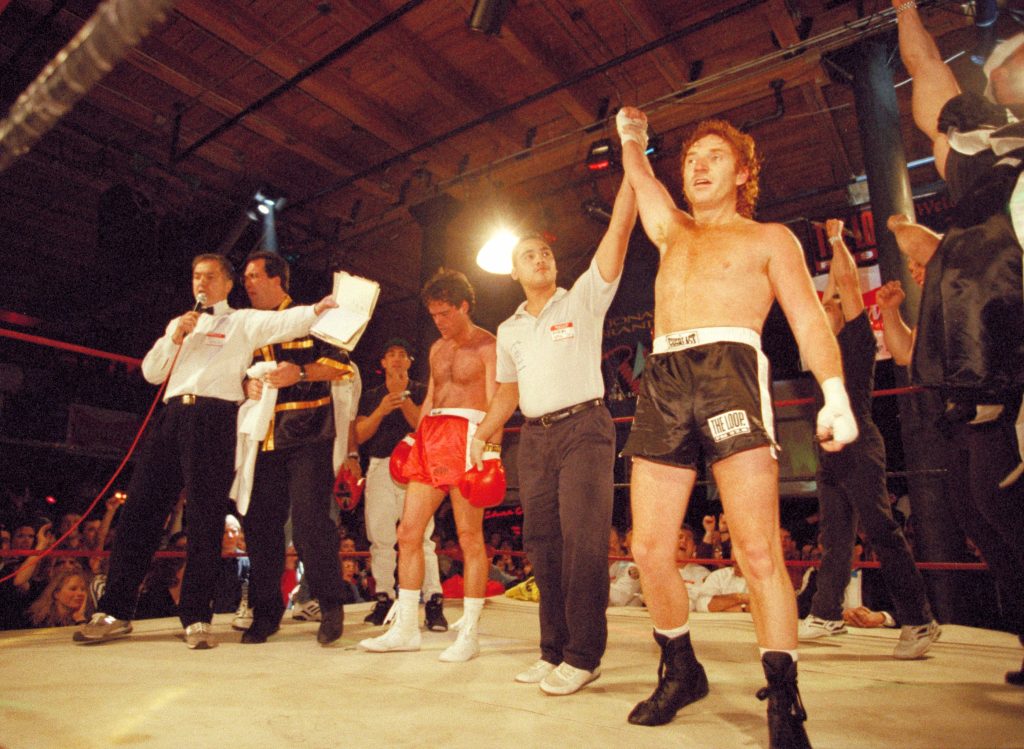
And so, on the Monday night of Jan. 17, 1994, the two men (Osmond was 36, 5-foot-9 and weighed 155; Bonaduce was 34, 5-foot-7 and 145) faced off in a three-round fight at the China Club, a then-popular nightclub and concert venue in the West Loop/Fulton River District.
The crowd was loud and raucously over-served, some 2,200 people and me.
Offering commentary was emcee Brandmeier, his on-air sidekick Buzz Kilman, broadcaster Jack Brickhouse, sports promoter and one of the stars of radio’s and TV’s “The Sportswriters,” Ben Bentley and boxer Leon Spinks.
The Tribune had assigned freelance writer Dennis Polkow to cover the event and this is some of what he wrote, “It was billed as a fight between two former childhood stars, but given the displays of temper and lack of sportsmanship displayed Monday evening by Donny Osmond and Danny Bonaduce at their charity boxing match, both could easily have passed for the ages associated with them back in the ’70s: i.e., children.”
The fight was ridiculous, with the pair flailing at one another, Bonaduce losing his headgear three times, and neither man landing any significant blows. I did think that Osmond got the best of it, barely, but not so the three judges, who awarded Bonaduce the 2-1 decision, which was loudly disputed by Osmond and his many fans.
Charities got some money ($8,000 to the Tom and Roseanne Arnold Foundation and $3,000 to the Children’s Miracle Network), many in the crowd lingered for a while before walking out into single-digit temperatures.
Though this night would mark the end of Osmond’s pugilistic career, it sparked an outbreak of celebrity boxing matches. Bonaduce would fight on, jumping in the ring with such characters as retired baseball player Jose Canseco. In 2002, he fought Barry Williams (aka Greg Brady on “The Brady Bunch”) as part of a Fox television show called “Celebrity Boxing,” which also featured such “stars” as Vanilla Ice, Tonya Harding, Paula Jones, basketball’s Manute Bol, Joey Buttafuoco and our own William “Refrigerator” Perry.
While thinking of all that silliness — the show deservedly lasted only two episodes — I began to remember how many great writers have tried to explain boxing, millions of words from as far back as Homer and Plato. Jack London wrote about boxing and so did George Bernard Shaw. A.J. Liebling called it the “sweet science,” while Hemingway and Norman Mailer wrote about it more effectively than they practiced it.
It was such a dominant force in American culture that it rivalled baseball in its mid-20th century popularity. I caught the tail end of that, thanks largely to the tremendous talent and personality of Ali, and the pay-per-view broadcast boom that made popular such heavyweights as Frazier and George Foreman, and, from different weight classes, such others as Sugar Ray Leonard, Thomas Hearns, Marvin Hagler and Roberto Durán.
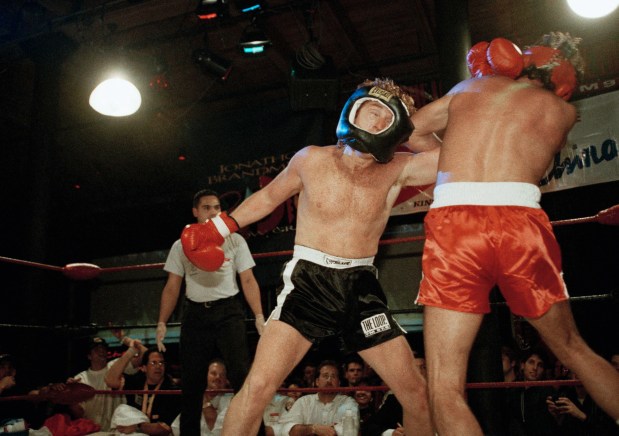 Danny Bonaduce, left, and Donny Osmond duke it out during fight in Chicago, Jan. 17, 1994. (Tim Boyle/AP)
The last boxer on my radar was Mike Tyson, whose name for a time was as prominent as any on the planet and whose fame was, as writer Mark Kriegel put it in his “Baddest Man: The Making of Mike Tyson,” “a lethal dose of a peculiarly American disease, a form of insanity whose victims include Elvis, Marilyn and Tupac.”
And so, Osmond is now headlining a solo show at Harrah’s Las Vegas in which, employing AI and CGI technology, he performs a duet with his 14-year-old self.
After leaving Chicago in 1996, Bonaduce worked in various TV and radio jobs until retiring from a Seattle radio station after having successful brain surgery in 2023. He lives in Palm Springs, California.
The China Club was converted in 1997 into a 112-unit brick-and-timber residential loft development and remains so.
And I could not tell you the name of a current professional boxer if you paid me.
rkogan@chicagotribune.com