
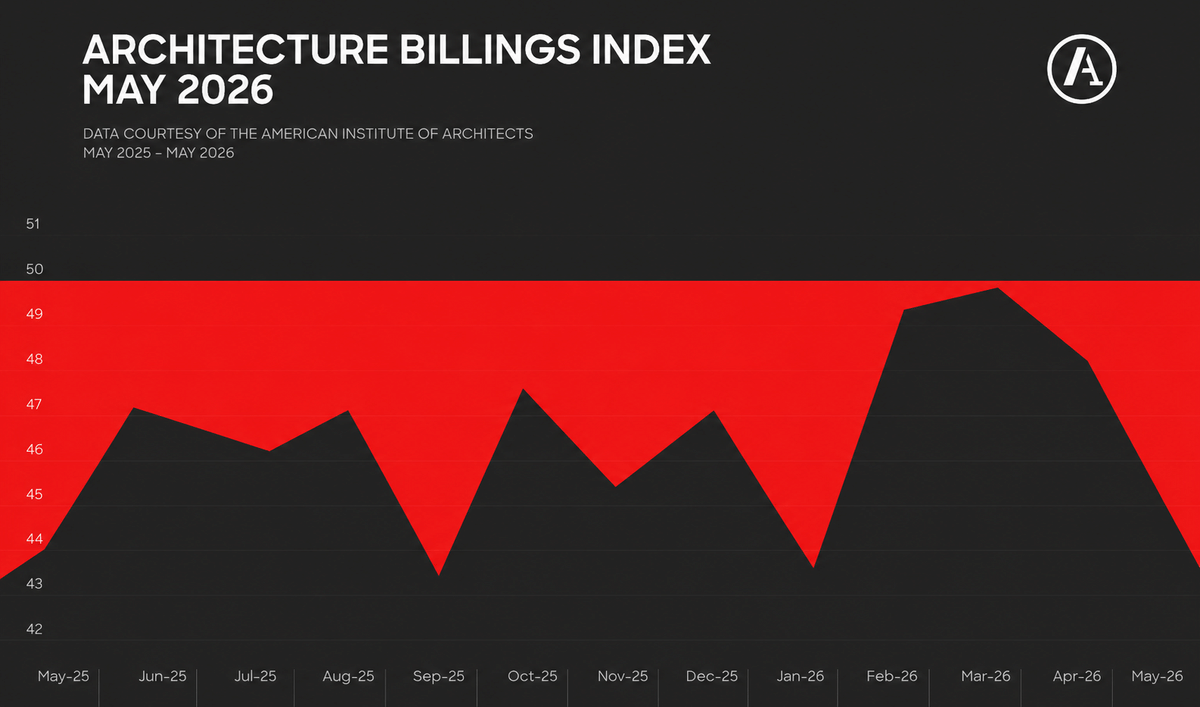
After softening again in April, business conditions at U.S. architecture firms deteriorated more significantly in May, according to the latest AIA/Deltek Architecture Billings Index.
Released this morning, the May ABI score fell to 44.5, down sharply from April’s 48.3 and marking the lowest national reading since January. Any score below 50.0 indicates a decline in billings compared to the previous month.
The report suggests that ongoing economic uncertainty, including inflationary pressure tied to higher energy prices and the conflict in Iran, is continuing to cause some clients to delay or pause new projects. New project inquiries also slipped below 50.0 for the first time in four months, while the value of newly signed design contracts weakened to its lowest level since January.
Firm leaders also appear less confident about the coming quarter. According to the AIA, one quarter of responding firm leaders now expect their billings to decline by 5 percent or more in the third quarter. Nearly half, 46 percent, expect billings to remain about the same, while 30 percent expect billings to increase by 5 percent or more.
Declines spread across regions and sectors
Business conditions remained soft across every region in May, although the South continued to come closest to growth at 49.6. The West, which had been near growth earlier this year, fell more sharply to 45.4. All major firm specializations also reported declining billings, reversing recent momentum among multifamily residential and institutional firms.
Broader economic conditions remain challenging as well. The AIA report notes that the Consumer Price Index increased by 0.5 percent in May and was up 4.2 percent from one year earlier, the highest annual increase in more than three years. Architectural services employment added 100 positions in April, the most recent month available, but has remained generally flat so far this year.
Staffing remains uneven across the profession
This month’s report also highlights a mixed staffing picture across the profession. More than 6 in 10 responding firm leaders, 62 percent, said their firm is currently appropriately staffed with architecture staff. However, 23 percent reported being understaffed, while 15 percent said they were overstaffed. Among firms that were understaffed, the average shortfall was four full-time architecture staff positions.
Recruiting also remains a challenge. Nearly two-thirds of responding firm leaders, 63 percent, said recruiting architectural staff is presently a problem at their firm, including 16 percent who called it a serious problem. Retention appears to be less of a concern, with 63 percent saying retaining existing staff is not currently a problem.
The most common actions firms are taking in response to current staffing conditions include increasing salaries above typical levels to retain current staff, reported by 31 percent of firms; offering additional employee perks such as a four-day work week or remote work options, reported by 29 percent; and offering additional employee benefits, reported by 25 percent.
The AIA also asked firms whether AI has affected staffing over the past year. The overwhelming majority, 88 percent, reported that AI has had no impact on staffing. Three percent said they had reduced staff due to AI, while 2 percent said they had added staff because of AI.

Related explainer on Archinect: How to Understand Architecture Business Conditions Using the AIA’s Architecture Billings IndexMay ABI Highlights
Regional averages: South (49.6); Northeast (46.2); West (45.4); Midwest (45.3)Sector index breakdown: multifamily residential (49.2); institutional (46.9); commercial/industrial (45.5)Project inquiries index: 49.7Design contracts index: 45.1
Archinect has covered contributing factors to the ongoing economic uncertainty for architecture firms, including unpredictable trade tariff policies and volatile construction material pricing.
Archinect Jobs, the industry-leading architecture job board, continues to be a strong metric for the health of the industry. Take a look at the current list of opportunities, or post your firm’s openings now. To browse thousands of job seeker profiles and find the right candidates quickly, try Archinect’s Talent Finder service.
How has business been feeling in your region and market? Do the ABI numbers reflect what you are seeing on the ground? Share in the comments below.